Lyrical Abstraction — Between Gesture, Color, and Emotion
↓ Share this articleLyrical Abstraction: Understanding a Major Movement in Modern Painting
Lyrical abstraction refers to one of the major movements in modern European art following World War II. It emerged in France in the 1940s and 1950s, at a time when many artists were seeking to break free from the conventions inherited from Cubism, Surrealism, or traditional figurative art. The term evokes a style of painting liberated from recognizable subject matter, yet deeply imbued with gesture, material, color, and emotion. Whereas geometric abstraction emphasizes order, construction, and rigor, lyrical abstraction champions a more intuitive, more physical, and at times dazzling style of painting.
In this history, figures such as Hans Hartung, Pierre Soulages, Georges Mathieu, and Nicolas de Staël play a central role. Each, in his or her own way, explores the power of the mark, the density of color, and the painter’s presence in the act of painting. Even today, lyrical abstraction continues to influence contemporary abstract art, particularly among artists who view the canvas as a space of energy, tension, and revelation.
Born in France in the 1940s–1950s
The emergence of lyrical abstraction took place in the postwar context. Paris remained a major artistic center at the time, even as New York began to assert itself on the international scene. European artists were faced with a crucial question: How should they paint in the wake of this historic catastrophe? Many rejected a return to a classical representation of the world. They sought a form of painting capable of expressing fragility, violence, inner reconstruction, and newfound freedom.
Hans Hartung plays a fundamental role in this dynamic. His works are characterized by energetic lines, scratches, and clusters of marks that seem to imprint an immediate vibration onto the canvas. For Hartung, the gesture becomes a form of writing. The painting does not depict a scene; rather, it manifests a presence, an impulse, a tension. This gestural abstract painting opens up a new realm, where the painting appears as the memory of a movement.
Pierre Soulages, another major figure, developed a body of work based on the relationship between matter, light, and black. As early as the 1940s, his compositions featured large, dark, powerful, architecturally structured forms. Later, he would call this approach “outrenoir”—an experience in which black is no longer an absence, but a space for the reflection of light. Soulages does not merely paint with black: he works the surface to bring forth light from within it.
Georges Mathieu, for his part, embodies a spectacular and calligraphic dimension of lyrical abstraction. His swift, taut, and sometimes monumental canvases place the speed of execution at the heart of the creative process. The mark takes on an almost theatrical intensity. Mathieu emphasizes the act of painting as an event, as a sudden emergence. The canvas becomes the site of a visual battle, where the gesture is forcefully inscribed.
Nicolas de Staël occupies a unique position. His work is not always strictly associated with lyrical abstraction, as it often retains a connection to landscape, the figure, or the object. Yet his flat areas of color, his impasto, and his way of making the surface vibrate are integral to the evolution of postwar abstraction. In de Staël’s work, color constructs space, the material imposes a presence, and the boundary between abstraction and figuration becomes deliberately unstable.
Lyrical Abstraction and American Abstract Expressionism: Two Different Movements
Lyrical abstraction is often compared to American Abstract Expressionism, represented by Jackson Pollock, Willem de Kooning, Mark Rothko, and Franz Kline. The two movements emerged around the same time and share several common concerns: the abandonment of traditional subject matter, the emphasis on large-scale works, the centrality of the painter’s gesture, and the desire to make painting a direct experience. Yet there are significant differences between them.
In the United States, Abstract Expressionism developed within a cultural context marked by New York’s emergence as an artistic capital. Pollock invented “dripping,” a technique in which paint is dripped, poured, or splattered onto a canvas laid on the floor. The painting becomes the result of a total physical action. De Kooning, for his part, maintained a more conflicted relationship with the figure, particularly in his series of women, where the image seems to be both constructed and destroyed by the gesture.
In France, lyrical abstraction is characterized by an often more intimate relationship with the sign, with the act of making, with the material, and with the European pictorial tradition. The brushstroke is central to this approach, but it frequently takes the form of a condensed mark, an almost calligraphic sign, or an architectural arrangement of material. Whereas Pollock deploys an “all-over” energy, covering the surface with continuous networks, Hartung and Mathieu often incorporate directional tensions, impacts, and rhythms that are more readily legible as graphic events.
This is not simply a matter of contrasting two continents. Artists look to one another, respond to one another, and sometimes influence one another. But French lyrical abstraction retains a distinctive poetic dimension: it seeks not so much to fill the space entirely as to evoke an intensity, a vibration, an inner language.
Gesture as a Language: The Painter's Trace, Sign, and Energy
In lyrical abstraction, the gesture is not merely a technical means. It becomes a language. The mark left on the canvas bears witness to an act, a decision, a breath. Every line, every scratch, every impasto carries the memory of a bodily movement. This is why gestural abstract painting should not be perceived as arbitrary chaos. It obeys a sensitive logic—sometimes swift, sometimes painstakingly constructed—in which the painter commits both physical and mental energy.
The sign plays an essential role. It can evoke writing without forming words, calligraphy without belonging to an alphabet, music without producing sound. In a lyrical painting, the eye follows directions, breaks, and accelerations. The painting reads almost like a musical score. The viewer does not identify a subject; he or she feels an intensity. He or she perceives a rhythm, a tension, a balance between control and surrender.
This aspect explains the enduring power of lyrical abstraction. It offers a direct experience, without an imposed narrative. The painting becomes a space for the viewer to project their own interpretations. It does not say, “This is what you must see,” but rather facilitates an encounter between the energy of the painting and the viewer’s individual sensibility.
Color and Light: Soulages, Outrenoir, de Staël, and Solid Color Fields
Color plays a major role in lyrical abstraction, even when the palette appears limited. In Pierre Soulages’ work, black becomes a luminous field. “Outrenoir” is not merely a color—it is an optical experience. Depending on the viewer’s line of sight, the texture of the surface, the lighting, and the viewer’s position, black reveals reflections, depths, and flashes of light. Light is not simply added to the painting; it emerges from the worked-on material itself.
In Nicolas de Staël’s work, color functions differently. His flat areas of color create masses, tensions, and balances. They do not merely fill the canvas; they structure space. Color becomes a form of sensory architecture. It can evoke a landscape, the sea, or light, without being confined to description. De Staël’s flat areas of color demonstrate that abstraction can retain a memory of reality while asserting its artistic autonomy.
This relationship between color, light, and material remains one of the great legacies of lyrical abstraction. It continues to inspire many contemporary artists, who explore the expressive possibilities of oil, acrylic, layering, transparency, and contrast.
Lyrical Abstraction and the L’Adresse des Maîtres® Art Gallery in Dreux
The L’Adresse des Maîtres® Art Gallery in Dreux offers a way to explore lyrical abstraction not only as a historical movement but also as a language that remains very much alive today. Based on the available information about their works, techniques, and bodies of work, several of the gallery’s artists can be linked to the themes of lyrical abstraction, gestural abstract painting, and abstract contemporary art.
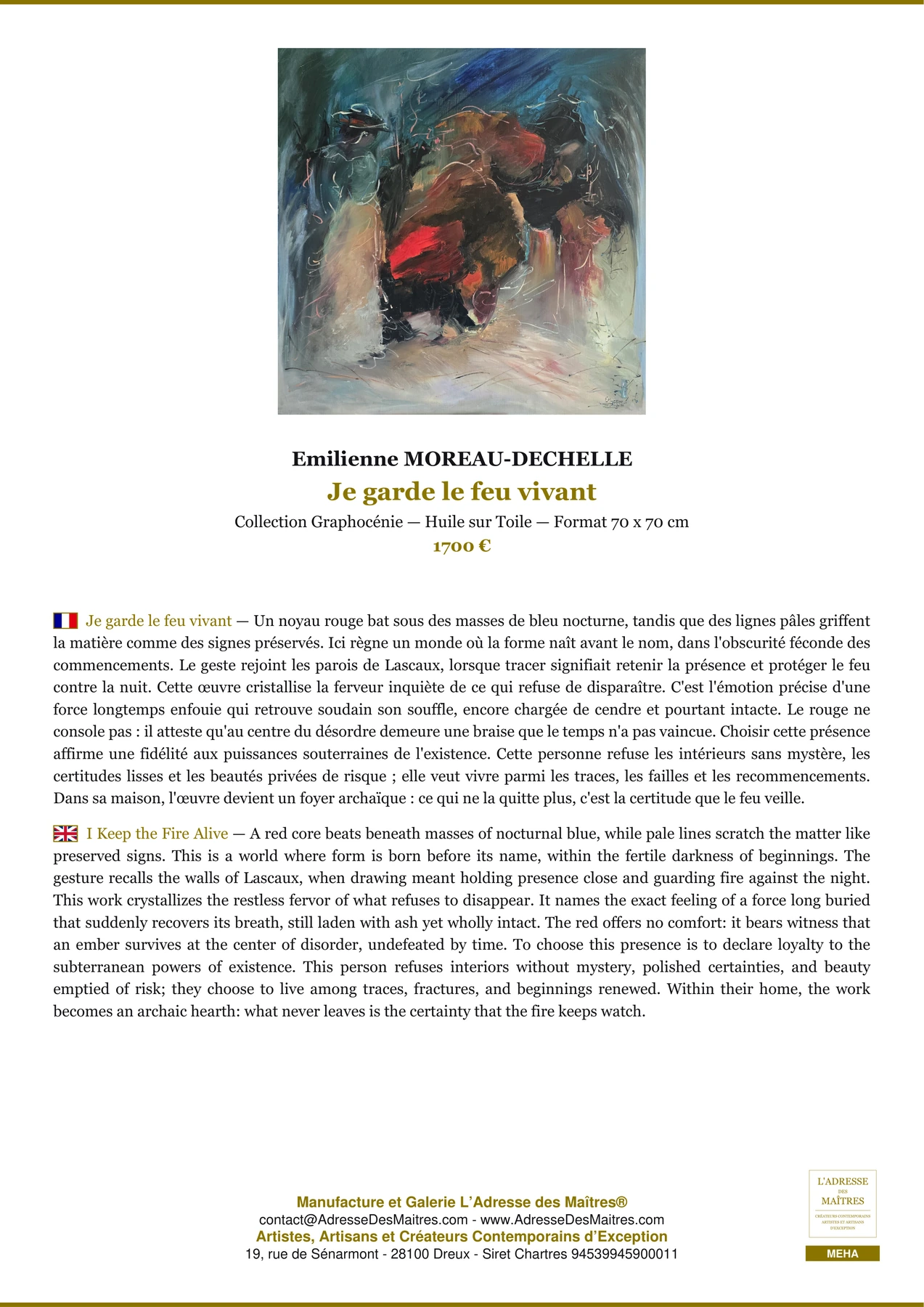
Emilienne MOREAU-DECHELLE is represented by 41 oil paintings, including “Passage sous les braises.” Oil paint, with its rich texture and ability to preserve the traces of the painterly process, offers a particularly conducive medium for an interpretation rooted in lyrical abstraction. A title like “Passage sous les braises” situates the work within an imaginary realm of tension, heat, and passage—elements that resonate with the idea of inner energy characteristic of this artistic movement.
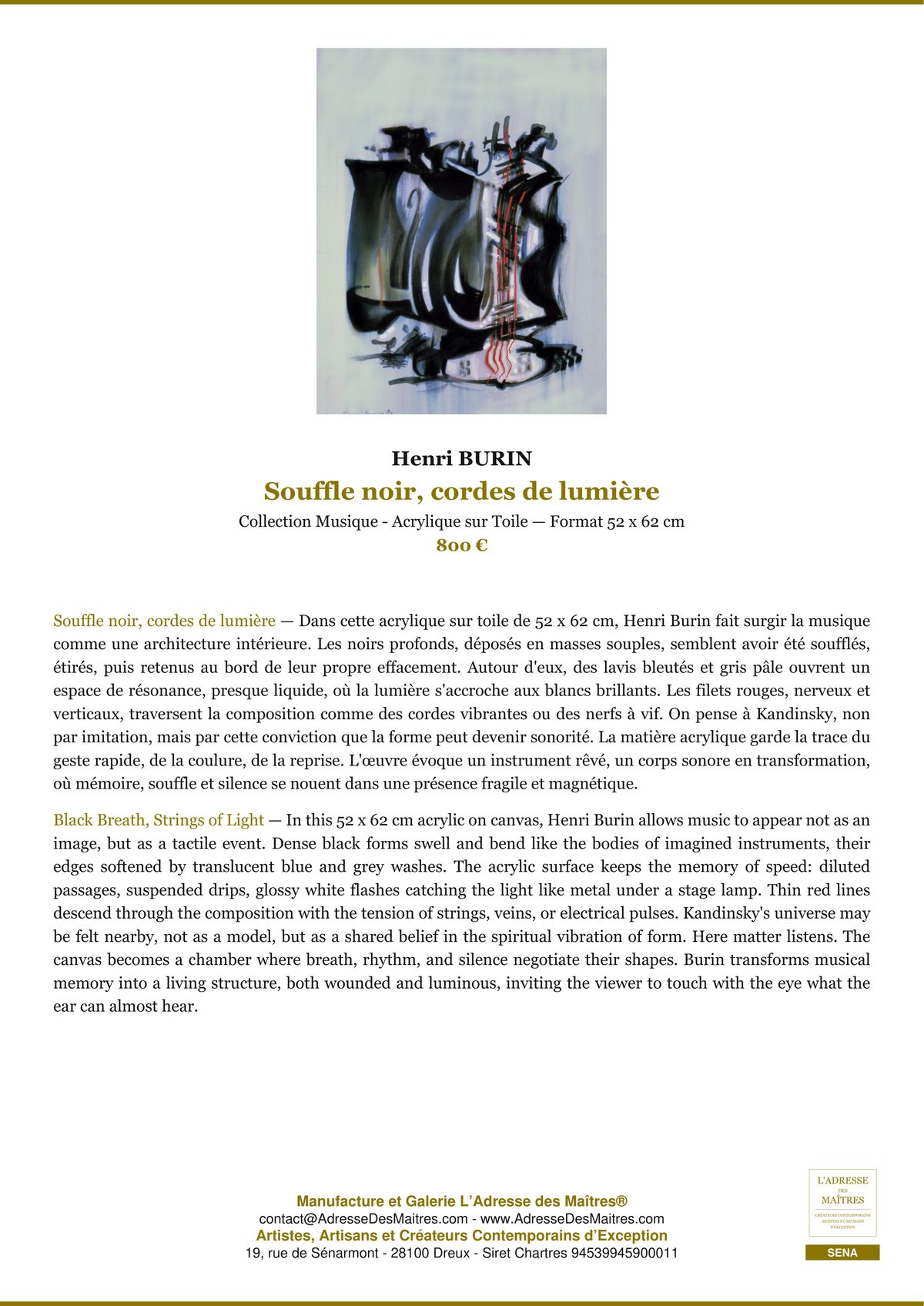
Henri BURIN presents 40 acrylic paintings, including “La contrebasse rêve sous rideau.” Acrylic allows for quick brushstrokes, layering, and a wide variety of surface effects. Within the context of lyrical abstraction, this technique can support an exploration of rhythm and composition. The title evokes a musical resonance, which is intriguing when considering abstract painting as a visual score, composed of silences, bursts of energy, and movements.
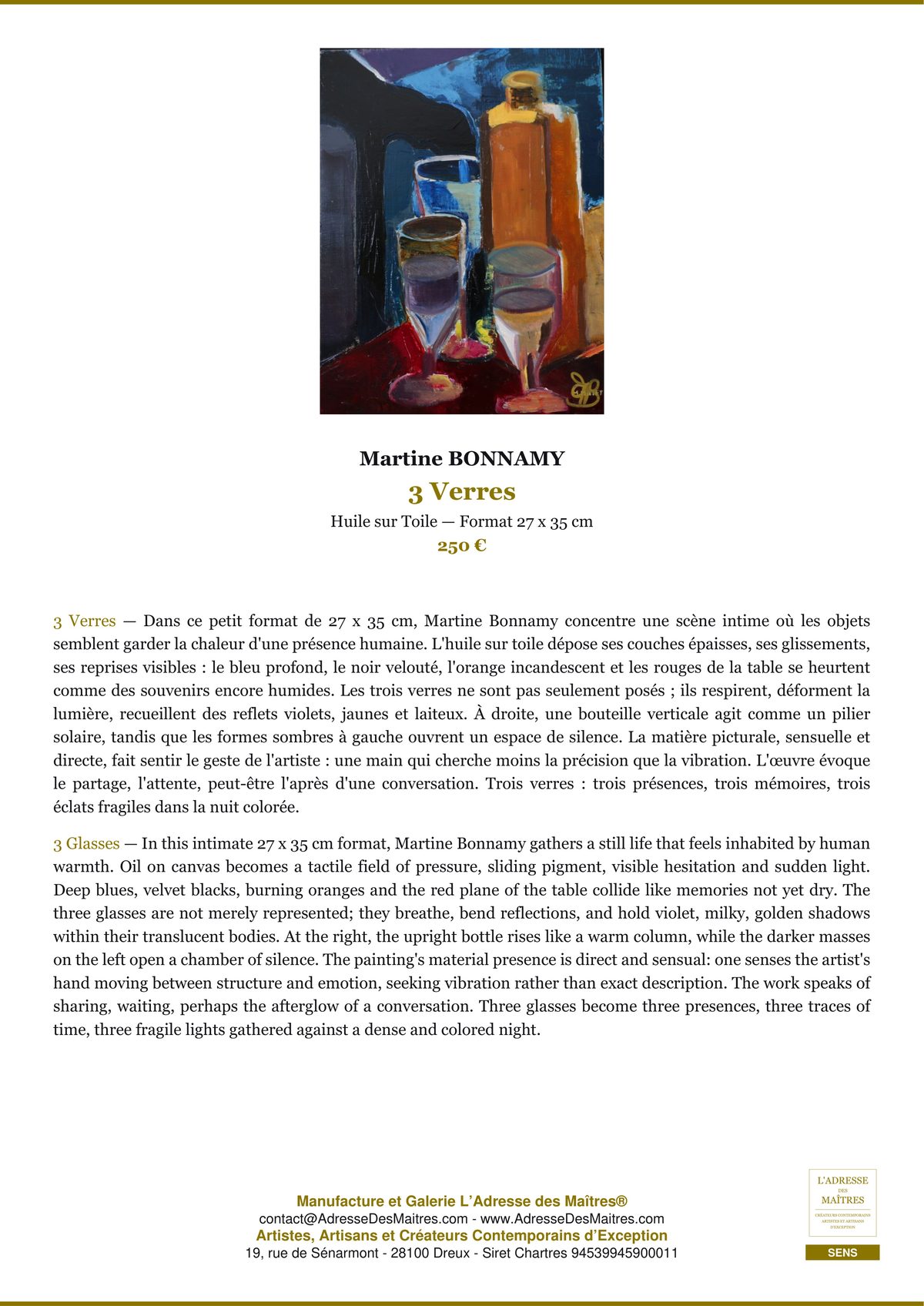
Martine BONNAMY has created 35 oil paintings, including “Céruléenne, mémoire d’un rivage.” Oil paint lends itself to chromatic depth and variations in light. The title mentioned combines a color-based reference, “céruléenne,” with the idea of memory and a shoreline. Without reducing the work to a mere description, one can see in it a connection to one of the central questions of lyrical abstraction: how can color convey a sensation, a memory, or a presence without resorting to direct figuration?
Joëlle METZGER-REVERDI is represented by 21 oil paintings, including “Visage de braise intérieure.” The expression “inner ember” naturally resonates with the idea of contained intensity, often associated with lyrical abstraction. The oil painting technique allows the artist to explore density, transitions, and depth. From an educational perspective, this body of work can be linked to the question of the visible and the invisible: how can an abstract or semi-abstract work suggest an inner presence?
Sylvia BEAUCHAIN presents 14 oil paintings, including “La mémoire des courants” (The Memory of Currents). This title evokes movement, flow, and trace—three fundamental concepts for understanding lyrical abstraction. Once again, oil allows the artist to imbue the medium with the temporality of the gesture. Within the context of abstract contemporary art, these works can be approached through the idea of flow: the flow of color, the flow of memory, and the flow of the gaze.
Lyrical Abstraction Today: Legacies and Renewal
Today, lyrical abstraction is not a rigid style belonging to the past. It constitutes an active legacy. Many contemporary artists are reclaiming the importance of the gesture, the mark, and energy, while incorporating new techniques, new formats, and new concerns. Some continue to work with oil and acrylic; others combine painting, drawing, installation, and performance.
The resurgence of lyrical abstraction is also due to its adaptability. In a world saturated with digital images, it reminds us of the irreplaceable power of the hand, the body, and the material. It offers a sensory experience that a screen cannot fully replicate: depth, textures, reflections, and variations depending on natural light. Standing before the canvas, the viewer rediscovers a physical presence.
Why Lyrical Abstraction Attracts Major Collectors
Major collectors are drawn to lyrical abstraction for several reasons. First, its historical significance is undeniable. It represents a pivotal moment in the postwar era, when European painting was reinventing its means of expression. Owning a work connected to this tradition—or to its contemporary legacy—means becoming part of a major chapter in art history.
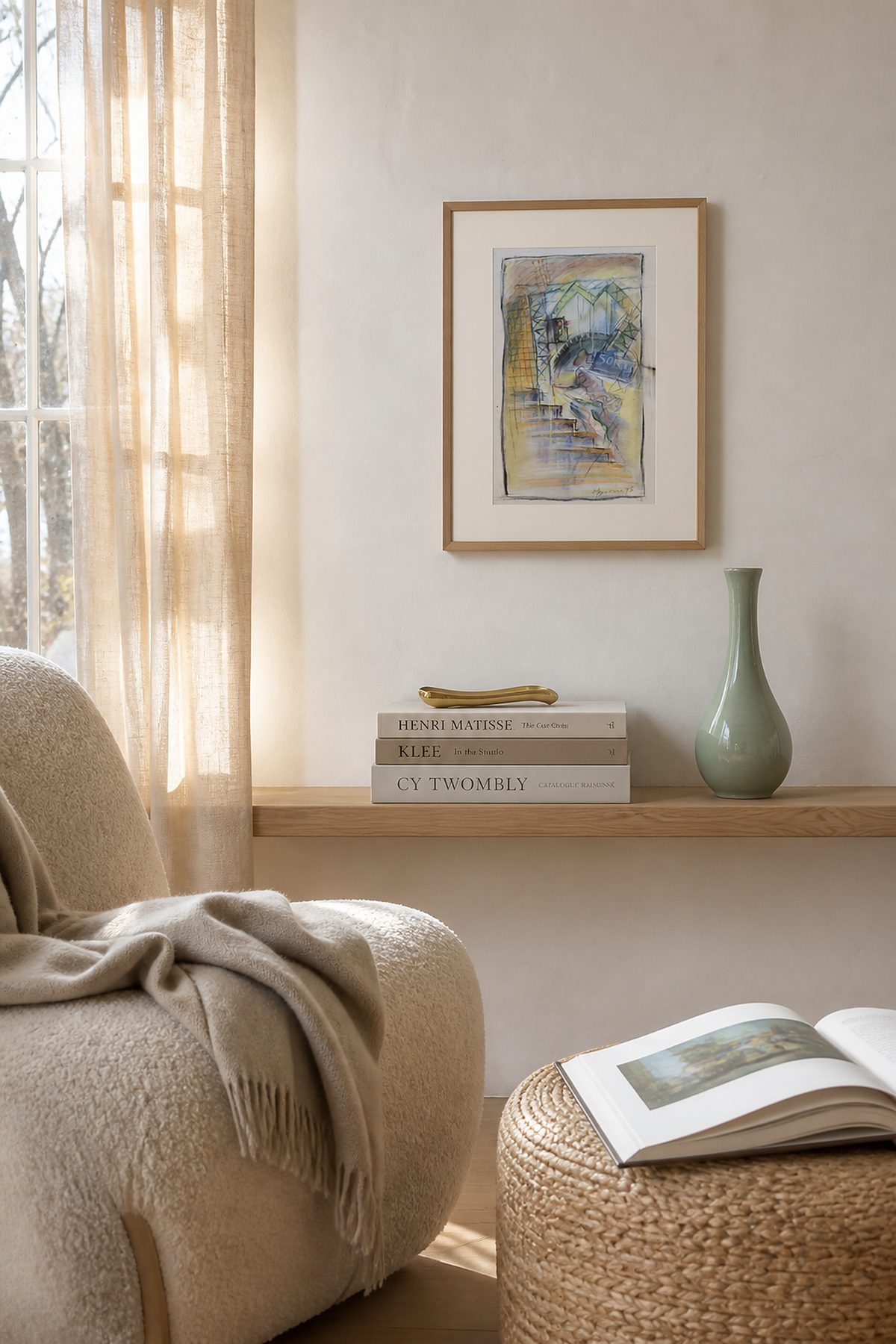
Furthermore, lyrical abstraction possesses strong decorative power without being limited to mere decoration. His works can transform a space through color, format, material, and visual energy. They fit equally well into contemporary interiors and discerning collections, as they offer multiple levels of interpretation: immediate visual pleasure, formal complexity, and emotional depth.
Finally, this trend is appealing because it affords the viewer a great deal of freedom. Unlike a narrative image, it is not limited to a single interpretation. A work of lyrical abstraction can be rediscovered every day depending on the light, one’s mood, the viewing distance, or the angle from which it is viewed. It is this ability to remain open, alive, and vibrant that explains collectors’ enduring fascination with lyrical abstraction, gestural abstract painting, and abstract contemporary art.
Check out our gallery
Would you like to experience these artistic movements in person? Visit the online gallery of L’Adresse des Maîtres®—more than 606 original works by contemporary artists.
Leave a comment