Art and Noble Materials — Silk, Oil, and Pastel as Languages of Life
↓ Share this articleNoble Materials in Art: When the Material Breathes
There are works that we simply look at, and others that we almost feel coming to life. They do more than simply occupy a wall, a picture rail, a living room, or a collector’s study: they alter the quality of the air around them. Their presence stems less from their effect than from their materiality. Silk that absorbs light, linseed oil that slowly continues to oxidize, a pastel whose powder seems suspended between mineral and breath, lacquer that encapsulates time in its depth: these are what we rightly call noble artistic materials.
But what is a “noble” material in art? It is not merely an expensive, rare, or prestigious material. It is a material that possesses a physical presence, a density, and a memory. A material that requires care, demands a mastery of technique, and transforms the relationship between the artist, the work, and the viewer. Silk,linseed oil paint, dry pastels, lacquer, certain fibers, certain earth pigments, certain ceramics: what they all have in common is that they are not neutral. They react, absorb, reflect, develop a patina, age, and sometimes become fragile, but they never become inert.
In an age saturated with fleeting images and interchangeable surfaces, these materials remind us of an essential truth: art is not just an idea. It is also an embodiment. It is precisely this embodiment that an art gallery focused on works of presence champions—such as the Galerie d’Art L’Adresse des Maîtres® in Dreux, where the material is never merely a medium, but often the very heart of the aesthetic experience.
Silk in Art: Woven Light
Among all fibers, silk holds a unique place. It is at once animal, textile, optical, and almost spiritual. Derived from the cocoon, it already embodies a metaphor for life: enclosure, metamorphosis, patience. Silk art is not merely beautiful; it possesses a rare ability to capture and reflect light.
This quality stems from its very structure. The silk thread, smooth and prismatic, reflects light with a delicacy that no ordinary fiber can truly imitate. It doesn’t just shine—it shimmers. Depending on the angle from which it is viewed, the time of day, and how close it is to the body, a silk surface transforms. It is never quite the same.
The Lyon silk industry elevated this science of reflection to the status of an art form. In Lyon, silk was long associated with textile architecture: brocades, lampas, chiseled velvets, floral motifs, and liturgical or aristocratic decorations. Here, the fabric becomes a sophisticated surface, a space for dialogue between design, color, and light. The weaver’s hand does not produce a static image, but rather a continuous modulation of brilliance.
At the other end of the spectrum of this same fascination, Hereke silk art carpets exemplify an exceptional level of craftsmanship. Born of a tradition of the highest-quality Ottoman craftsmanship, Hereke carpets are distinguished by the fineness of their knotting, the richness of their patterns, and that unique luminosity that only silk can offer. The Hereke silk art carpets in the collection presented by the L’Adresse des Maîtres® Art Gallery in Dreux belong to this rare category: textile works that are not viewed as mere decorative objects, but as compositions of light, patience, and memory.
A silk carpet—especially one of this level of precision—is a painting without a brush. Each knot becomes a brushstroke. Each variation in the thread acts as a nuance. And the whole, far from being static, changes with the lighting, the season, and the viewer’s position. Silk thus reminds us that the nobility of a material lies in its ability to interact with the present moment.
Linseed oil: Paint as a Slow-Growing Organism
In Western history, few materials have shaped our visual perception as much as linseed oil. It is not merely the binder in oil painting; it is its very lifeblood. When pigments are mixed with linseed oil, they take on an intensity, a suppleness, and a depth that water alone cannot provide. The painting becomes skin.
Linseed oil paint works through oxidation. Contrary to popular belief, it does not simply “dry” through evaporation: it hardens by absorbing oxygen from the air. This drying process gradually transforms the paint. It gives the painting its durability, but also its mystery. For an oil painting continues to “evolve” long after it is created. For years, sometimes decades, the paint evolves, tightens, stabilizes, and develops a patina.
This slow transformation lends oil paintings an almost biological quality. An older work is not merely older than a more recent one; it is more deeply marked by the passage of time. Its glazes have gained depth, its transparencies have changed, some colors have dulled, and others have taken on a new gravity. The patina is not merely an external alteration: it is the signature of time imprinted on the material.
As the discerning collector knows, an oil painting is not a static object. It requires specific storage conditions and attention to humidity, light, and temperature fluctuations. It rewards this care with an inimitable presence. Here again, its nobility lies not only in the richness of the material but also in the careful attention it demands.
Pastel: powder of light, supreme fragility
Dry pastel is one of the most fascinating paradoxes in art. It is both fragile and permanent. Fragile, because it often lies on the surface of the paper in the form of delicate particles that are sensitive to friction. Permanent, because high-quality pigment can retain its remarkable intensity over time. Pastel is a powder of light.
Its composition is twofold: mineral and plant-based. Mineral in the pigments, earths, oxides, and colors derived from the materials of the world. Plant-based in certain binders, gums, and preparations that allow the powder to become a stick, and then a mark. Pastel retains something of its origins: it does not mask the pigment; it reveals it. Whereas oil paint envelops color in a liquid depth, pastel deposits it almost bare onto the surface.
That is why pastel possesses such a unique optical quality. Light does not bounce off a smooth surface; it penetrates the powder, scatters among the grains, and returns to the viewer with a soft, matte, and vibrant glow. This absence of direct brilliance creates a sense of intimacy. Pastel does not proclaim; it whispers. It is the art of luminous velvet.
This technique requires a special level of skill. The stroke must be both precise and restrained. Too much pressure crushes the powder; too little leaves it lacking in strength. Pastel thus embodies an ethic of moderation. It forces the artist to work with the very vulnerability of the medium. Perhaps that is why it is so moving: because it reveals a beauty that does not shield itself entirely.
Lacquer: Depth, Patience, and the Passage of Time
Lacquer, too, is one of the great noble materials of art. Whether it stems from ancient Asian traditions or Western decorative innovations, it is based on a fundamental principle: depth is built up layer by layer. A lacquered surface is never merely a shiny surface. It is the patient accumulation of preparations, waiting periods, sanding, touch-ups, and polishing.
Lacquer teaches us that beauty can arise from repetition. Each layer contains the one before it and prepares the way for the next. The viewer’s gaze, therefore, does not encounter an immediate image, but rather a condensed depth. The light seems to come from within, as if it had been captured and then slowly released. Here again, the noble material does more than simply adorn the work: it determines its rhythm, its density, and its breath.
Contemporary Artists and Their Relationship with Materials
The question of noble materials is not limited to ancient traditions. It also permeates contemporary practices, whenever the artist allows the material to think alongside him. At the L’Adresse des Maîtres® Art Gallery in Dreux, several artists explore this sensitive dimension, each through a specific and recognizable technique.
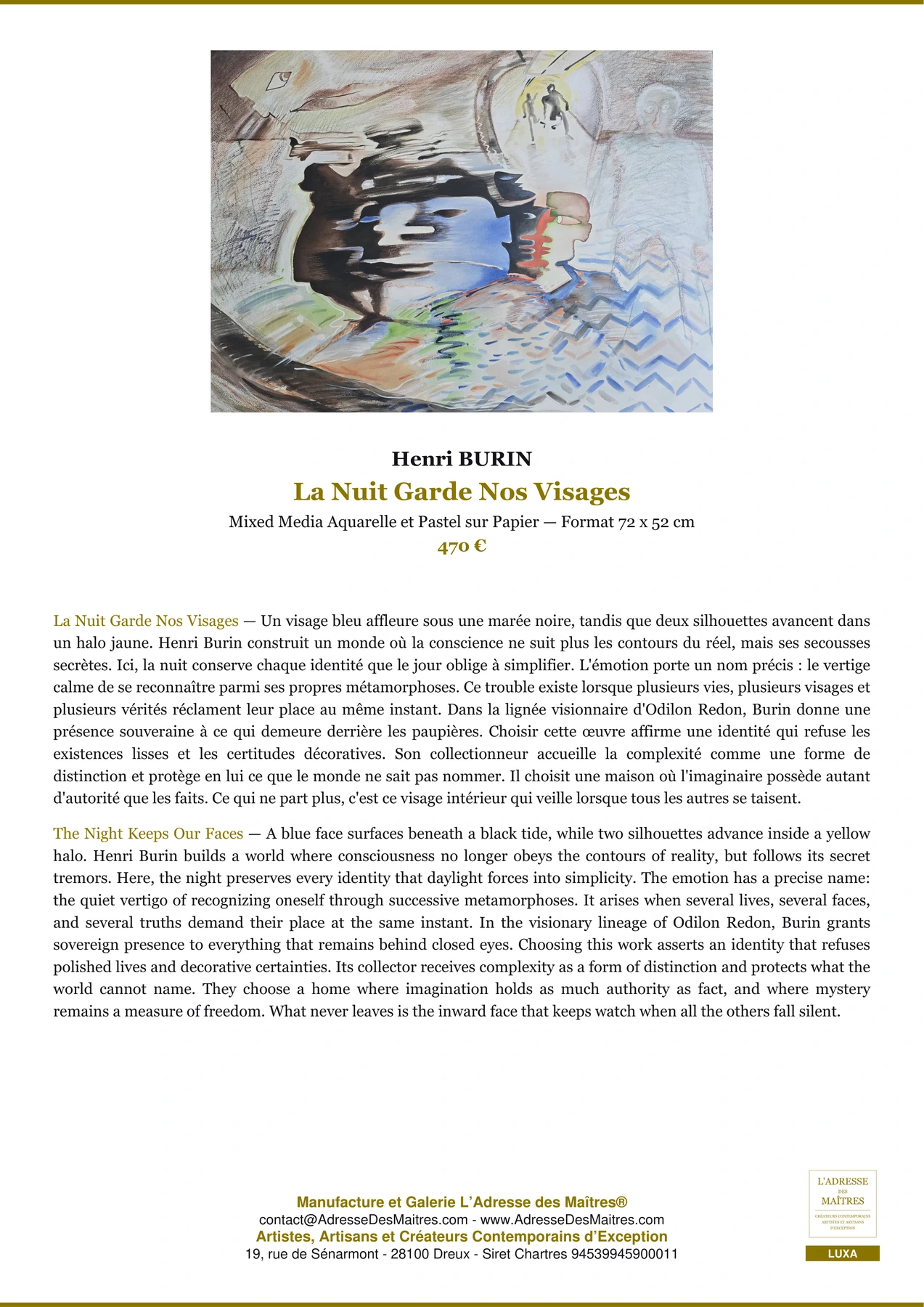
Henri BURIN is represented by eight works in mixed media, watercolor, and pastel on paper, including *La Nuit Garde Nos Visages*. Through the combination of mixed media, watercolor, and pastel on paper, his work establishes a direct relationship with the surface, absorption, transparency, and the application of pigment. In his work, the paper becomes a space of transition between water, colored pigment, and the composition.
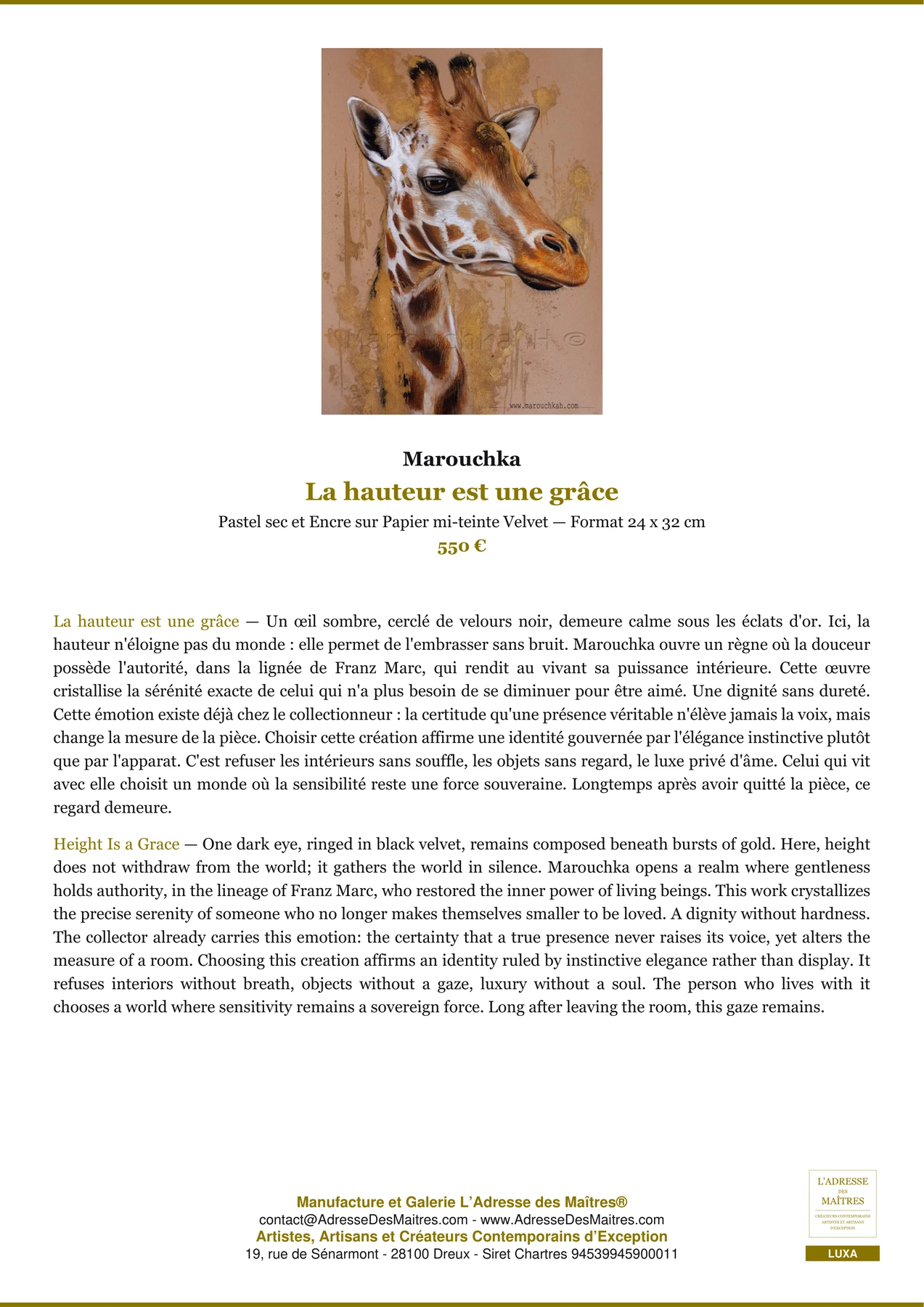
Marouchka presents seven works in dry pastel, including *La hauteur est une grâce*. Because of its powdery nature, dry pastel establishes an immediate connection with the pigment. These works remind us just how much pastel remains a tactile medium, where color retains a physical closeness to the hand and the surface.
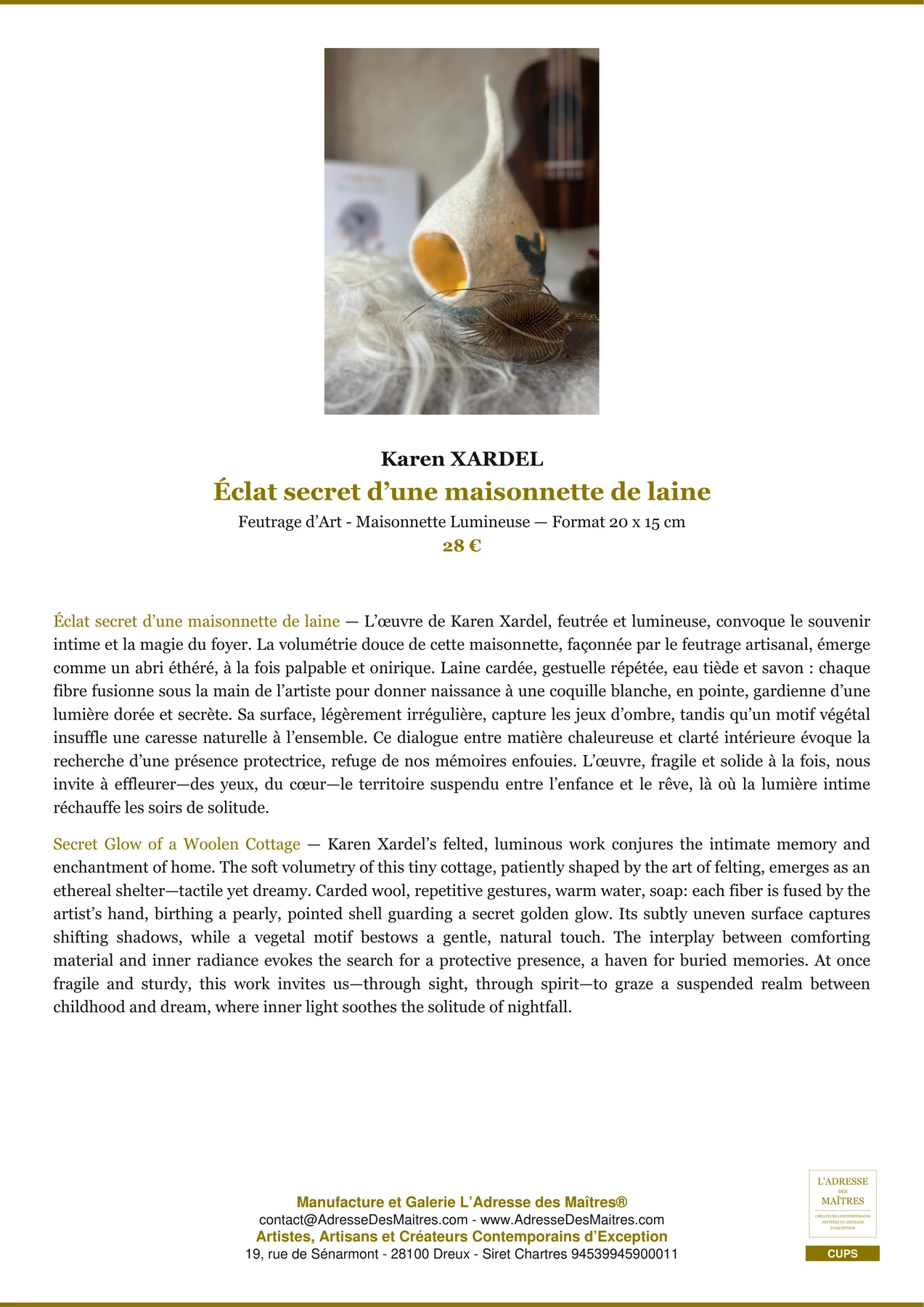
Karen XARDEL is represented by three works in artistic felting, including *Éclat secret d’une maisonnette de laine*. Artistic felting brings fiber into the work: a textile material—tactile and organic—whose density arises from its interlacing. Wool, through its origin and texture, broadens the exploration of the living in art.
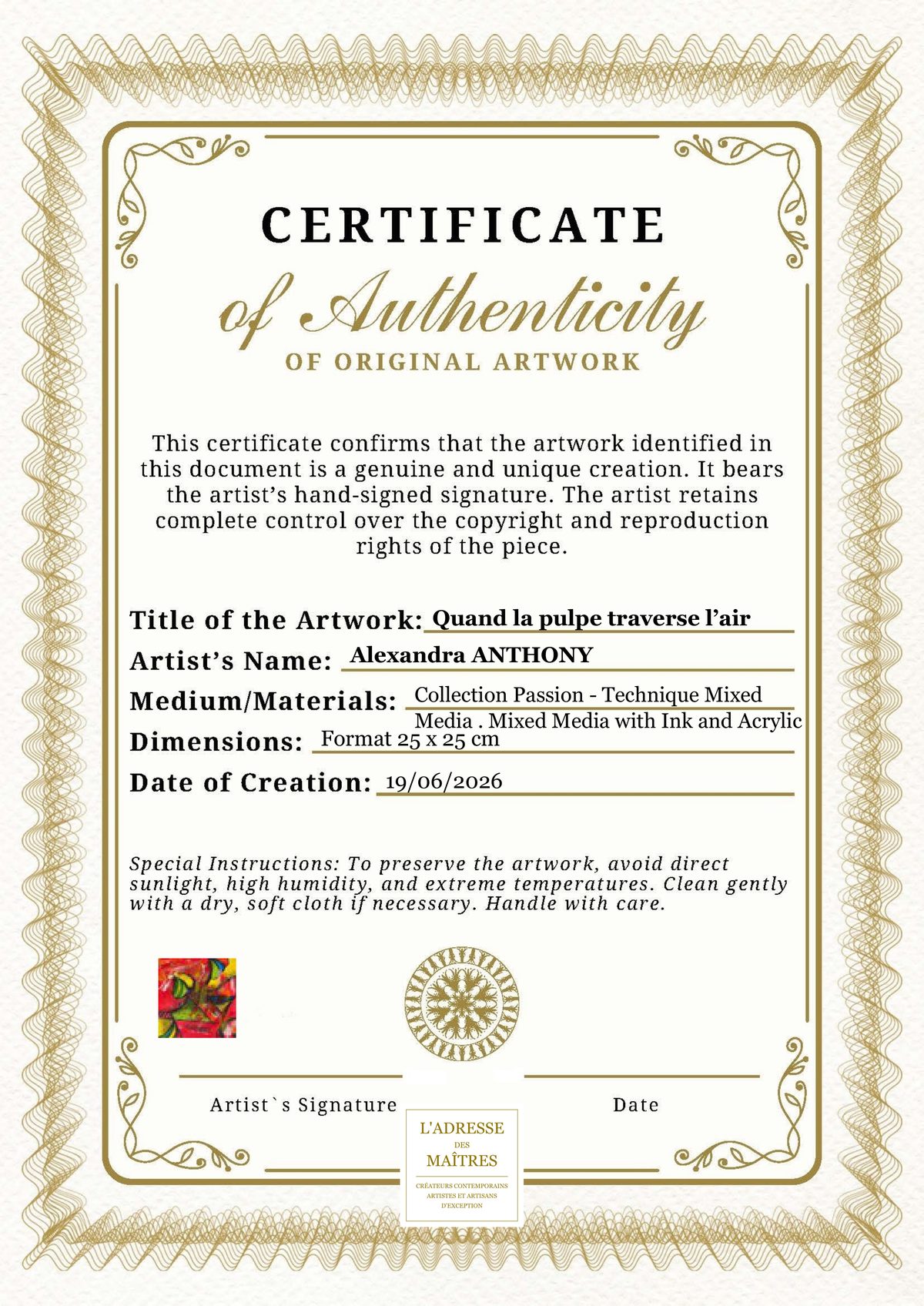
Alexandra ANTHONY presents one mixed-media work using ink and acrylic, titled *Matière insurgée* on powder-pink paper. The title itself places the material at the forefront, while the ink and acrylic, used in a mixed-media technique, invite viewers to reflect on the interplay of fluidity, opacity, and layers.
Bernadette MAURO is represented by one work in ceramics, *Écoute de la matière*. Ceramics embody a different kind of nobility: that of clay transformed by fire. In this medium, the material undergoes the trials of firing, endurance, and metamorphosis. It reminds us that, in art, life can also be expressed through attentive listening to the elements.
Life: Care, Time, Fragility
To say that a material is alive does not mean that it breathes biologically like an organism. It means that it has an active relationship with time. It changes, reacts, and presents itself differently depending on the conditions. It is vulnerable. It requires care. It compels us to slow down.
A noble material conveys something of a biological nature because it bears the marks of transformation. Silk comes from the cocoon. Linseed oil comes from a seed and hardens through oxidation. Pastels are made from ground pigments, earth, and binders. Wool is felted through pressure, moisture, and friction. Ceramics transform from raw clay to fired clay. All these materials tell a story of transition: from supple to stable, from liquid to solid, from fragile to durable.
That is where their emotional power lies. They are never completely abstract. They retain traces of a material world that predates the artwork: the plant, animal, mineral, and artisanal worlds. They remind us that art does not exist in a vacuum. Even the most poetic image is grounded in a physical substance, in the time spent preparing it, and in the skill of the hand.
What the collector gains
For a collector, choosing fine materials is not just about acquiring a more valuable work of art. It is about entering into a deeper relationship with it. A work’s enduring value does not depend solely on its market value, rarity, or the artist’s signature. It also depends on the work’s ability to remain present—physically, emotionally, and over the long term.
A silk painting, a pastel, an oil painting, a ceramic piece, an artistic feltwork, or a well-chosen mixed-media piece possesses a quality that reproductions and digital images can never capture: a depth of presence. They have a texture, a surface, a vibrancy. They catch the morning light differently than the evening light. They come alive in the space that houses them.
The Hereke silk art rugs in the collection are a particularly striking example of this. Their value lies not only in the finesse of the knotting or the nobility of the fiber, but in that rare convergence of craftsmanship, light, and durability. They remind the collector that art can be contemplated, but it can also structure a space, inhabit it, and breathe life into it.
In a world where many objects wear out quickly, fine materials impose a different sense of time. They do not seek an immediate impact; they foster a sense of attachment. They age, but they do not become obsolete. They demand that the eye return to them, compare, and discover. Perhaps that, at its core, is the true nobility of art: not to impress once, but to continue to speak for a long time.
Fine materials are therefore not a superficial luxury. They hold the promise of depth. They connect the artist to the creative act, the artwork to time, and the collector to care. And when chosen with discernment, they transform an acquisition into a silent companionship. A work crafted from living materials can never truly be possessed: it is to be cherished, listened to, and approached with care.
Check out our gallery
Vous souhaitez découvrir ces courants artistiques en vrai ? Visitez la galerie en ligne de L’Adresse des Maîtres® : plus de 1633 œuvres originales d’artistes contemporains.
Leave a comment