

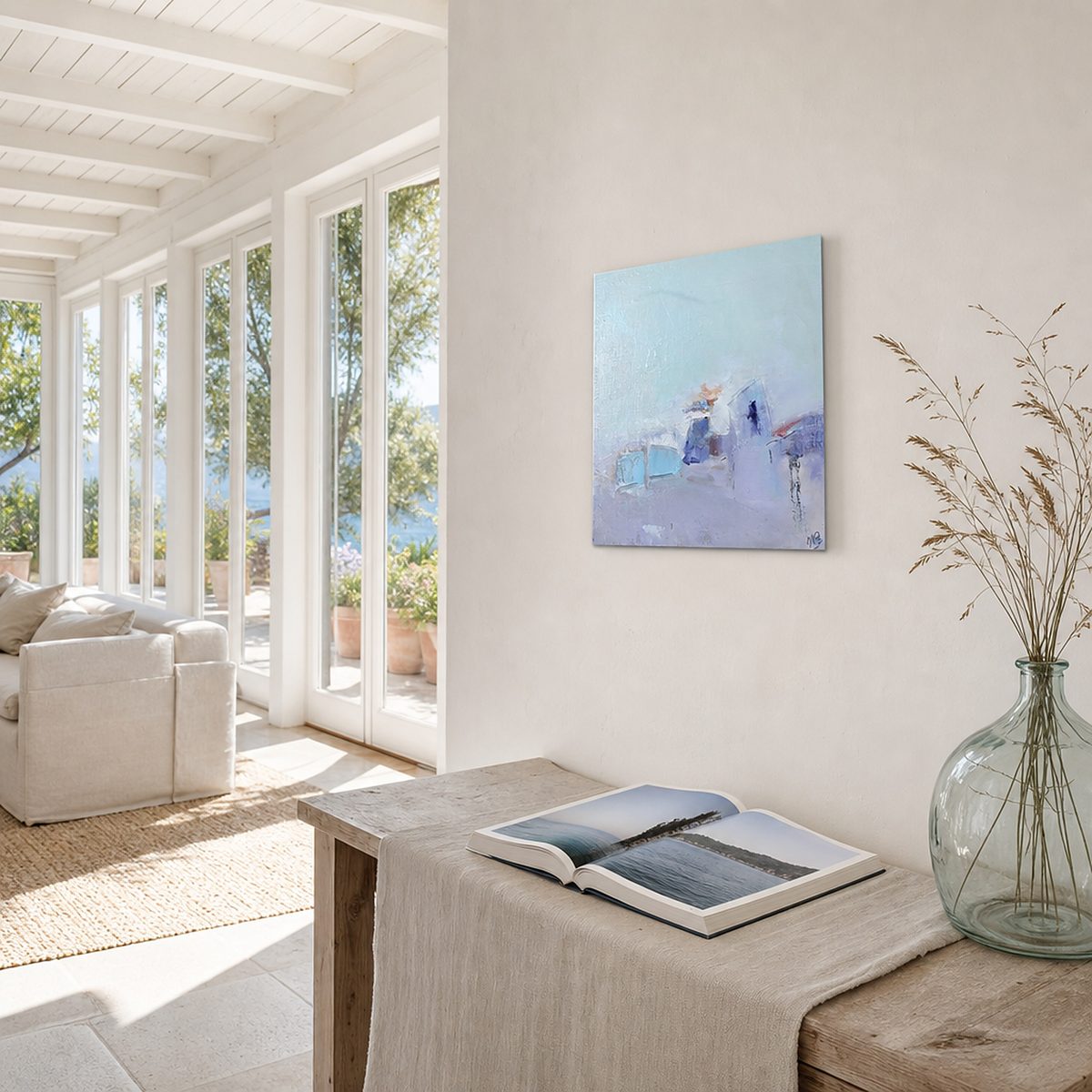
Painting the Sea — A Pictorial Realm from Monet to Today’s Masters
↓ Share this articleMarine painting: the eternal challenge of capturing what eludes us
There are subjects that we depict, and others that we pursue. The sea belongs to the latter category. For centuries, it has forced painters to grapple with the unstable, the shifting, the elusive. A face can pose, a still life can remain still, a terrestrial landscape can wait for the evening light; the sea, however, never quite cooperates. It advances, recedes, ripples, breaks apart, reflects, absorbs, and erases. That is why marine painting is not merely a pictorial genre: it is a test of truth.
From antiquity to contemporary seascapes,maritime art speaks as much to our relationship with the horizon as it does to our inability to possess it. In an age when images seem to capture everything, the sea reminds us that there are still forms of beauty that can only be captured by betraying them just a little. The great seascape is precisely the one that embraces this betrayal and transforms it into a vibration.
From the Origins to the Dutch Navy: The Sea as a Historical Force
The sea has been a subject of painting for millennia. We can already glimpse it in ancient frescoes, Roman mosaics, and mythological tales in which Neptune, the Nereids, and sea monsters embody both fertility and danger. But it was not until the modern era that the sea became a subject in its own right, separate from mere narrative backdrop.
In the 17th century, the United Provinces established the navy’s reputation. Dutch seascapes reflect the identity of a nation defined by trade, naval power, and conquest. Ports, ships, low-hanging skies, estuaries, and naval battles are not merely motifs: they express a civilization oriented toward trade, expansion, and risk. In the works of the Dutch masters, water is often structured, monitored, and filled with human activity. The sea is a stage where economic power, nautical skill, and humanity’s fragility in the face of the elements are played out.
These paintings lay the foundation for an essential tradition: that of a sea observed with precision. The boat provides the sense of scale, the sky the atmosphere, and the horizon the balance. The painter is not yet fully romantic; he is a chronicler, a surveyor, a witness to a world whose prosperity depends on mastering the waves.
Turner: When the Sea Becomes a Vision
With Joseph Mallord William Turner, marine painting underwent a transformation. The sea was no longer merely a space; it became a metaphysical force. In Turner’s work, storms, sea spray, blazes of light, mist, and shipwrecks dissolve the contours of the visible world. The subject is no longer the ship, but the potential engulfment of all certainty.
Turner understands better than anyone what the sea demands of the painter: the impossibility of capturing it. In its presence, lines dissolve, perspective wavers, and colors blend together. Water has no color of its own; it takes on the color of the sky, the seabed, the wind, the time of day, and the threat of storm. It is pearl gray in the morning, green during a storm, golden at sunset, and almost black when it swallows the light.
Turner’s greatness lies in this reversal: he does not paint the sea in spite of its instability, but rather from it. He allows painting to become mist, brilliance, and vertigo. In doing so, he paves the way for future abstraction. Long before the 20th century theorized the dissolution of the subject, Turner sensed that the sea could be the place where painting breaks free from description.
Romanticism and Impressionism: Two Seas, Two Perspectives
The Romantic tradition sees the sea as a mirror of the sublime. It is stormy, dramatic, and at times somber. The waves are mountains, the skies are battlefields, and people are fragile silhouettes. The Romantic sea challenges the insignificance of humanity. It is a moral stage: shipwrecks, solitude, fate, and the grandeur of nature.
In contrast, the Impressionists turned the sea into a laboratory of light. In Monet’s work—particularly at Étretat and Belle-Île—the cliffs, the waves, the foam, and the sky become variations. Monet does not seek to capture the eternal sea; he paints the sea at that precise moment, under that precise light, at that specific air temperature. In Étretat, the arch and the needle structure the composition, but the true subject remains the way light falls on the surfaces. In Belle-Île, the rock battered by the waves becomes a clash of brushstrokes, an almost musical rhythm.
The Impressionist sea is luminous, but never simple. It is less spectacular than it is ever-changing. Where the Romantic seeks the event—the storm, the shipwreck, the threat—the Impressionist seeks the apparition. The seascape becomes a pretext for observing the atmosphere itself. It is here that marine painting reaches one of its most subtle truths: the sea is never alone; it is always a relationship between water, sky, light, and the viewer’s gaze.
What the Sea Demands of the Painter
To paint the sea is to accept an almost paradoxical constraint: to depict a form without a stable shape. Water moves, but its movement cannot be reduced to a few decorative curves. A wave is not a repetitive pattern; it arises from a surge, swells, breaks, spreads out, and then disappears. A poor seascape freezes the wave like a soft sculpture. A good painting gives the impression that it continues beyond the frame.
Light is a second requirement. A high-quality seascape depends on impeccable consistency in lighting. If the sky suggests a cool, diffuse light source, the water cannot suddenly reflect warm glints without justification. If the sun is low, the shadows, reflections, and crests of foam must follow that logic. The discerning collector therefore focuses less on the “pretty blue” and more on the accuracy of the relationships between elements.
The horizon, finally, is a silent challenge. Too high, it overwhelms the sea; too low, it dramatizes the sky; if handled poorly, it throws the composition off balance. Inmaritime art, the horizon is not merely a line: it is a breath. It organizes distance, sets the scale of the gaze, and establishes or disrupts the stability of the painting. Certain contemporary works may abolish it, of course, but this abolition must be intentional, deliberate, and necessary.
The Contemporary Sea: Memory, Ecology, Abstraction
In contemporary art, the sea has lost none of its symbolic power. It has even taken on new meanings. It is a reminder of journeys, exiles, crossings, and disappearances. It is also an ecological territory, a space scarred by pollution, global warming, coastal erosion, and rising sea levels. The beauty of the sea can no longer be entirely innocent: painting the sea today often means painting a world under threat.
Contemporary seascapes thus oscillate between figuration and abstraction. Some artists carry on the tradition of the seascape by depicting harbors, shorelines, boats, and swells. Others retain only the sea’s rhythms: layers, flows, densities, transparencies, and eddies. Water becomes a mental substance. It is no longer necessarily depicted; it is evoked, condensed, and sometimes reduced to a chromatic vibration.
This development is not a break with tradition, but a return to the essentials. Turner had already foreshadowed this dissolution. Monet, in his own way, had understood that the subject could be lost in the light. Contemporary art builds on this insight: the sea is not merely what we see, but what we feel in the face of the world’s instability.
"Contemporary Echoes" at the L’Adresse des Maîtres® Art Gallery in Dreux
In today’s exploration of the sea, artistic media are becoming increasingly diverse. Photography, acrylics, mixed-media works, and more conceptual approaches are enriching the fields of marine painting andmaritime art. At the Galerie d’Art L’Adresse des Maîtres® in Dreux, several artists invite viewers to explore this dialogue between image, material, memory, and suggestion.
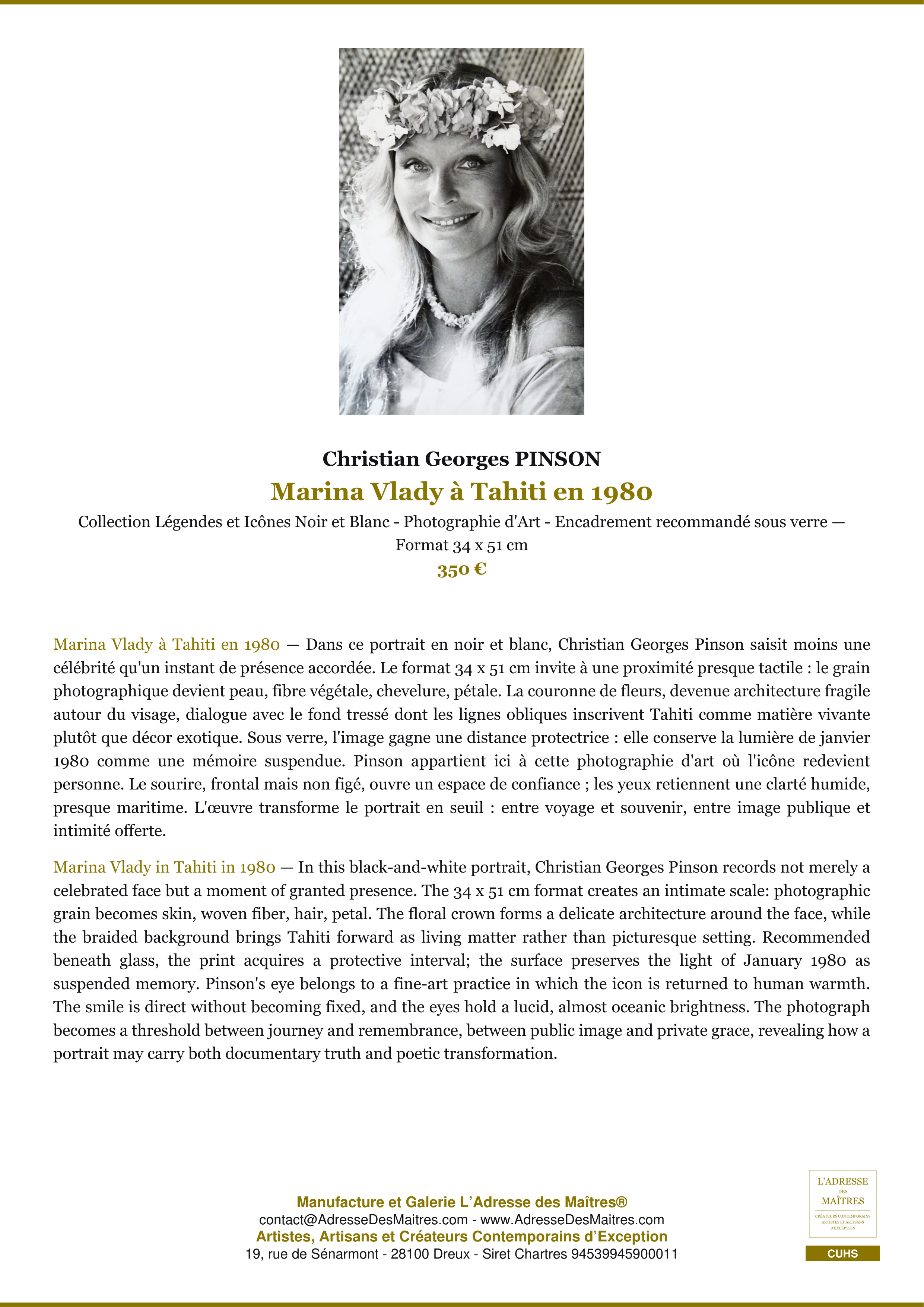
Christian Georges PINSON, with six works in fine art photography, brings the power of photographic memory to the maritime subject. A work such as *Marina Vlady in Tahiti in 1980* captures the imagination of the sea in a dimension that is at once human, insular, and temporal. Fine art photography does not seek to rival painting; rather, it offers another form of presence, where place, memory, and the figure resonate with one another.
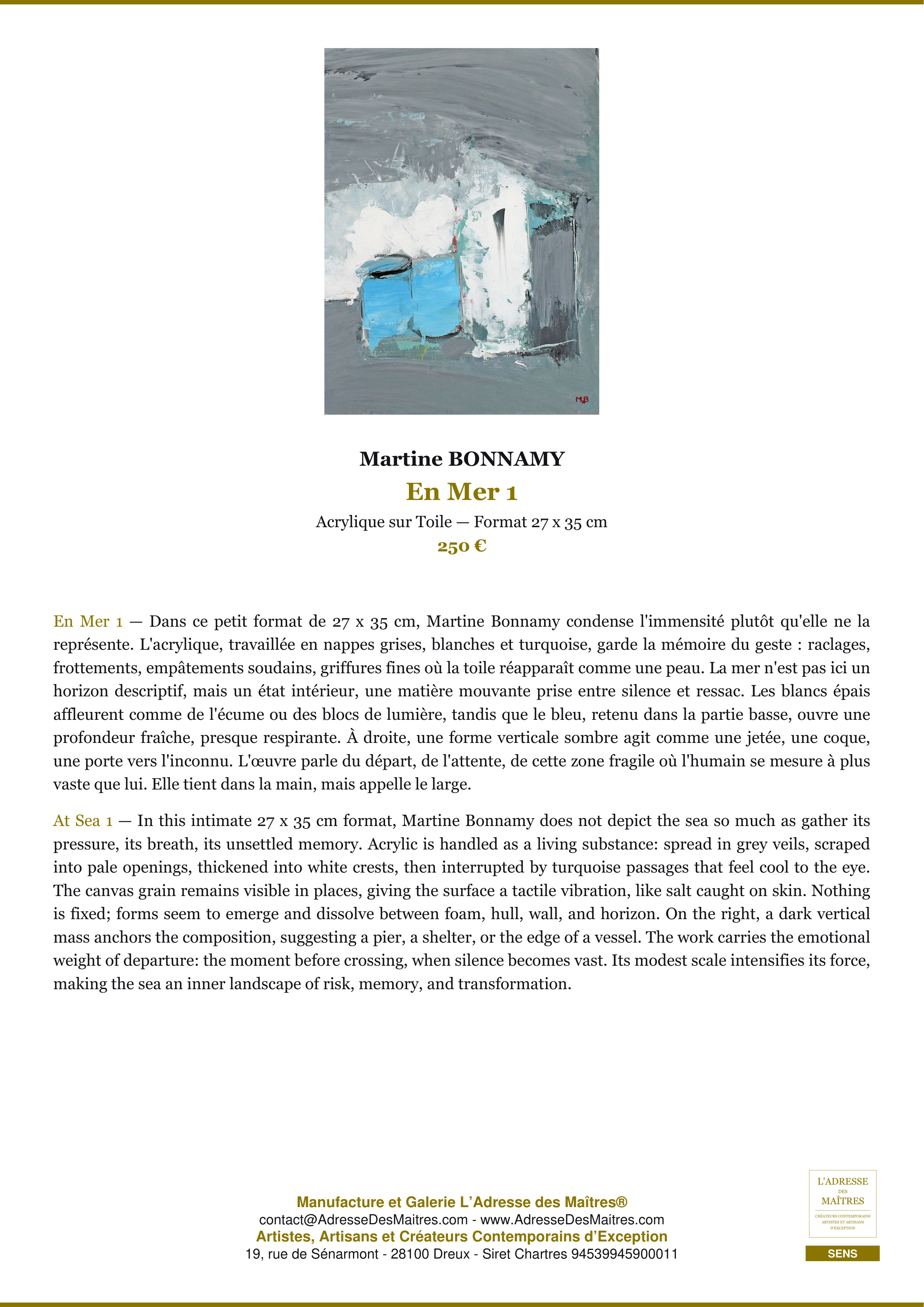
Martine BONNAMY, represented by five acrylic paintings, engages more directly with the marine theme through a work titled *En Mer 1*. Acrylic paint, with its quick drying time and ability to layer planes, lends itself particularly well to conveying effects of movement, density, and chromatic composition. It allows the sea to be approached not only as a landscape but as an active surface.
Pascale HETTINGER-CARRIER, with one work in the Artwork section—including *Vagues à l’âme*—reminds us how much maritime imagery goes beyond the simple depiction of the coastline. Here, the wave becomes an inner motif, a sensitive metaphor. The title points to this convergence between the movement of water and emotional movement, between external currents and inner turmoil.
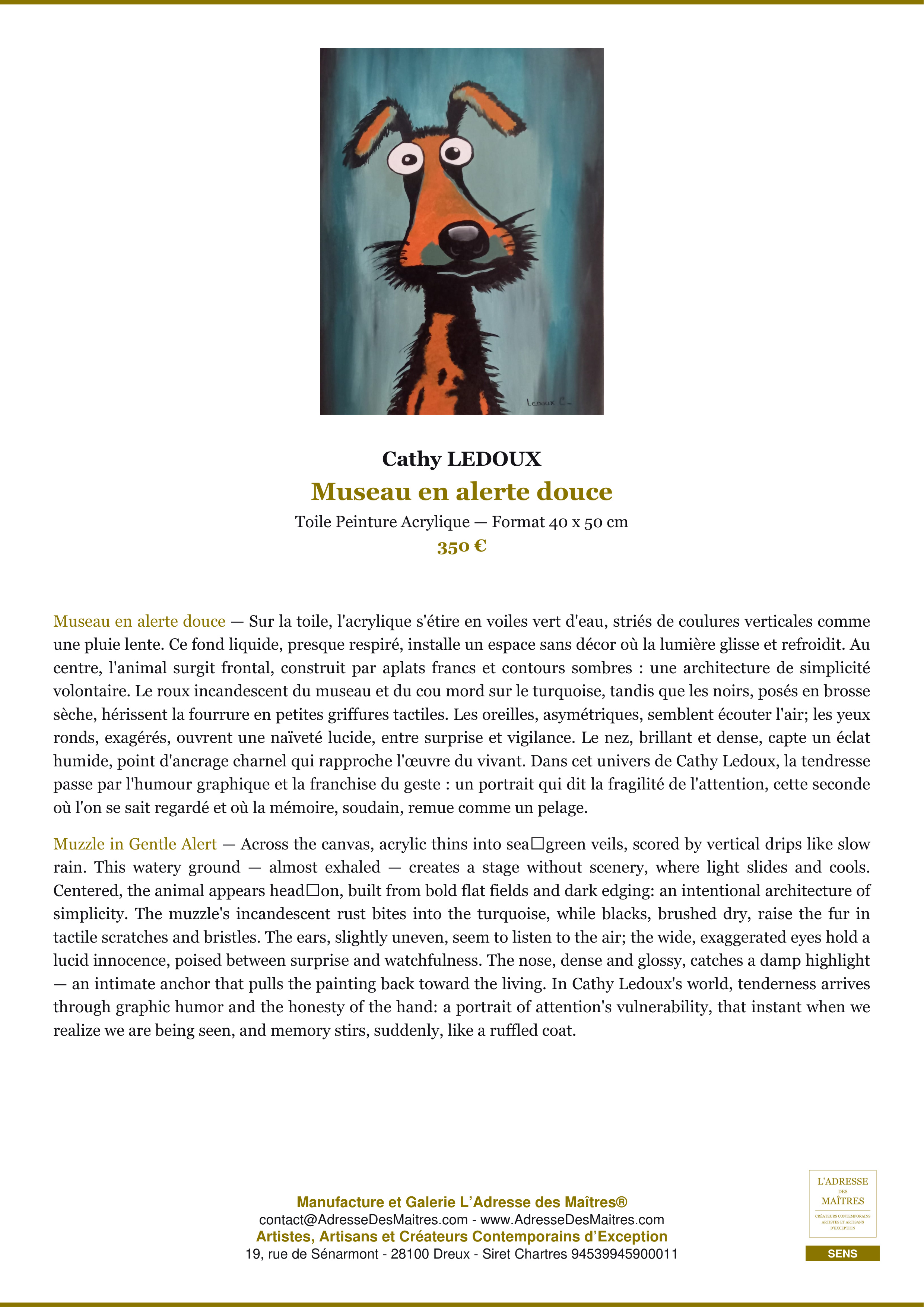
Cathy LEDOUX, with five acrylic paintings—including *Museau en alerte douce*—offers an organic and attentive counterpoint. In the context of a reflection on seascapes, the presence of acrylic and living things serves as a reminder that the maritime world is not limited to the horizon: it also engages a sensitivity to animated forms, presences, and the subtle signals of life.
How can you tell if a seascape painting is of high quality?
The discerning collector knows that a successful seascape cannot be judged solely by its decorative appeal. The sea is easily captivating: deep blues, sunsets, white sails, spectacular white caps. But that allure can be a trap. A good seascape stands up to prolonged scrutiny.
First criterion: consistency in lighting. The painter must understand where the light comes from, how it strikes the water, and how it reflects or fades away. Even a single inconsistency in the reflections is enough to make the scene look artificial. Second criterion: the movement of the water. Waves must not be superimposed like a decorative motif; they must be driven by an internal energy. Even in a calm sea, there is tension, a rhythm, and subtle movement.
Third criterion:the horizon. Its placement, clarity, or obscurity determines the balance of the painting. In a figurative work, it must be accurate; in an abstract work, its absence must convey meaning. Fourth criterion: the relationship between sea and sky. A weak seascape simply juxtaposes two areas of color. A strong seascape creates a dialogue between the atmosphere and the water until they seem to belong to the same world.
Finally, we must consider the purpose of the painting. Why this particular sea? Why this composition, this texture, this color, this intensity? Great seascapes are never mere “views of the sea.” They convey a vision.
Marine Art as an Investment Opportunity
The sea occupies a unique place in the art market. It is immediately visible to the eye, yet difficult to capture successfully. This tension explains the rarity of truly compelling contemporary seascapes. Many artists tackle the subject; few manage to avoid clichés. Collectors should therefore seek not merely a pleasing image, but a work imbued with mastery: controlled light, solid composition, vibrant texture, and restrained emotion.
In an art gallery, a high-quality seascape has a clear advantage: it transcends trends. It engages with history, with contemporary interiors, and with the ecological and commemorative concerns of our time. But its value lies in its qualitative rarity. A beautiful contemporary seascape is not merely a painting of the sea; it is a work capable of revitalizing an ancient motif without diminishing it.
This is also why the guidance of a professional eye remains invaluable. At the L’Adresse des Maîtres® Art Gallery in Dreux, the approach is precisely to place works within a broader context: that of techniques, sensibilities, subjects, and the demands of collecting. Because buying a seascape often means buying more than just a landscape: it means acquiring a relationship with space, time, and the infinite.
The Horizon as a Promise
From Dutch seascapes to contemporary art, from Turner to Monet, from the Romantic storm to Impressionist light, the sea has continually pushed the boundaries of painting. It has taught artists that simply seeing is not enough; one must capture its instability, its brilliance, its depth, and its transience. It has instilled in them a sense of humility in the face of change.
Seascape painting thus remains one of the great realms of art: popular for its subject matter, demanding in its execution, and infinite in its variations. It speaks to the sailor, the dreamer, the collector, the historian, the environmentalist, and the painter himself. And perhaps that is its secret: the sea can never be reduced to a single image. It compels each generation to start anew.
A high-quality seascape does not simply say, “Here is the sea.” Rather, it whispers, “Here is what the sea does to light, to time, to the gaze, and to the soul.” It is this rare and precious resonance that the collector must learn to recognize.
Check out our gallery
Would you like to experience these artistic movements in person? Visit the L’Adresse des Maîtres® online gallery: over 1,022 original works by contemporary artists.

Leave a comment