Delphine PERLSTEIN — Artist Profile
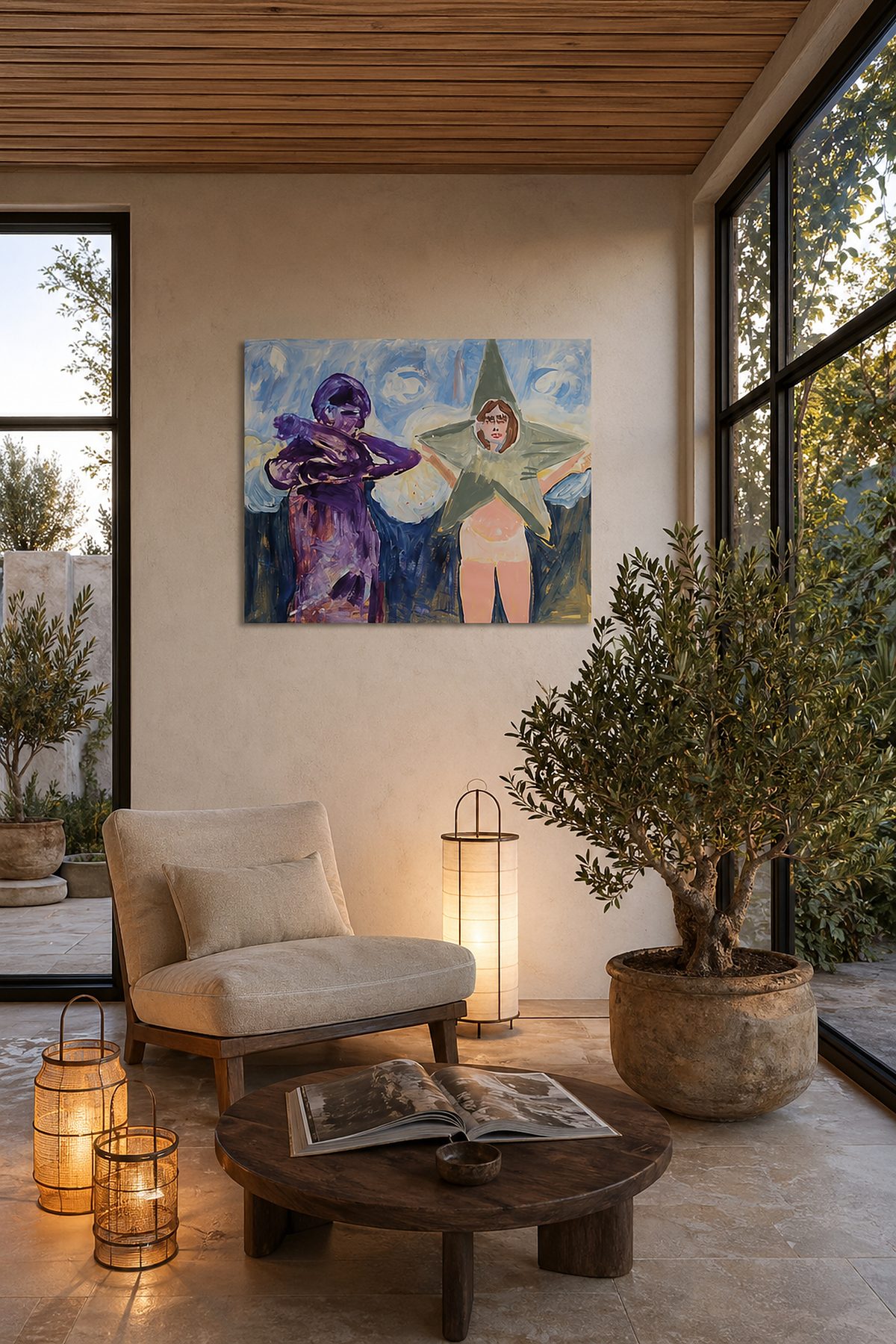
↓ Share this articleThere are works of art that do not reveal themselves immediately: they draw near, then recede, only to return and haunt the viewer’s gaze with a silent intensity. Delphine PERLSTEIN ’s paintings belong to this family of images that are both sensitive and enigmatic, where the painterly medium becomes a realm of apparitions. Exhibiting three works at the Galerie d’Art L’Adresse des Maîtres® in Dreux, the artist unfolds a universe where acrylic becomes vibration, passage, skin, and memory. Through *Sous l’étoile du passage*, *La Ronde du Loup Égaré*, and *Lumières Hésitantes sur la Peau*, a unique approach tocontemporary art emerges, blending poetic abstraction, narrative tension, and organic presence.
Delphine PERLSTEIN: Painting of Thresholds and Apparitions
To engage with Delphine PERLSTEIN’s work is to enter a pictorial space that always seems to be in motion. Nothing there appears completely fixed: forms shift, light wavers, and lines suggest more than they define. The artist does not seem to seek to impose a single image, but rather to create an open field of perception, within which each viewer can experience their own journey.
This quality of liminality is essential. The paintings evoke suspended moments, as if the artwork were capturing the exact instant when a figure, a memory, or an emotion is about to emerge. Acrylic, the central medium of her work, allows her to play with layering, transparency, contrasts in density, and shifts in rhythm. The surface thus becomes a place of fragile balance between appearance and disappearance.
In the context of an art gallery dedicated to contemporary art, the presence of these three works in Dreux offers a concise yet eloquent interpretation of the artist’s visual language. Each piece evokes its own distinct atmosphere, while engaging in a dialogue with the others around recurring themes: passage, wandering, light, the implied body, and sensation.
Acrylic as a Living Material
The technique used in Delphine PERLSTEIN’s works isacrylic painting. This medium, often valued for its quick drying time and flexibility, becomes much more than a tool here: it forms the very heart of the visual dynamic. Acrylic allows the artist to build up layers, revisit the surface, and intensify certain areas while letting others breathe.
In her works, the subject matter never seems purely decorative. It carries an emotional charge. The textures, color transitions, and variations in light create a sense of depth without necessarily relying on classical perspective. The painting becomes almost atmospheric: it envelops the viewer’s gaze, inviting it to wander and seek out what lies beyond the first impression.
This approach to working with the surface brings the artist closer to some of the major concerns ofcontemporary art: How can a sensation be made visible? How can the unstable be given form? How can abstraction and narrative coexist without confining the work to a single interpretation? For Delphine PERLSTEIN, the answer lies in an intuitive yet structured style of painting, in which each stroke seems to retain an element of mystery.
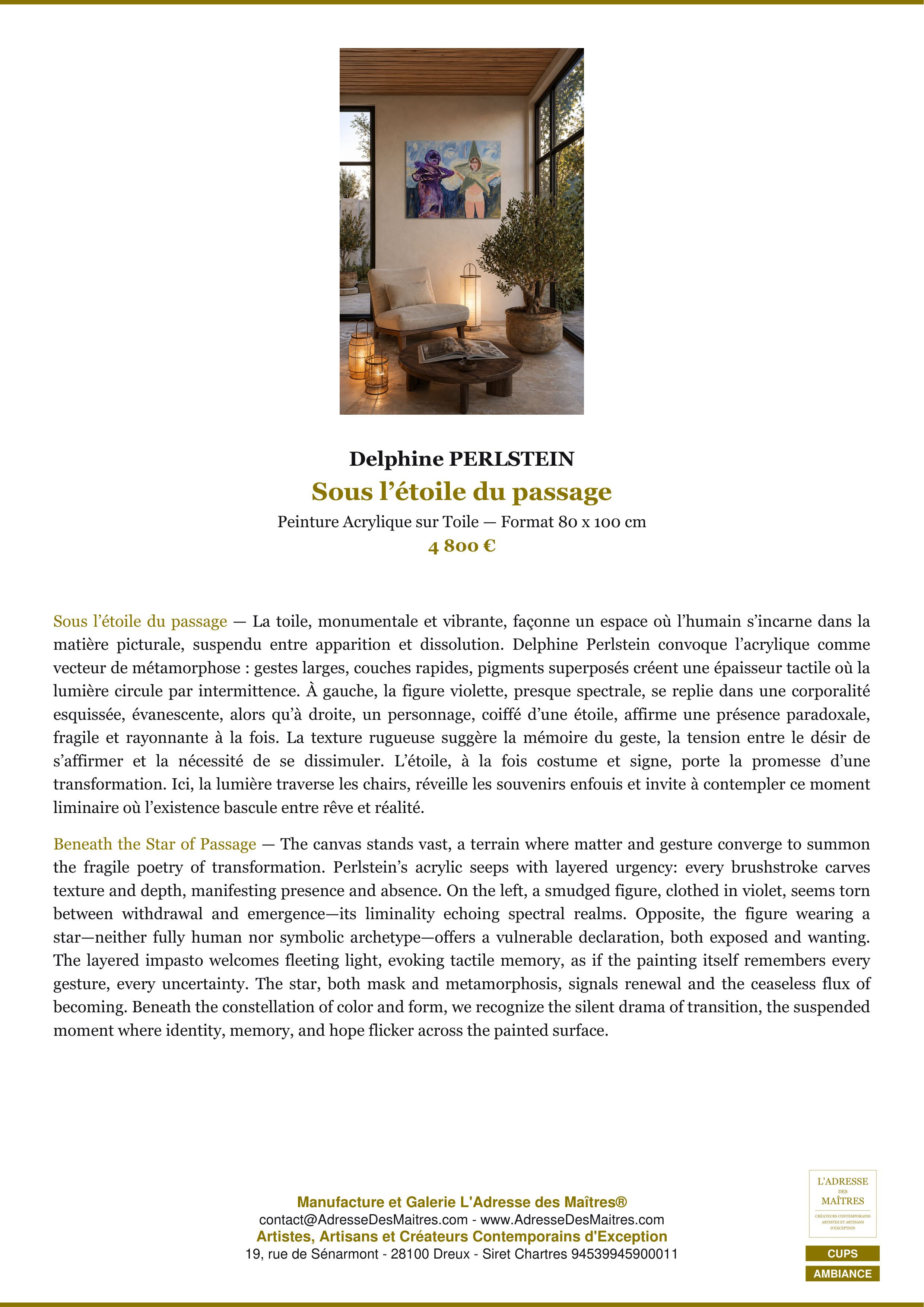
Under the Star of the Passage: An Inner Map
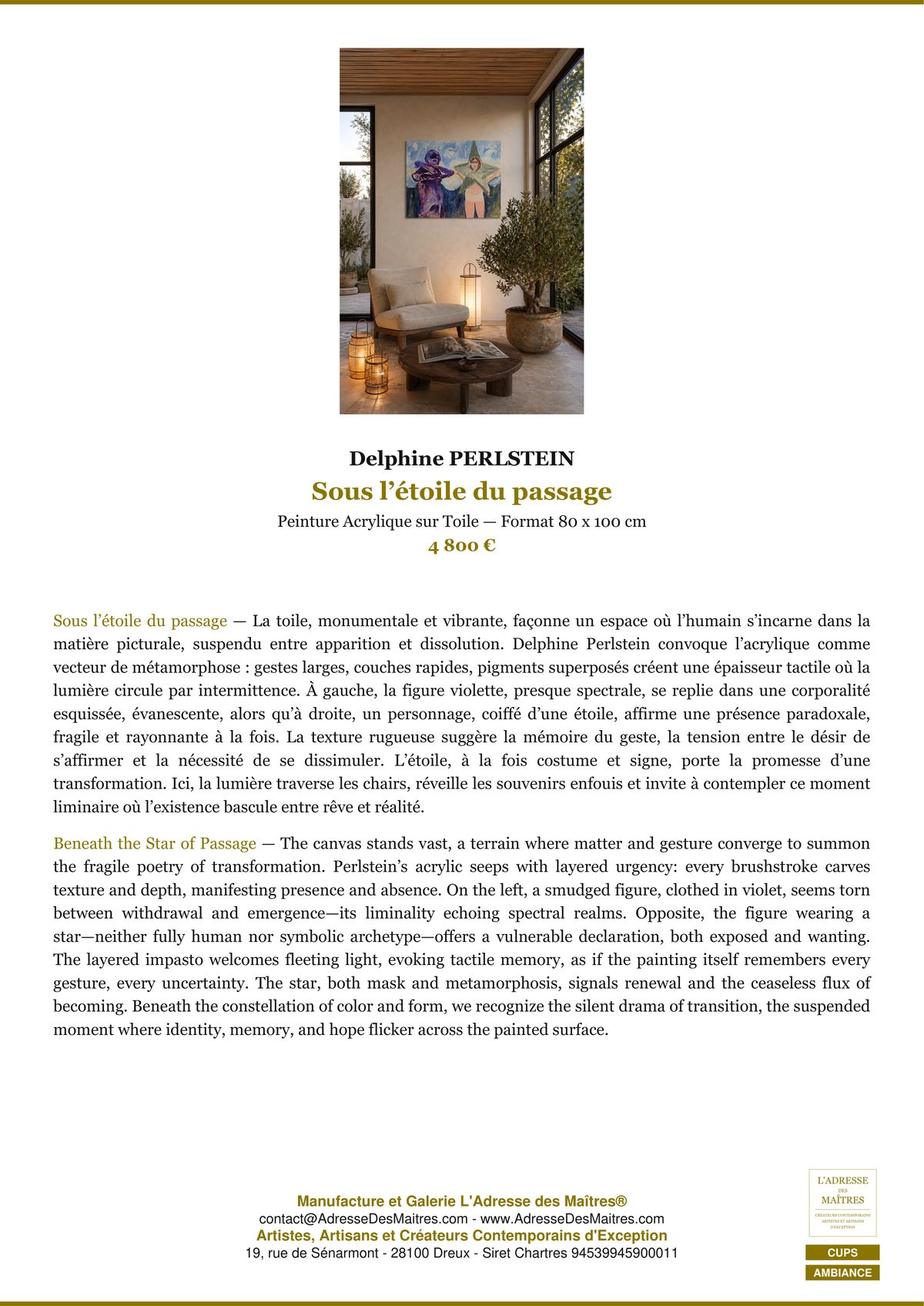
The title *Sous l’étoile du passage* immediately evokes a powerful imagination. It suggests a journey, a transition—perhaps a night spent under the glow of a distant light. In this work, the viewer may come to perceive the painting as a sensory map: not a representation of a real place, but of an inner state.
The concept of “passage” is central. It can refer to a boundary, a transformation, or a pivotal moment. The painting thus seems to function as a space through which the gaze migrates. The areas of color, the tensions between light and darkness, and the rhythms of the composition create a sense of movement. We do not simply look at the work; we pass through it.
The word “star” adds a dimension of orientation. It does not necessarily refer to a figurative star, but rather to a luminous principle, a focal point. In Delphine PERLSTEIN’s paintings, light is not merely a visual effect: it becomes a discreet, almost symbolic presence that guides without explaining. The work thus retains great poetic power, leaving it up to the viewer to invent their own narrative.
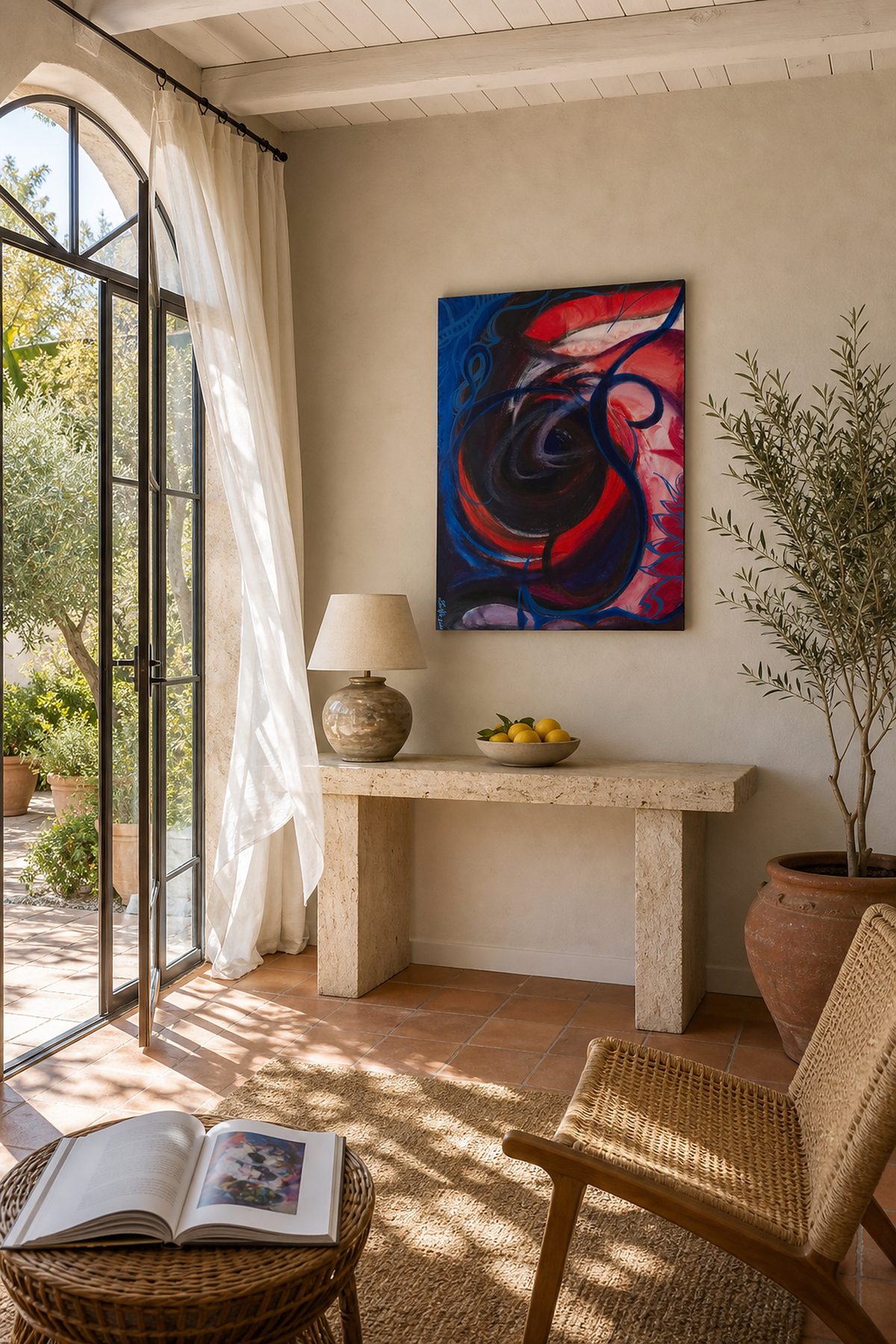
The Dance of the Lost Wolf: Between Instinct, Myth, and Movement
With *La Ronde du Loup Égaré*, the title introduces a more narrative, almost mythological dimension. The wolf, the quintessential ambivalent figure, can evoke loneliness, instinct, fear, freedom, or exile. Combined with the idea of a circle, it creates a fascinating tension: the circular, collective, or ritualistic movement meets the bewilderment of an isolated figure.
From a stylistic perspective, this work can be viewed as an exploration of imbalance. The circle suggests repetition, a rhythm, perhaps a dance. Disorientation, on the other hand, opens a breach. Delphine PERLSTEIN thus appears to be exploring the contrast between order and disorientation, between structure and wandering. According to this interpretation, the composition does more than simply organize forms: it portrays an inner tension.
This type of work illustrates the artist’s ability to evoke mental images without descending into illustration. The wolf does not need to be depicted literally to be present. It can inhabit the painting as an energy, a possible silhouette, a vague sense of unease. It is precisely this freedom of interpretation that gives his work a relevant place in an art gallery attuned to contemporary sensibilities.
Faint Lights on the Skin: The Surface as a Sensitive Territory
*Hesitant Lights on the Skin* is a title of great delicacy. It associates light with uncertainty, and skin with surface. This work seems to explore the relationship between the visible and the tactile. Within the pictorial field, the skin is not merely a bodily motif: it can become a metaphor for the canvas itself—that membrane upon which traces, transparencies, and intensities are laid.
The term “hesitant” is particularly revealing. It suggests a light that does not intrude, that seeks its place, that settles cautiously. In Delphine PERLSTEIN’s work, this light seems less spectacular than vibrational. It skims the surface. It does not reveal everything, but rather reveals in fragments. This restraint lends the painting an intimate, almost whispered quality.
One can see in it a reflection on the fragility of the gaze. Looking at a work of art sometimes means accepting that we cannot grasp everything. Here, the painting seems to invite slow, mindful attention and sensory openness. The painted surface becomes a point of contact—not in a physical sense, but in an emotional one: something touches the viewer because nothing is forcefully imposed.
Three works, the same poetic atmosphere
The three works on display at the L’Adresse des Maîtres® Art Gallery in Dreux form a cohesive whole. They do not tell a linear story, but rather create a certain atmosphere. The passage, the sense of being lost, and the light on the skin can be understood as three ways of approaching the human experience: moving forward, getting lost, and feeling.
What stands out in this selection is Delphine PERLSTEIN’s ability to create paintings that remain open-ended. The artist does not lock down the meaning. She offers points of entry and avenues for interpretation. Viewers may be drawn to the composition, the color, the title, the texture, or the overall atmosphere. Every approach is valid, because the work operates through resonance.
In thecontemporary art world, this approach is invaluable. It reminds us that painting does not need to explain everything to be deeply meaningful. On the contrary, its power often lies in that controlled element of ambiguity—in its ability to evoke a presence without reducing it to a message.
A must-see in Dreux
Through the L’Adresse des Maîtres® Art Gallery in Dreux , the city showcases works that offer visitors the chance to explore a variety of sensitive artistic approaches. Delphine PERLSTEIN’s inclusion in this selection contributes to this openness toward contemporary painting that is both demanding and accessible. Her three works invite viewers to engage in both observation and introspection.
For art lovers, collectors, or curious visitors, seeing these paintings in a gallery allows you to fully appreciate their nuances. Reproductions give a first impression, but the acrylic medium, surface effects, and subtle play of light take on a whole new dimension when viewed up close. It is through this direct encounter that a painting often reveals its true intensity.
Conclusion: An Invitation to Look
Delphine PERLSTEIN ’s work is distinguished by a sensitive pictorial style, in which acrylic becomes a bridge between the visible and the invisible. Under the Star of Passage, *La Ronde du Loup Égaré* and *Lumières Hésitantes sur la Peau* form a triptych of atmospheres, permeated by light, wandering, and the presence of the implied body. Without imposing a fixed narrative, the artist offers the viewer a space of freedom, poetry, and contemplation.
To discover Delphine PERLSTEIN’s works and explore the selection of contemporary art available, visit the online gallery of Galerie d’Art L’Adresse des Maîtres® in Dreux today.
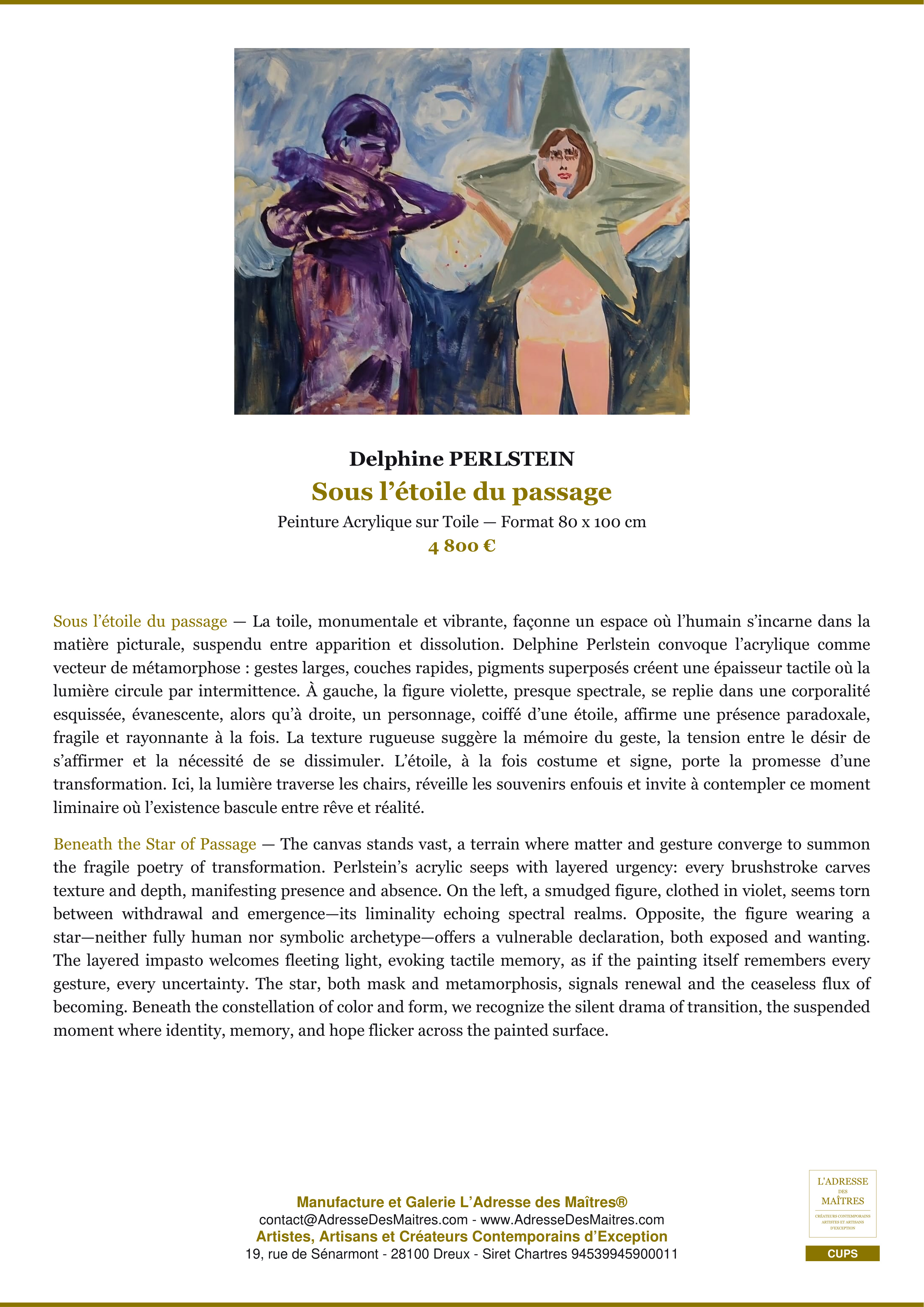
Discover the works of Delphine PERLSTEIN: Under the Star of the Passage · The Dance of the Lost Wolf · Faint Lights on the Skin
Explore Delphine PERLSTEIN's complete collection in our online gallery —more than 3 original works available.
Leave a comment