

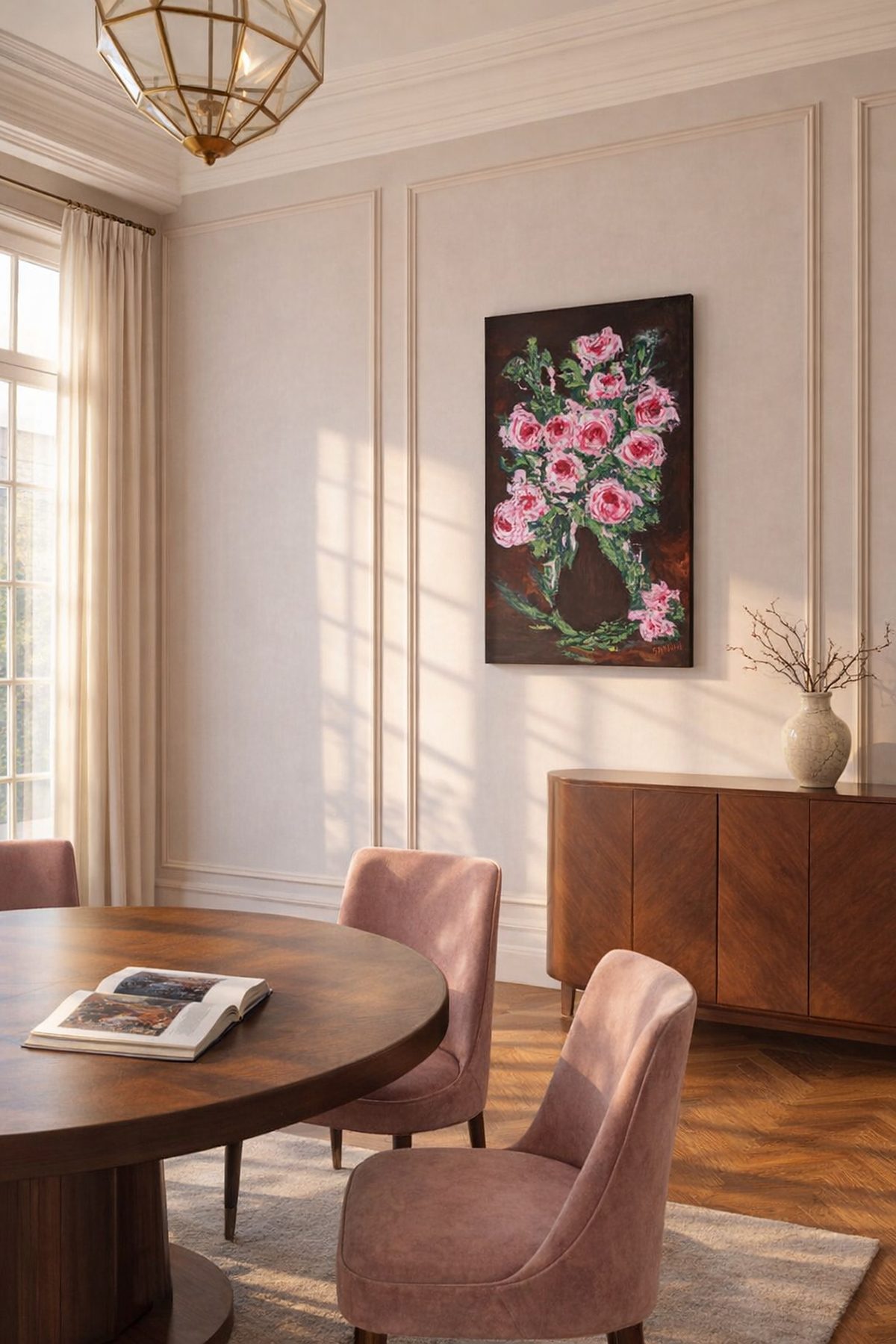
Sabrina BENAZZOUZ — Artist Profile
↓ Share this articleThere is something in Sabrina BENAZZOUZ’s bouquets that defies mere floral contemplation. The flower is never merely an isolated decorative motif; it becomes memory, embers, restrained light, and an inner vibration. Through her sensitive and intensely colorful paintings, the artist transforms the bouquet into an emotional landscape, hovering between appearance and disappearance, gentleness and incandescence.
Sabrina BENAZZOUZ: Floral Artistry at the Heart of Contemporary Art
Exhibiting at the Galerie d’Art L’Adresse des Maîtres® in Dreux, Sabrina BENAZZOUZ embraces an approach tocontemporary art in which the floral subject is reinterpreted with a bold artistic freedom. Her compositions do not seek to faithfully reproduce nature; rather, they capture its vitality, fragility, and luminous presence.
With nine works currently on view in the gallery, the artist presents a cohesive body of work centered on the bouquet as a recurring, almost meditative motif. Yet far from being repetitive, each painting explores a different nuance of memory, light, or texture. The titles themselves open up a poetic space: Bouquet in the Wake of Light, Bouquet, Memory in Embers, Bouquet of Dawn, Pink Memory, Roses in the Wake of Light, Red Bouquet, Memory in Embers. They do not merely describe an image; they suggest an atmosphere.
Acrylic Paint as a Medium for Light
The technique used by Sabrina BENAZZOUZ—acrylic painting—plays a central role in the expressive power of her works. Acrylic paint allows for great chromatic intensity and speed of execution, as well as layering that lends the painted surface a unique richness. In the artist’s work, this technique becomes a means of creating tension between transparency and density.
The colors sometimes appear as if laid down like luminous veils, and at other times are rendered with greater depth, evoking the warmth of embers or the vibration of a memory. This plasticity of acrylic paint allows Sabrina BENAZZOUZ to create a dialogue between the visible and the felt. The bouquet is not simply painted: it emerges, unfolds, burns away, or glows.
In a work like *Bouquet, mémoire en braise*, the title invites us to perceive color as a fiery trace. Red, orange, and other warm tones refer not only to the flower but also to a lingering emotion. The painting becomes an active memory, a substance still warm, almost incandescent.
The Bouquet: Motif, Symbol, and Interior Space
The bouquet holds a prominent place in art history, from classical still lifes to modern explorations of color. Sabrina BENAZZOUZ takes this traditional motif and reinterprets it through a contemporary lens. Her bouquets are neither static nor strictly realistic. They seem caught in an inner movement, as if the painting were capturing the moment when the flower becomes a sensation.
In *Bouquet d’aube, mémoire rose*, the evocation of dawn suggests a beginning, a nascent light. The color pink, associated with memory, lends the work a gentle yet not passive quality. This is not merely a matter of chromatic delicacy: pink becomes a mood, an emotional imprint, a way of bringing time to life through color.
In contrast, *Bouquet rouge, mémoire en braise* exudes a more intense energy. Red dominates as a vital, almost organic force. This variation on the bouquet clearly illustrates one of the major themes in Sabrina BENAZZOUZ’s work: a single motif can serve as a vehicle for very different emotional states. The bouquet is an open form, capable of embracing light, memory, combustion, vigil, or anticipation.
A Painting Between Presence and Absence
One of the most captivating aspects of Sabrina BENAZZOUZ’s work lies in the way she brings forms to life without confining them. The flowers may be recognizable, but they are often permeated by color, absorbed into the overall atmosphere of the painting. This approach gives her compositions an almost dreamlike quality.
In *Bouquet en veille de lumière* or *Roses en veille de lumière*, the phrase “en veille” is particularly revealing. It evokes a restrained, discreet light, ready to burst forth. The painting thus seems to explore the threshold: the threshold between day and night, between appearance and disappearance, between memory and immediate perception.
This tension gives the works a quiet presence. They do not command attention through spectacle, but through a gradual intensity. The viewer is invited to draw closer, to delve into the material, to let the colors take effect. This is a style of painting that does not reveal itself all at once: it is discovered layer by layer, like a visual memory.
Color, Emotion, and Pictorial Rhythm
Color is undoubtedly one of the primary means of expression in Sabrina BENAZZOUZ’s work. It is not merely used to depict flowers; it structures the space, creates rhythm, and conveys emotion. Warm tones, deep reds, vibrant pinks, and softer hues come together to form a sensitive visual language.
The painterly gesture seems to alternate between spontaneity and control. Some areas convey a sense of freedom, almost as if they were bursting forth, while others appear more deliberate, as if the artist were seeking to anchor the emotion within the composition. This interplay between energy and balance lends the works a distinctive musicality.
In the setting of an art gallery in Dreux, this approach offers collectors and contemporary art enthusiasts an experience that is both accessible and sophisticated. Sabrina BENAZZOUZ’s floral arrangements captivate with their immediate beauty, yet hold the viewer’s attention through their artistic and poetic depth.
A strong presence at the L’Adresse des Maîtres® Art Gallery in Dreux
With nine works on display, Sabrina BENAZZOUZ occupies a unique place within the selection at the Galerie d’Art L’Adresse des Maîtres® in Dreux. Her floral world brings a luminous freshness while asserting a distinct pictorial identity. Each canvas seems to engage in a dialogue with the others, forming a cohesive whole in which the concepts of memory, vigil, and light recur as underlying themes.
What sets her work apart is her ability to reinterpret the theme of the bouquet without ever reducing it to a mere decorative exercise. The floral motif becomes a language. Petals, swaths of color, contrasts, and transparencies come together to create a painting that conveys restrained emotion. The work invites the viewer not only to contemplate, but also to feel.
Why explore the works of Sabrina BENAZZOUZ?
Discovering Sabrina BENAZZOUZ means encountering an artist whose acrylic paintings combine vibrant colors with an atmospheric delicacy. Her works appeal equally to lovers of floral arrangements and tocontemporary art enthusiasts seeking paintings that are sensitive, expressive, and deeply evocative.
Her titles, always evocative, extend the visual experience. They open up possibilities without imposing a single interpretation. *Bouquet en veille de lumière* or *Bouquet, mémoire en braise* are both invitations to perceive the painting as a space of intimate resonance. The viewer projects onto it their own memories, their own lights, and their own silences.
For collectors, the appeal also lies in the coherence of the series on display. The nine available works offer a glimpse into a structured, recognizable world, where each painting possesses its own uniqueness while contributing to a shared exploration of flowers, color, and memory.
Browse the online gallery
Sabrina BENAZZOUZ ’s works offer a luminous, sensitive, and contemporary visual experience, to be discovered in all their subtlety. To appreciate the nuances of her floral arrangements, compare the available compositions, and find the piece that resonates with you, visit the online gallery of Galerie d’Art L’Adresse des Maîtres® in Dreux today.
Explore the online collection, discover Sabrina BENAZZOUZ’s 9 works, and let yourself be guided by the inner light of her bouquets.
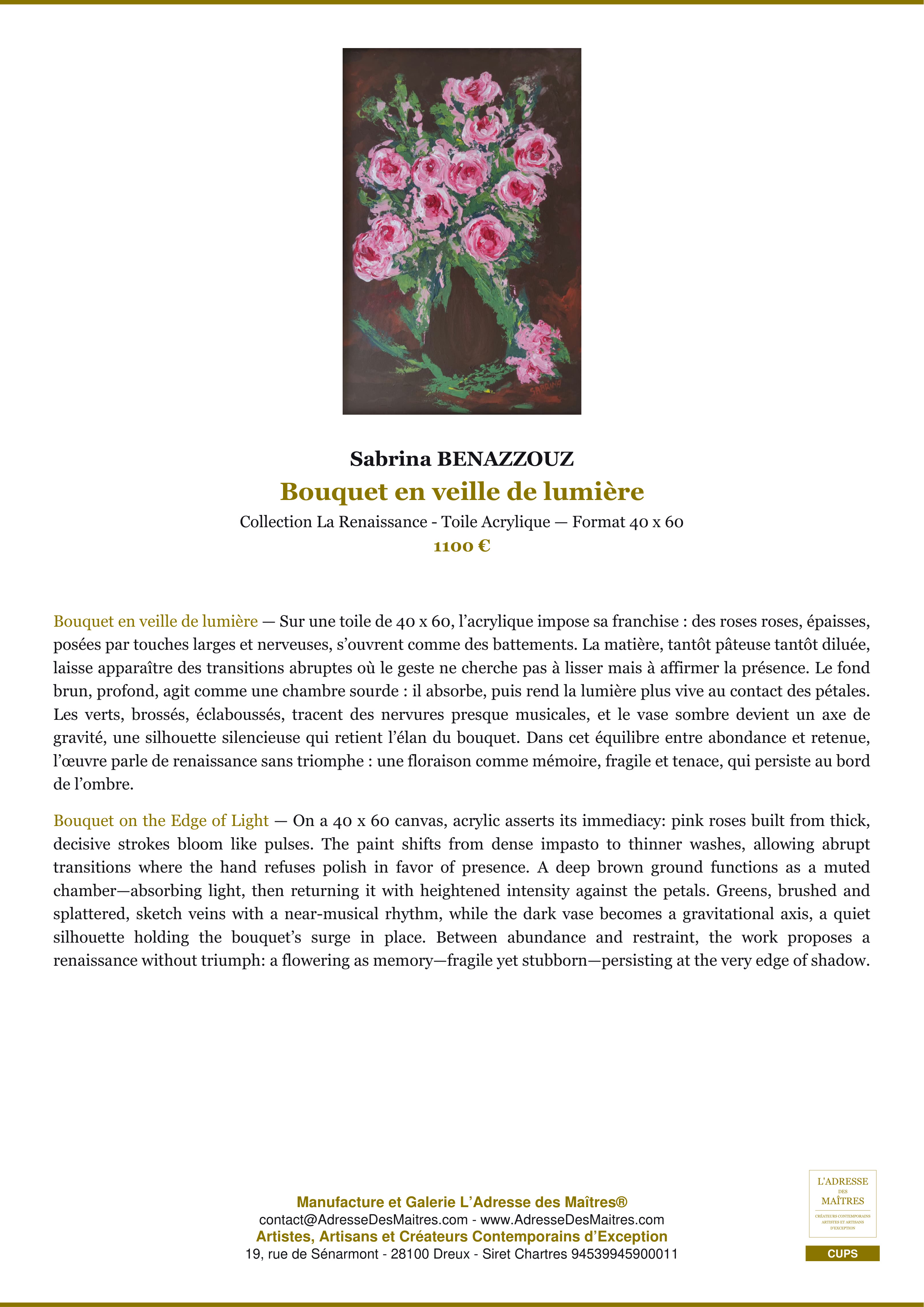
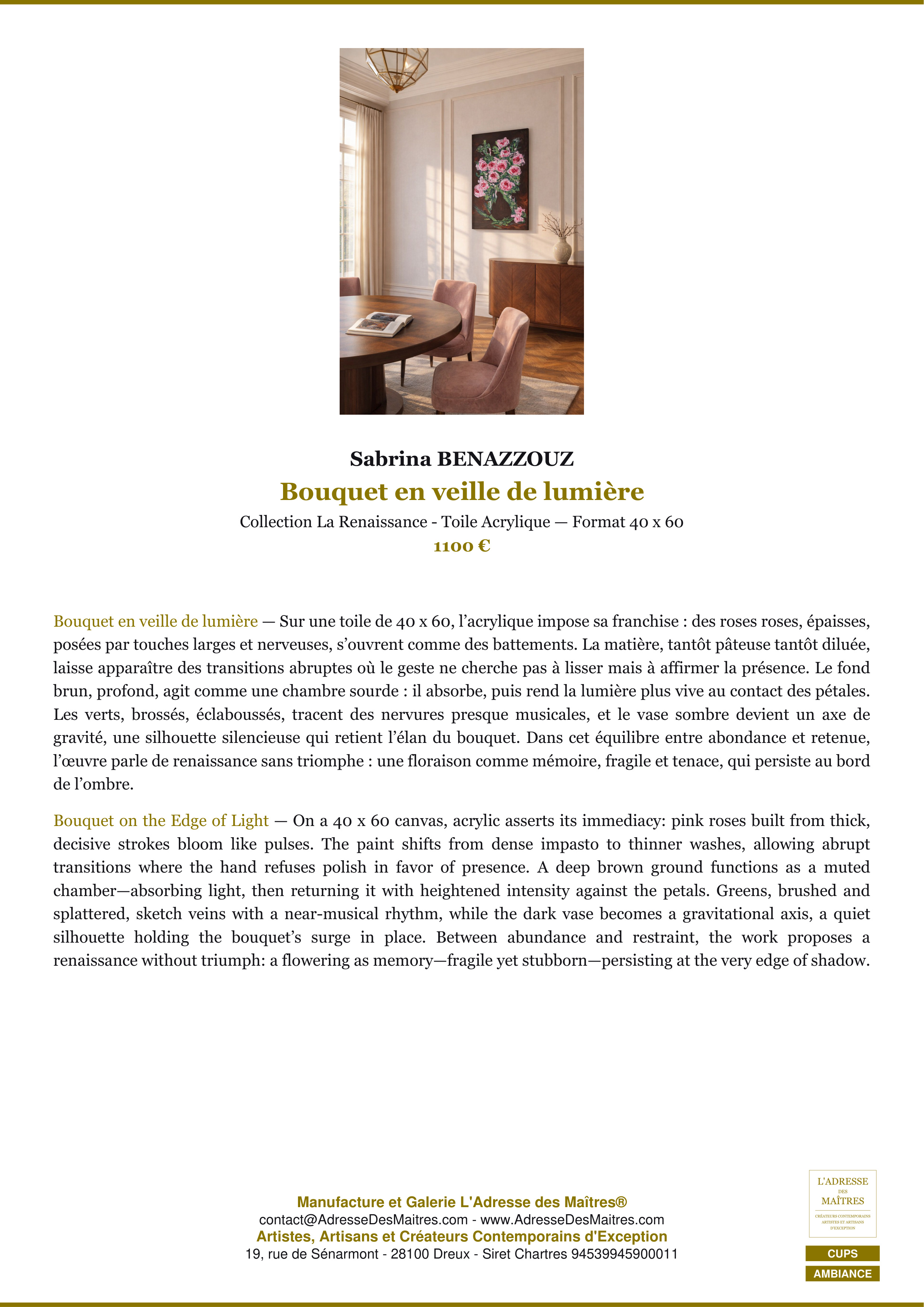
Discover the works of Sabrina BENAZZOUZ: Bouquet on the Eve of Light · Bouquet, Memory in Embers · Bouquet of Dawn, Pink Memory
Le catalogue de Sabrina BENAZZOUZ : retrouvez toutes ses œuvres réunies dans son catalogue numérique (PDF à feuilleter ou à télécharger).
Explore Sabrina BENAZZOUZ's complete collection in our online gallery —more than 9 original works available.


Leave a comment