Ceramics — Contemporary Art
↓ Share this articleThe Art of Ceramics: When Clay Becomes the Language of Contemporary Art
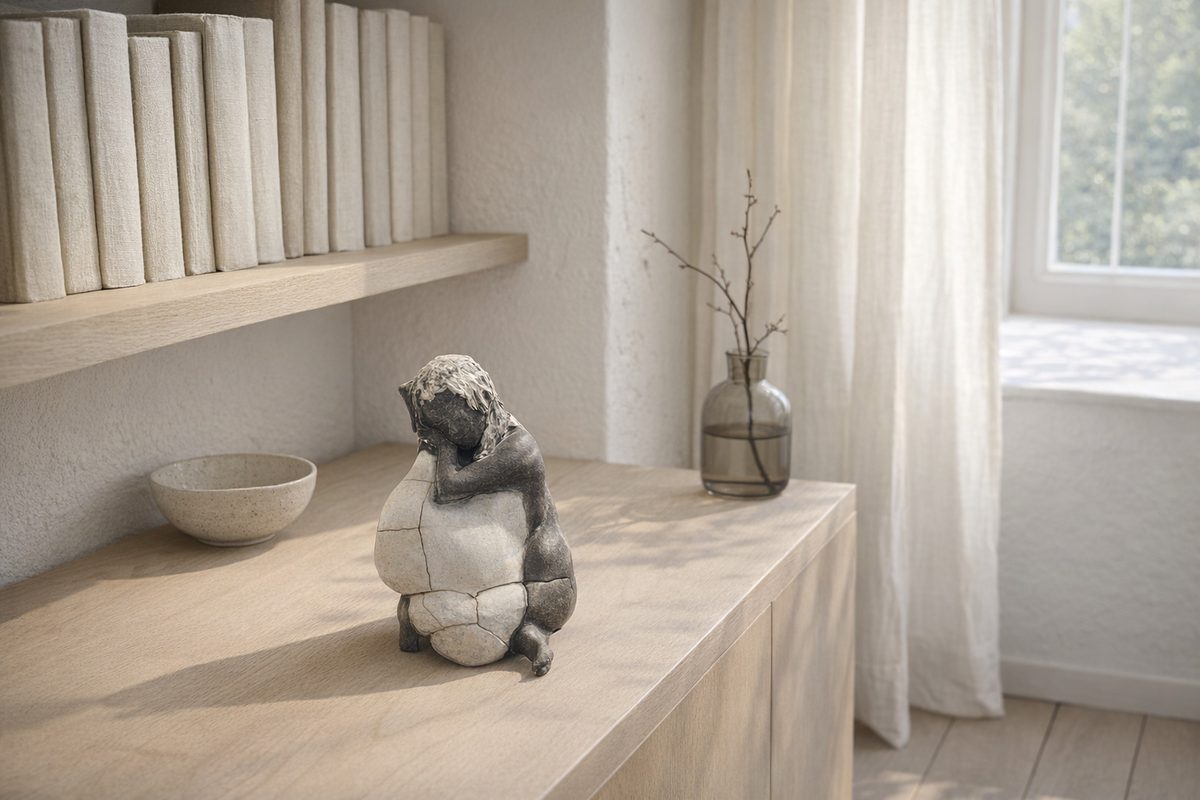
In the field ofcontemporary art, ceramics occupies a unique place: both ancient and resolutely modern, it brings together the hand, the material, fire, and the idea. Long associated with the decorative arts, utilitarian objects, and craftsmanship, ceramics has established itself over the past several decades as a true artistic medium, capable of rivaling painting, sculpture, and installation art. At the L’Adresse des Maîtres® Art Gallery in Dreux, this medium is represented by 15 works, notably through the work of artist Bernadette MAURO, who explores its expressive possibilities with sensitivity and mastery.
Understanding the Ceramics Technique in an Accessible Way
The term “ceramics” refers to all creations made from clay that has been transformed through firing. These may include earthenware, stoneware, porcelain, or other types of clay that have been mixed with chamotte, modeled, shaped, thrown, molded, or assembled before being fired at high temperatures. Ceramics are based on a principle that seems simple: a flexible, living, malleable material becomes solid and durable through the action of fire.
But behind this apparent simplicity lies great technical complexity. The artist must understand the plasticity of clay, how it shrinks as it dries, its resistance during firing, and the reactions of glazes, oxides, and engobes. Each step involves a degree of uncertainty. A ceramic work is never entirely predictable: the fire acts as a partner—sometimes docile, sometimes capricious. It is precisely this tension between control and chance that gives the Ceramics technique its full poetic power.
In contemporary art, ceramics can take the form of a sculpture, a wall relief, a conceptual object, an installation, or a hybrid piece combining multiple materials. It allows artists to explore volume, surface, color, texture, and light. Whether matte, glossy, rough, crackled, smooth, organic, or architecturally structured, it offers an extremely rich visual vocabulary.
An ancient history, with traditions that are constantly being reinvented
The history of ceramics is almost as old as that of humanity. The first earthenware appeared as early as prehistoric times, long before the invention of writing. It was used to make containers, figurines, and ritual or household objects. Across civilizations—Chinese, Greek, Egyptian, Islamic, Japanese, and European—ceramics have always been part of both the rhythms of daily life and expressions of the sacred and power.
Chinese porcelain, Greek vases, Delftware, Islamic ceramics with geometric designs, folk glazed pottery, and Limoges porcelain all bear witness to a universal mastery of craftsmanship. Yet for a long time, ceramics were considered inferior to the fine arts. They were admired for their technical mastery, refinement, or practicality, but rarely as an independent field of artistic experimentation.
In the 20th century, this perspective changed profoundly. Leading artists embraced ceramics, giving the medium new freedom. Pablo Picasso, for example, explored terracotta in Vallauris and transformed plates, pitchers, and vases into vehicles for artistic innovation. Joan Miró, Lucio Fontana, and later many contemporary artists made ceramics a distinct medium of expression in its own right. The line between art, design, and craftsmanship has become blurred, paving the way for broader institutional and commercial recognition.
The Role of Ceramics in Contemporary Art
Today, ceramics is experiencing a remarkable resurgence of interest incontemporary art. There are several reasons for this resurgence. First, ceramics reintroduces the concept of the handmade into a world saturated with digital images and industrially produced goods. It reminds us that a work of art can emerge from direct contact between the body and the material.
Furthermore, it has a strong ecological and symbolic dimension. Earth, water, air, and fire are the fundamental elements of ceramics. This relationship with raw materials resonates particularly with current concerns about nature, the long term, fragility, and transformation. A ceramic work carries within it the memory of its creation process: the pressure of the fingers, tool marks, internal tensions, and the effects of firing.
Finally, ceramics allow contemporary artists to explore a wide variety of themes: the body, memory, the home, fragments, ritual, objects, femininity, flaws, repair, and permanence. Ceramic works can be delicate or monumental, minimalist or baroque, raw or precious. Its richness lies in this ability to combine a millennia-old tradition with the most contemporary forms of artistic expression.
Bernadette MAURO: An Artist Worth Discovering in Dreux
At the L’Adresse des Maîtres® Art Gallery in Dreux, the ceramics medium is notably represented by Bernadette MAURO. Her work demonstrates the vitality of this medium and its ability to express a contemporary sensibility. Through the 15 works in this medium available at the gallery, visitors can appreciate the various qualities unique to ceramics: volume, texture, material effects, density, and the physical presence of the artistic object.
Bernadette MAURO belongs to a generation of artists for whom ceramics is not merely a decorative medium, but a true language. Clay becomes a space for exploration, intuition, and balance. It invites the viewer to slow down and observe the surfaces, the nuances, and the tensions between form and material. In her works, ceramics can be seen as a meeting of technical precision and quiet emotion.
What often strikes the viewer in a work of contemporary ceramics is its powerful presence. Unlike a two-dimensional image, it occupies space, interacts with light, and engages the viewer in an almost physical way. You can walk around it, take in its contours, and sense its weight, fragility, or strength. This materiality gives Bernadette MAURO’s pieces a special power: they are not merely meant to be seen; they are meant to be experienced.
Why collect a piece of ceramics?
When you purchase a work created using the Ceramics technique, you are choosing a piece that combines craftsmanship, uniqueness, and durability. Each ceramic piece is the result of a slow process, in which the artist allows the material to undergo a gradual transformation. Even when a series is produced, each piece retains a degree of uniqueness stemming from its shaping, firing, and surface variations.
For a collector, contemporary ceramics offer an exciting alternative to more traditional mediums. They fit just as well into a minimalist interior as they do into an existing collection of paintings, sculptures, or photographs. They bring a tactile, organic, and often timeless quality to a space. In an art gallery, they naturally draw the eye because they embody both fragility and permanence.
Ceramics is also a medium that lends itself to an intimate interpretation. A work made of terracotta, stoneware, or porcelain can evoke archaeology, the body, the landscape, minerals, or ritual objects. It spans the ages while remaining thoroughly contemporary. It is this dual sense of time that is attracting more and more art lovers.
Discover the Ceramics technique at an art gallery in Dreux
The city of Dreux has deep cultural roots, and the presence of a gallery dedicated to contemporary art allows both art lovers and collectors to discover works that have been carefully curated. Seeing a ceramic piece in a photograph is never quite enough: one must perceive its volumes, shadows, reflections, and the irregularities of the material. Experiencing the work in person is essential.
The L’Adresse des Maîtres® Art Gallery in Dreux thus offers an ideal setting for exploring the art of ceramics and understanding its place in contemporary art. The 15 works on display, all created using this medium, provide a wonderful opportunity to discover how clay—the quintessential primal material—becomes a rich medium for contemporary expression.
Through Bernadette MAURO’s creations, ceramics assert their status as a major art form: an art of fire, gesture, and time. She reminds us that modernity does not always mean breaking with the past, but sometimes reviving ancient knowledge to give it a new voice. In thecontemporary art scene, ceramics is therefore not a passing trend: it is a profound, sensitive, and enduring medium, capable of touching both the eye and the mind.
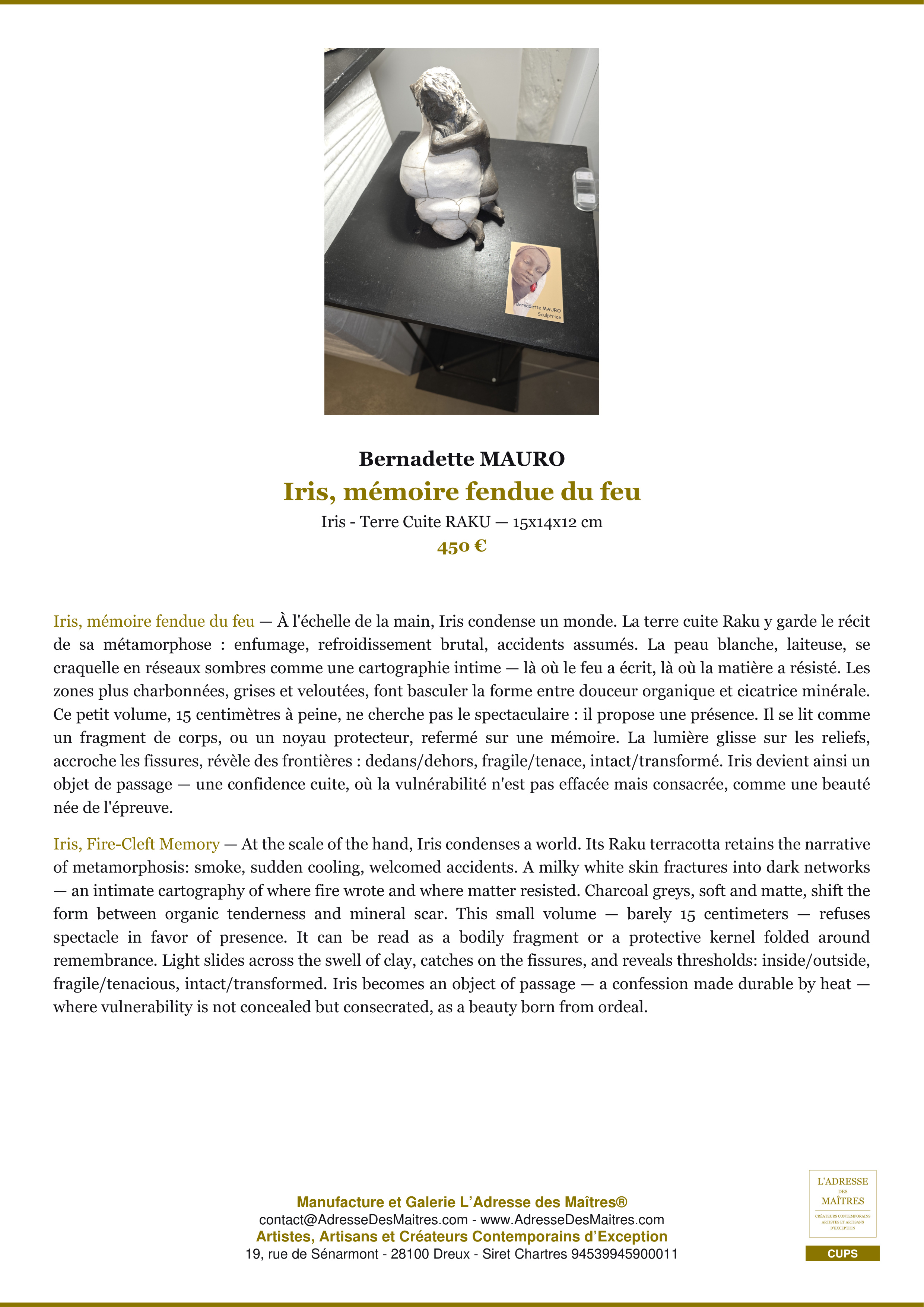
Découvrez 17 œuvres en Ceramics dans notre galerie en ligne.


Leave a comment