Lyrical Abstraction — When the Painter’s Body Responds to the Elements
↓ Share this articleLyrical Abstraction: When Gesture Becomes Atmosphere
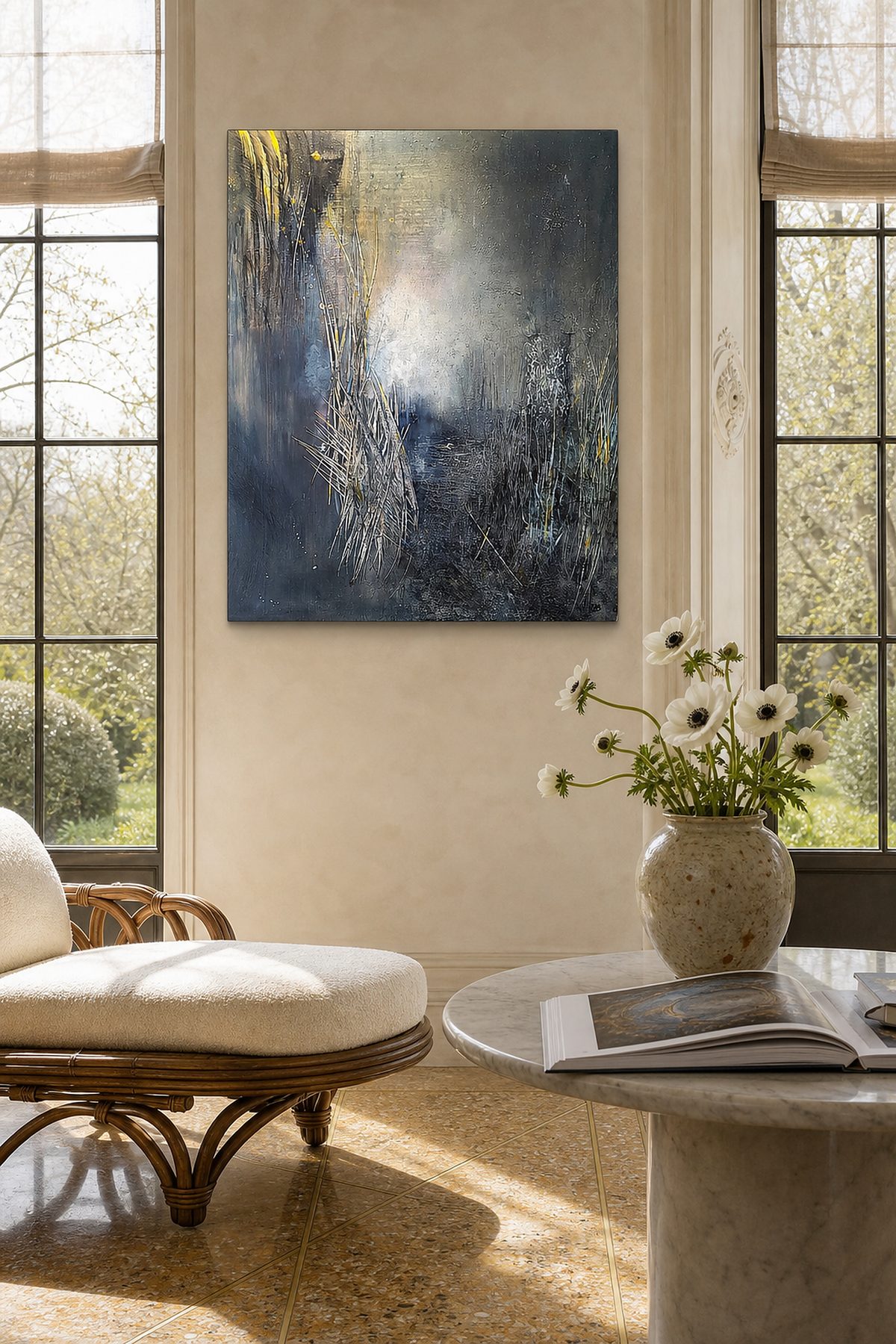
Lyrical abstraction is not merely a chapter in the history of abstract painting; it is a way of conceiving the painting as an event. Whereas other pictorial traditions organize the image around a stable composition, lyrical abstraction transforms the gesture into an immediate, almost breath-like form of expression. Here, the hand does not depict the world: it confronts it. It captures the pressure of the wind, the dazzling light, the fluidity of water, the bite of fire. The painter does not represent the natural elements as external motifs; instead, he allows their energy to pass through his body and then settle onto the canvas in the form of traces, bursts of energy, breaks, and densities.
This is where the profound uniqueness of this movement lies: the pictorial gesture becomes a form of bodily expression. It is neither a decorative gesture nor a gratuitous improvisation. It is tension, decision, speed, and sometimes struggle. In lyrical abstraction, the canvas is not a window opening onto a landscape; it is a place of passage, a surface of friction between the artist’s inner world and the elemental forces of the world. The wind is not painted there as a slanted branch, but as a nervous diagonal; water does not appear there as a river, but as a flow, transparency, dilution; fire does not become an illustrated flame, but incandescence, a chromatic wound, consumed matter.
The Origins of the Movement: Gesture as an Urgent Need
Historically, lyrical abstraction emerged in the postwar period, at a time when European painting was seeking a language capable of responding to the collapse of certainties. In Hans Hartung’s work, the line becomes a seismograph: scratches, beams, and bursts of black seem to convey energy rather than form. The painting does not tell a story; it strikes the viewer. Georges Mathieu, for his part, gives the gesture a spectacular and dazzling dimension: to paint quickly is to paint before thought can dampen the momentum. The canvas becomes the stage for a sense of urgency—not theatrical in a superficial sense, but vital.
Pierre Soulages introduces into this constellation a radical meditation on light. His blacks do not close off space; they reflect it, carve into it, and open it up. The material captures light through its striations, its reliefs, and its depths. Black becomes an element—almost mineral—and painting a physical experience of the gaze. On the other side of the Atlantic, Willem de Kooning engages gestural expression in a carnal, unstable tension, where forms emerge and dissolve. In his work, painting always seems to be struggling against its own emergence.
Hartung, Mathieu, Soulages, De Kooning: all of them, to varying degrees, shift painting toward the act itself. The painting is no longer merely the result of a composition; it preserves the memory of a body in motion. This is why lyrical abstraction remains so relevant incontemporary art: it poses a question that every era must rephrase. How can we capture in material form that which transcends us? How can we paint not what we see, but what affects us?
Painting Objects: Capturing Energy, Not Form
Painting natural elements from a naturalistic perspective involves recognizing forms: the tree in the wind, the reflection on the water, the embers in the hearth, the light on a facade. Lyrical abstraction takes a different path. It seeks not identification but correspondence. The wind becomes rhythm. Light becomes vibration. Water becomes expansion or dissolution. Fire becomes intensity, heat, an outpouring of color. What matters is not the element’s appearance, but its energy dynamic.
This difference is essential to understanding the power of abstract painting. A work can evoke a storm without showing the sky; it can convey a surge of heat without painting a flame; it can give the impression of immersion without depicting a shore. Lyrical abstraction operates through sensory equivalences. It does not copy nature; rather, it engages with it on the level of forces. It recognizes that the world is not composed solely of visible objects, but of pressures, flows, flashes, and resistances.
This shift lends the painting a particular intensity. The viewer is not invited to say, “This is water” or “This is fire,” but rather to experience a sense of fluidity, blaze, turbulence, or clarity. The painting ceases to be descriptive and becomes immersive. It does not simply depict a landscape; it draws the viewer into an experience.
The Pictorial Material: Depth, Speed, Texture
In lyrical abstraction, the material is never neutral. It is the very place where life leaves its mark. The thickness of a paste, the transparency of a glaze, the speed of a stroke, and the roughness of a surface are not secondary effects: they constitute the work’s fundamental vocabulary. Painting retains the memory of the gesture, but also that of its intensity. A quick line does not have the same temperature as a slowly worked flat area of color. A drip does not convey the same meaning as an incision. A smooth surface does not draw the eye in the same way as a textured one.
The role of oil, acrylic, ink, and mixed media is therefore crucial. Each medium imposes its own pace, its own resistance, and its own degree of compliance or defiance. Oil allows for revisions, depth, and shifts; ink favors sudden bursts, diffusion, and the irreversible; acrylic permits speed, layering, and surface tension. Following this logic, the painter does not simply apply a material: he negotiates with it. The canvas becomes a field of interactions, almost an organism.
In Dreux, Contemporary Presences in the Dialogue of the Elements
This dialogue between gesture, material, and elements finds tangible extensions today in the work of contemporary artists, whose art can be approached through the lens of pictorial energy. At the Galerie d’Art L’Adresse des Maîtres® in Dreux, several artists—through their techniques and certain titles—offer fruitful entry points for reflecting on this relationship between lyrical abstraction, material, and natural forces.
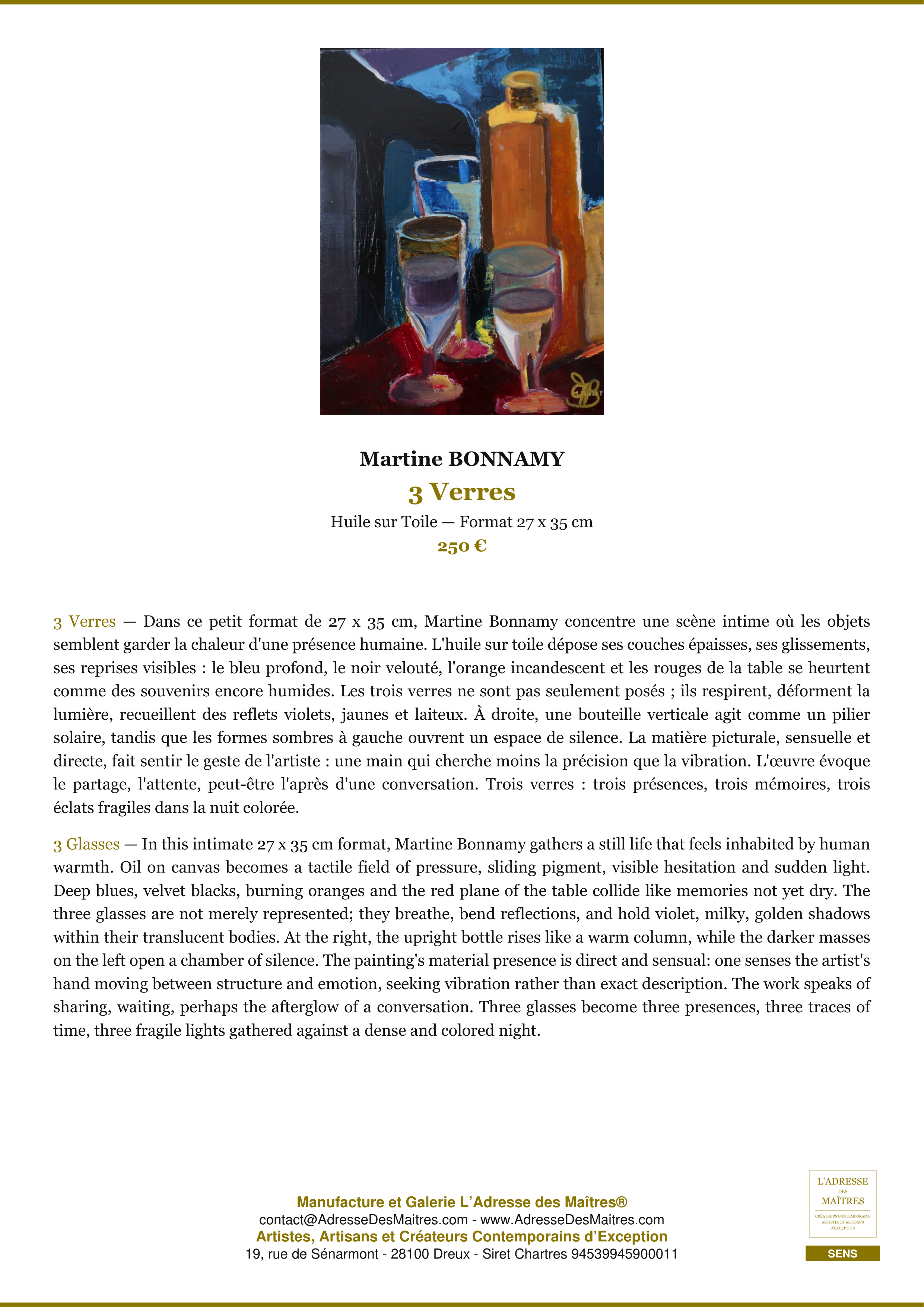
Martine BONNAMY, with 133 oil paintings—including 3 *Verres*—reminds us just how much oil painting can become a realm of slowness, density, and sensitive construction. In the context of lyrical abstraction, this medium lends a unique depth: it allows the brushstroke to settle, to resume, and to become imbued with time. The title *3 Verres* also invites a focus on presence—at the threshold between object and perception—without reducing the work to a figurative interpretation.
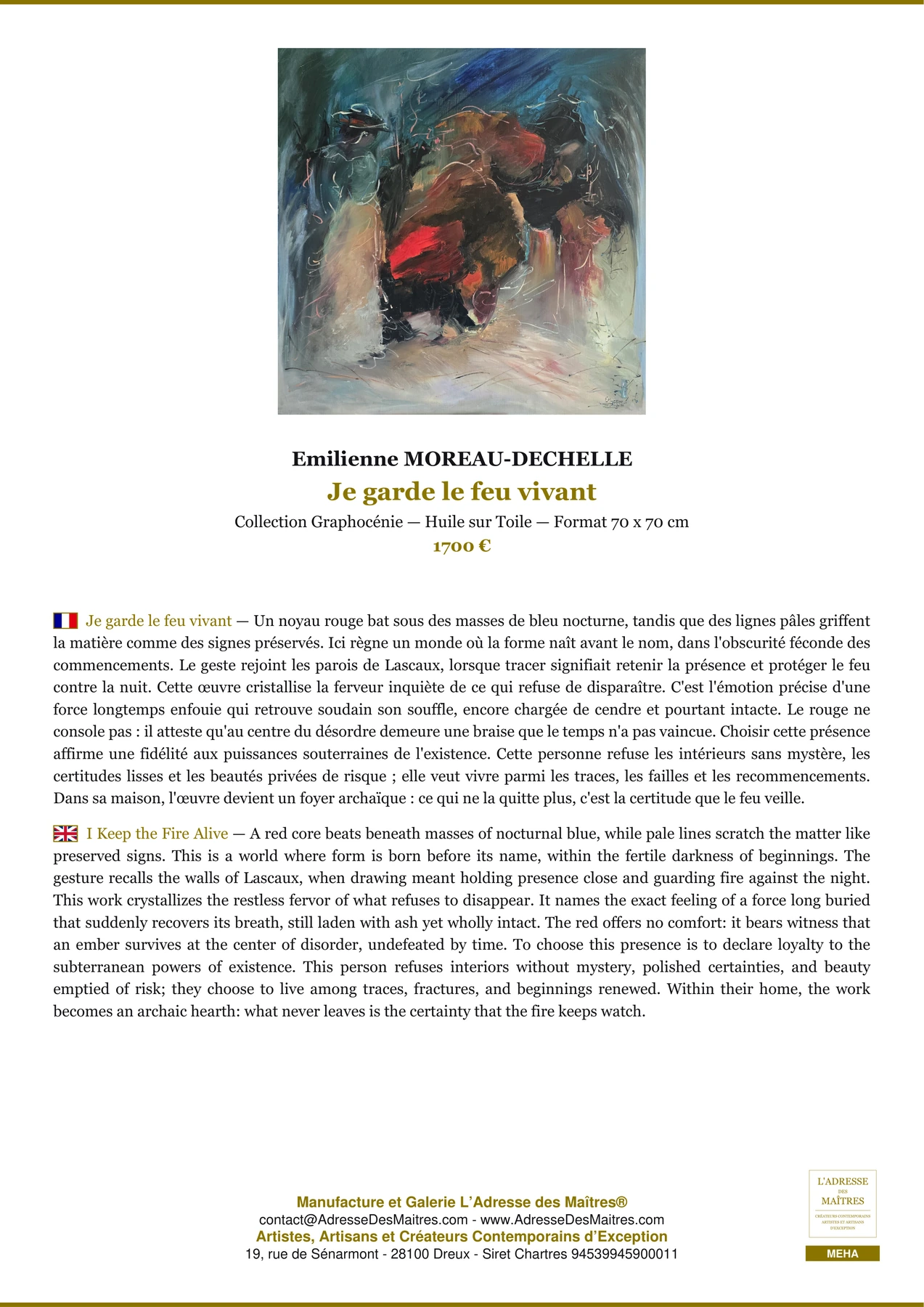
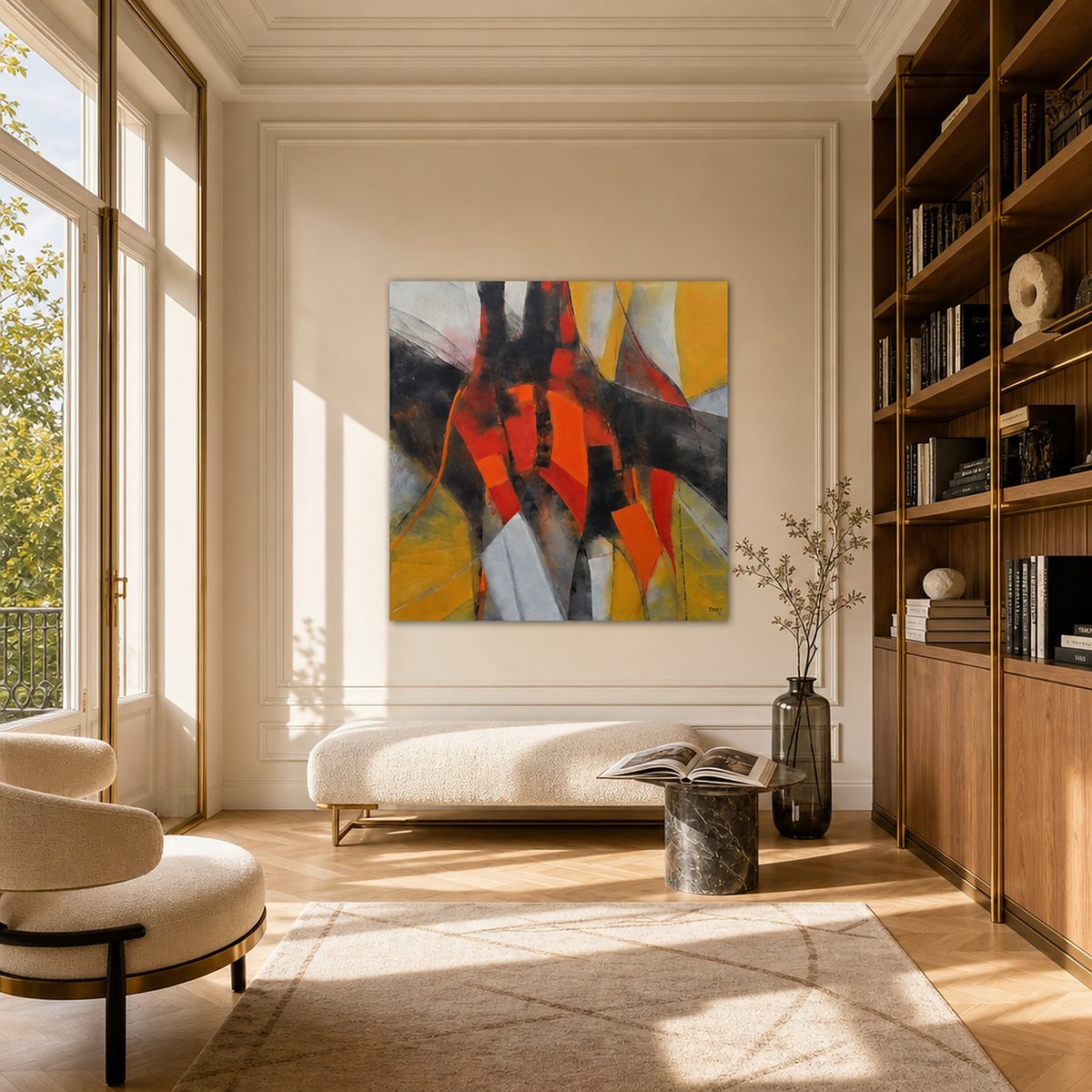
Emilienne MOREAU-DECHELLE, with 41 oil paintings—including *Passage sous les braises*—immediately establishes, through this title alone, a connection to the imagery of fire. Without speculating on what the work depicts, we can say that oil paint, combined with an evocation of embers, provides a particularly apt medium for conveying heat, chromatic depth, and the persistence of intensity. Fire, viewed from a lyrical perspective, is not merely a motif: it is a passage, a transformation, and residual energy.
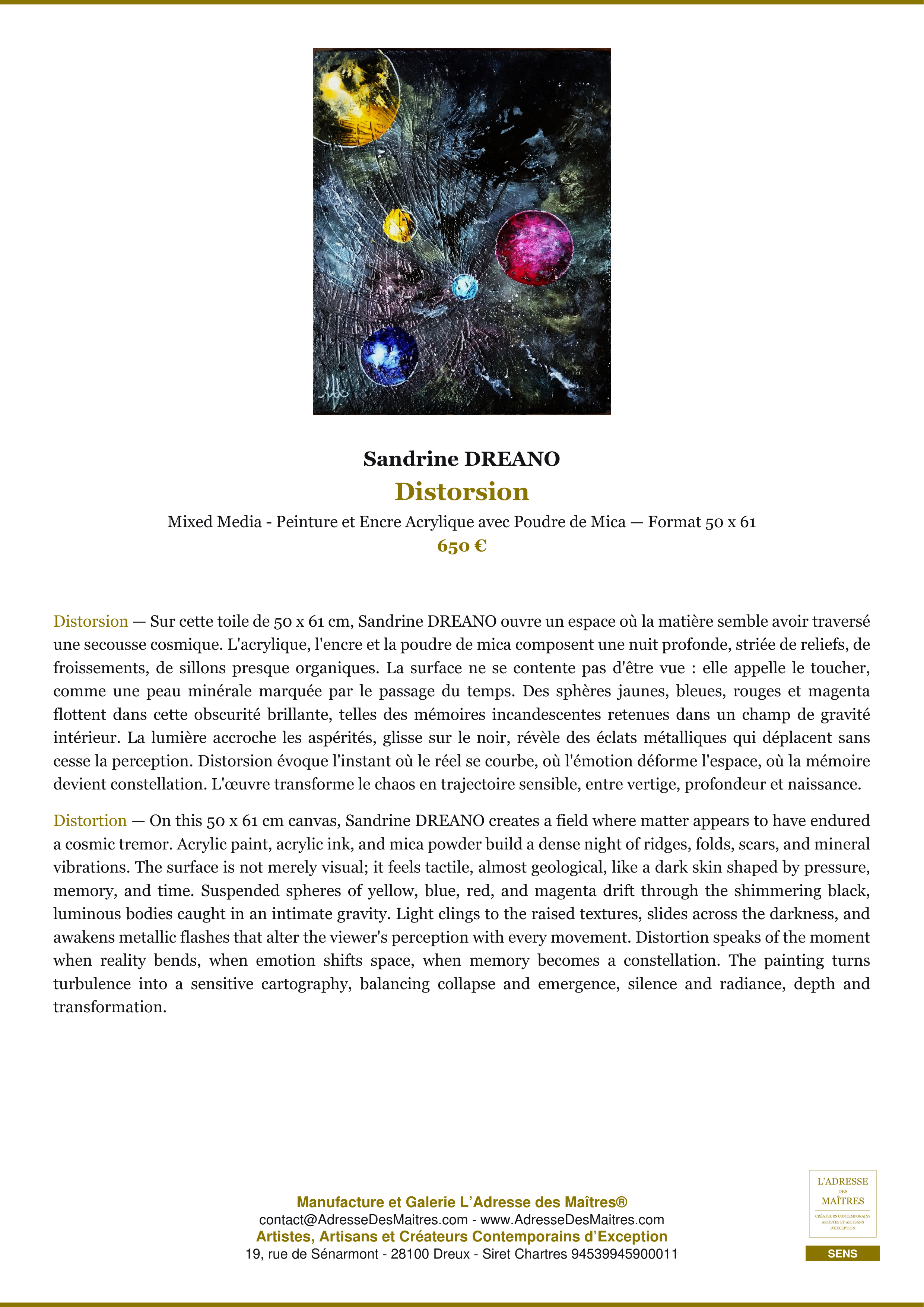
Sandrine DREANO, with 29 mixed-media works on canvas—including *Distorsion*—explores the interplay of media and perceptual distortion. Mixed media on canvas is particularly well-suited to a contemporary approach to lyrical abstraction: it allows for breaks in texture, contrasts in materials, and visual collisions. The title *Distorsion* resonates with the idea of a world depicted not in its stability, but captured in its tensions.
Joëlle METZGER-REVERDI, with 21 oil paintings—including *Visage de braise intérieure*—establishes a subtle connection between inner life and incandescence. Here again, without extrapolating beyond the available information, the title invites us to consider the embers as an image of intimate intensity. In the realm of abstract or semi-abstract painting, this notion of inner fire resonates with one of the driving forces of lyrical abstraction: making the pictorial material the site of an emotion that burns without necessarily telling a story.
Alexandra ANTHONY, with 18 mixed-media works using ink and acrylic—including *Le Jardin des Métamorphoses Ardentes*—combines mixed media, ink, and acrylic in a title where transformation and fervor converge. Ink and acrylic, through their distinct properties, can foster a style characterized by momentum, diffusion, and layering. The word “metamorphoses” opens up a particularly contemporary space: that of a nature that is not static, but constantly undergoing change.
These artists, brought together under the umbrella of an art gallery dedicated to contemporary expression, demonstrate that lyrical abstraction is not a closed style, but a method for approaching the visible and the invisible. At the Galerie d’Art L’Adresse des Maîtres® in Dreux, their presence invites viewers to see the material not merely as a surface, but as an active memory of the artist’s gesture.
Elements as partners, not as props
Contemporary artists are no longer content to use natural elements merely as poetic references. They increasingly view them as partners. Wind, water, light, and fire are not mere backdrops placed around the artwork; they become models of behavior. Wind teaches direction and dispersion. Water teaches fluidity, porosity, and erosion. Fire teaches intensity, disappearance, and transmutation. Light teaches appearance, withdrawal, and revelation.
This development is crucial. It reflects a contemporary sensibility in which nature is no longer perceived as a reservoir of available forms, but as a set of forces with which humans must come to terms. From this perspective, lyrical abstraction anticipates and accompanies our era. It does not dominate the landscape; it allows itself to be permeated by it. It transforms the painting into a space of encounter—and sometimes of confrontation—between human will and elemental forces.
Beyond Beauty: Emotional Resonance
If lyrical abstraction moves viewers so deeply, it is not merely because it creates beautiful surfaces. Beauty, in this context, is not enough. What moves us runs deeper: an emotional resonance that often predates words. When faced with a lyrical painting, the eye does not necessarily seek to understand; it recognizes an intensity. It rediscovers something of its own experience of the world: the build-up of tension, the calming of a flow, the radiance of joy, the trace of a burn.
As the discerning collector knows, a significant work of art is not one that captivates immediately, but one that continues to resonate after the first glance. Lyrical abstraction possesses this power of persistence. It accompanies the viewer; it transforms with the light, with distance, and with the viewer’s inner state. It does not convey a fixed message; rather, it opens up a realm of sensations.
This is why she occupies such a unique place incontemporary art and in the history of abstract painting. She reminds us that painting can still be an act of engagement with the world, a way of responding to the forces that surround and permeate us. At the L’Adresse des Maîtres® Art Gallery in Dreux, this approach finds a natural echo: that of an art gallery where material, gesture, and emotion remain at the heart of the encounter between the artwork and the viewer.
Check out our gallery
Would you like to experience these artistic movements firsthand? Visit the online gallery of L’Adresse des Maîtres®—featuring over 390 original works by contemporary artists.
Leave a comment