Digital Art — The Creative Revolution of the 21st Century
↓ Share this articleWhat is digital art?
Digital art refers to all artistic practices that use digital technologies as a tool for creation, distribution, or presentation. This can include computer-generated images, algorithm-generated works, interactive installations, augmented reality creations, or NFT art. At the intersection of contemporary art, computer science, and new media, digital art is transforming the way works are produced, viewed, collected, and exhibited.
Today, digital art is becoming increasingly prominent in galleries, art fairs, and online sales. It appeals to both enthusiasts of visual innovation and collectors interested in new forms of artistic ownership. This evolution is part of a rich history that began long before the rise of blockchain and artificial intelligence.
A History of Digital Art: From the 1960s to the Present
The history of digital art dates back to the 1960s, when certain artists and engineers began exploring the creative possibilities of computers. At that time, computers were bulky, expensive, and mainly confined to laboratories or institutions. Yet pioneers were already using code, mathematical patterns, and automated systems to produce novel forms. The idea that the computer could become a creative partner was born then.
In the 1970s and 1980s, the rise of personal computing led to a wider adoption of these practices. Artists began experimenting with digital imagery, animation, and video. Digital technology became a medium in its own right, rather than merely a technical tool. At the same time, interactive art emerged: viewers were no longer merely observers; they could sometimes influence the artwork.
The 1990s marked a turning point with the rise of the Internet. The web became at once a medium, a subject, and a space for exhibition. Net art emerged, based on the circulation of images, interactivity, and dematerialization. Artworks could be viewed anywhere, without necessarily existing as a single physical object.
During the 2000s and 2010s, creative software became more powerful and accessible. Graphics tablets, high-definition digital printing, 3D technology, and immersive installations further expanded the scope of digital art. Then, in the 2020s, two phenomena accelerated its visibility: AI art, driven by artificial intelligence tools, and NFTs, which introduced new ways to certify and sell digital works.
The Major Forms of Digital Art
Digital art is not a single style, but a diverse range of practices. Some are based on code, others on computer-generated imagery, and still others on audience interaction or immersive technologies.
Generative art
Generative art relies on the use of rules, algorithms, or automated systems that contribute to the visual creation process. The artist designs a framework, a program, or a transformation logic, and then allows the system to generate variations. This does not imply a lack of human creativity; on the contrary, the artist defines the parameters, the aesthetic choices, and the intent of the work.
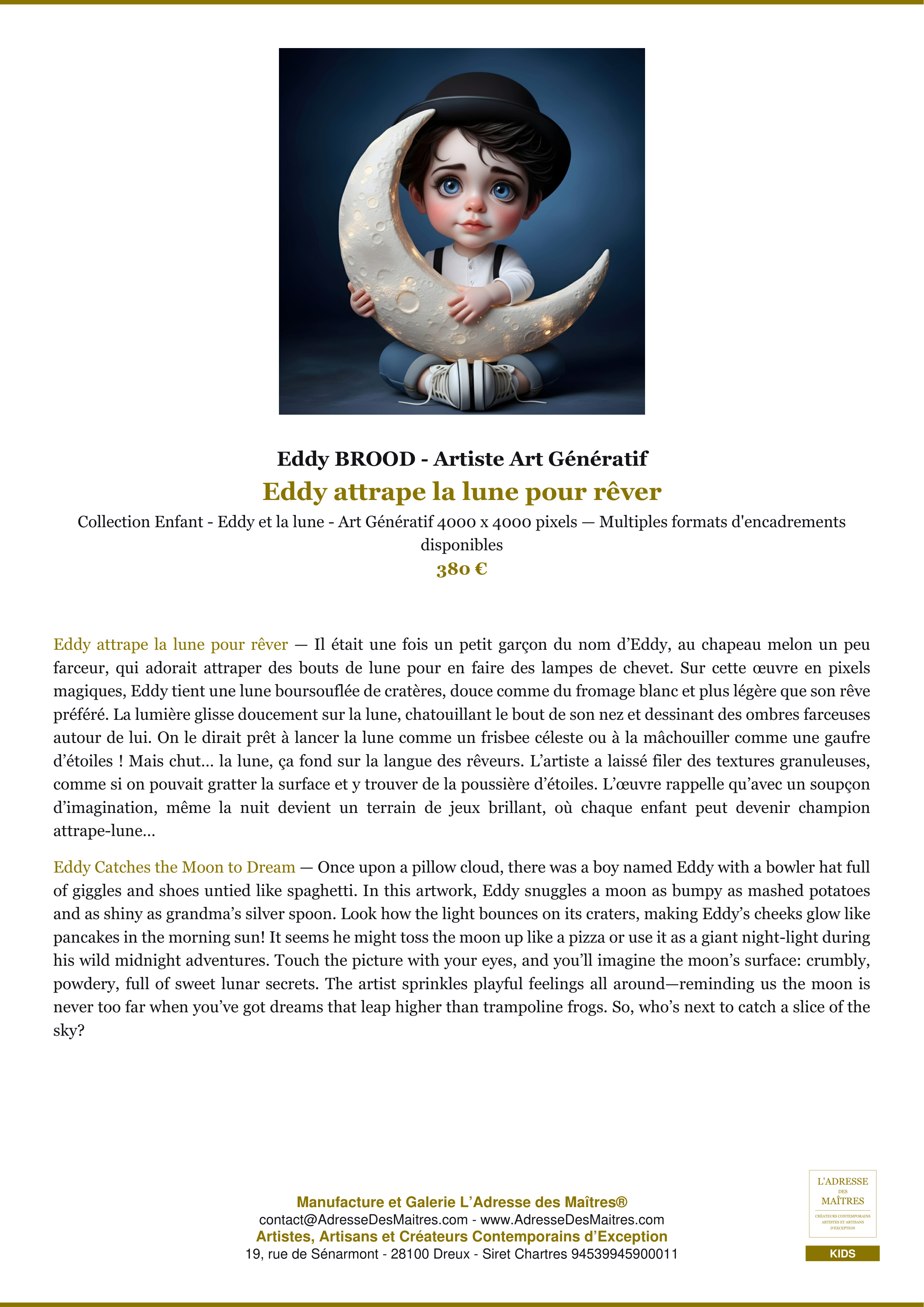
In this field, the L’Adresse des Maîtres® Art Gallery in Dreux showcases several artists associated with this practice. Eddy BROOD is featured there as a generative artist with 14 works of generative art, including “Eddy Catches the Moon to Dream.” This exhibition demonstrates the richness of the generative art movement: a single approach can produce a coherent body of work while still allowing for variation. It also illustrates how code and visual systems can become an artistic language in their own right—one that is recognizable and conveys an intention unique to each artist.
AI art
AI art, or art created using artificial intelligence, has recently become a major topic of discussion in the art world. In this context, artists use AI models to generate, transform, or enhance images. These tools can produce compositions based on textual instructions, recreate artistic styles, or create complex visual worlds in a matter of moments.
This practice raises important questions: how much of the credit goes to the artist, and how much to the tool? Does AI replace the human hand, or does it become a new kind of brush? In reality, within a demanding artistic context, artificial intelligence is often just one tool among many. The work lies in the selection, direction, editing, composition, intention, and coherence of the final result.
Augmented reality
Augmented reality adds digital elements to the real world, often through a smartphone, tablet, or specialized glasses. In the art world, it allows animations, information, or virtual forms to be superimposed onto a physical artwork or exhibition space. An art gallery can thus offer an enriched experience, where visitors discover multiple layers of interpretation.
This form of digital art is of particular interest to institutions and physical galleries because it bridges the gap between physical presence and digital content. It revitalizes the visual experience without severing the connection to the physical space.
NFTs
NFTs, or non-fungible tokens, are digital certificates recorded on a blockchain. In the realm of NFT art, they are used to link a work of art to a unique, traceable, and verifiable record. An NFT is not necessarily the same as the image itself; rather, it acts as a title, certificate, or proof of ownership, depending on the terms defined at the time of sale.
NFTs have brought significant visibility to digital art by enabling the creation of rare, digital works. They have also attracted new collectors who are already familiar with digital environments. The L’Adresse des Maîtres® Art Gallery in Dreux is embracing this trend by offering NFTs as well, demonstrating its openness to new developments in the contemporary art market.
Tools for creating digital art
Digital artists today have access to a wide variety of tools. Graphic design and image editing software allows them to compose, paint, manipulate, and finalize images. Other software is specialized in animation, 3D, generative design, or immersive environments. The choice of tool always depends on the artistic project: still image, video, installation, interactive artwork, or NFT art.
Graphics tablets also play a central role. They offer a more natural way of interacting than a mouse and bring digital drawing closer to traditional drawing techniques. For many artists, they enable direct, precise, and fluid expression.
Some of the works on display in the gallery illustrate this aspect: the creation of an image conceived specifically for the digital medium itself, characterized by a masterful use of formal choices and rooted in a distinct artistic approach.
Finally, artificial intelligence now rounds out this suite of tools. It does not replace traditional software, but it expands the possibilities for visual research, form generation, and conceptual exploration. Artists can use it to generate ideas, create variations, or build a final work.
Authenticity, originality, and certification in digital art
One of the major issues in digital art concerns authenticity. Unlike a painting or a sculpture, a digital image can be copied endlessly without any loss of quality. So how can we distinguish the original from the copy? How can we verify that a work truly belongs to a collector?
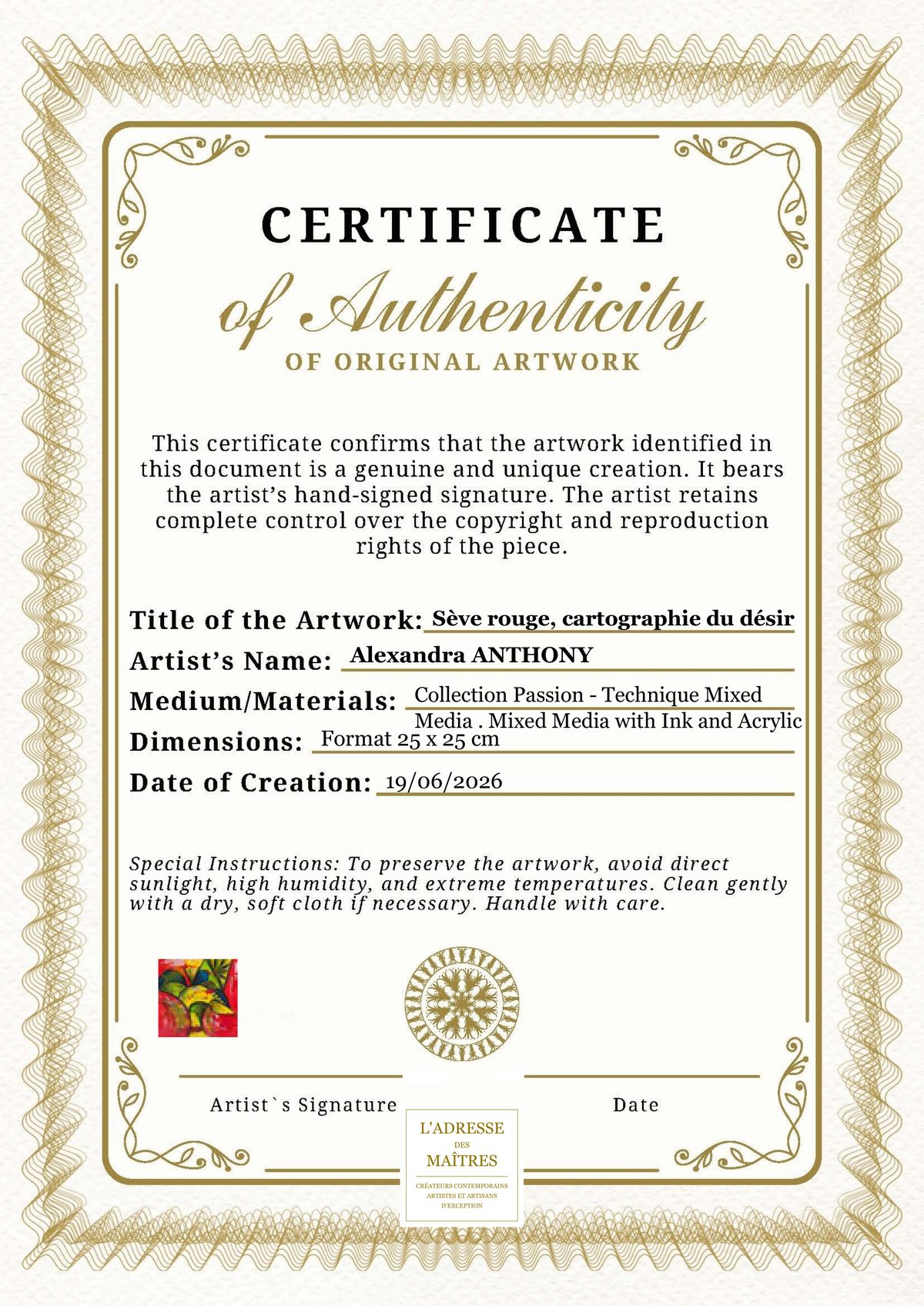
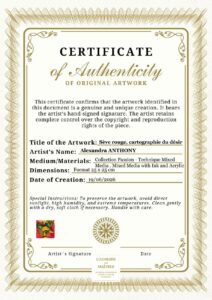
There are several options available. Some works come with a certificate of authenticity issued by the artist or the art gallery. This document specifies the work’s identity, its creator, its format, whether it is part of a limited edition, and the terms of distribution. In the case of a limited edition, it also indicates the number of authorized copies.
NFTs offer another solution: blockchain technology allows for the recording of proof of ownership and transaction history. While this does not resolve all legal or artistic issues, it does create a new level of traceability. It remains essential to verify exactly what the buyer is acquiring: a file, a certificate, a right of use, or a broader set of rights defined by the sales contract.
In any case, trust in the gallery, the clarity of the information provided, and the quality of the documentation remain essential for serious collecting of digital art.
How to Buy and Collect Digital Art
Buying digital art requires a few specific considerations. The first is to clearly identify the work: is it a one-of-a-kind piece, a limited edition, a signed digital file, a print accompanied by a certificate, or an NFT? You should then verify the artist, the gallery presenting the work, the storage conditions, and any associated rights.
Collectors can purchase art from galleries, specialized platforms, private sales, or directly from artists. At a physical gallery, personalized assistance is often a valuable asset: advice, insight into the creative process, authentication, guidance, and post-purchase support. This is particularly helpful in a field where the technical aspects may seem complex at first.
Collecting NFT art also requires familiarity with certain tools: digital wallets, the blockchain used, transaction fees, and access security. Even though the technology is appealing, the logic behind collecting remains similar to that of contemporary art: looking, comparing, understanding an artist’s approach, and choosing a piece that resonates.
To start with, it is recommended that you focus on established artists or galleries, request comprehensive documentation, and place as much emphasis on artistic quality as on technological innovation.
The Future of Digital Art in Physical Galleries
Far from undermining traditional art galleries, digital art opens up new possibilities for them. Physical galleries remain essential venues for discovery, dialogue, and contextualization. Viewing a work on a screen, in a curated space, or as part of an exhibition that combines digital and physical works profoundly changes the audience’s experience.
In the future, galleries are expected to increasingly adopt hybrid formats: high-quality screens, augmented reality artworks, blockchain certificates, digital editions accompanied by physical objects, and exhibitions that blend contemporary art, digital art, and NFT art. This evolution does not replace traditional exhibition design; it enriches it.
The L’Adresse des Maîtres® Art Gallery in Dreux exemplifies this trend by featuring artists associated with generative art and digital art, while also highlighting its NFTs. Through the inclusion of Eddy BROOD, it demonstrates that digital art can be presented in an art gallery setting with sophistication, clarity, and an openness to new forms of collecting.
Conclusion
Digital art has established itself as one of the major creative fields of our time. Emerging from the early computer experiments of the 1960s, it now encompasses generative art, AI art, augmented reality, and NFTs. Its tools are diversifying, its markets are taking shape, and issues of authenticity are gradually being addressed through certificates and blockchains.
For both the general public and collectors, this is not merely a technological phenomenon, but a genuine field within contemporary art. Physical galleries have a major role to play here: they make these practices visible, understandable, and desirable. In this context, an art gallery like L’Adresse des Maîtres® in Dreux helps bring digital art into tangible spaces for interaction, connecting with artists, works, and new approaches to collecting.
Check out our gallery
Vous souhaitez découvrir ces courants artistiques en vrai ? Visitez la galerie en ligne de L’Adresse des Maîtres® : plus de 1633 œuvres originales d’artistes contemporains.
Leave a comment