Contemporary Art as Cultural Heritage — Investing to Preserve and Pass On
↓ Share this articleContemporary Art as Cultural Heritage: A Sustainable Approach to Collecting
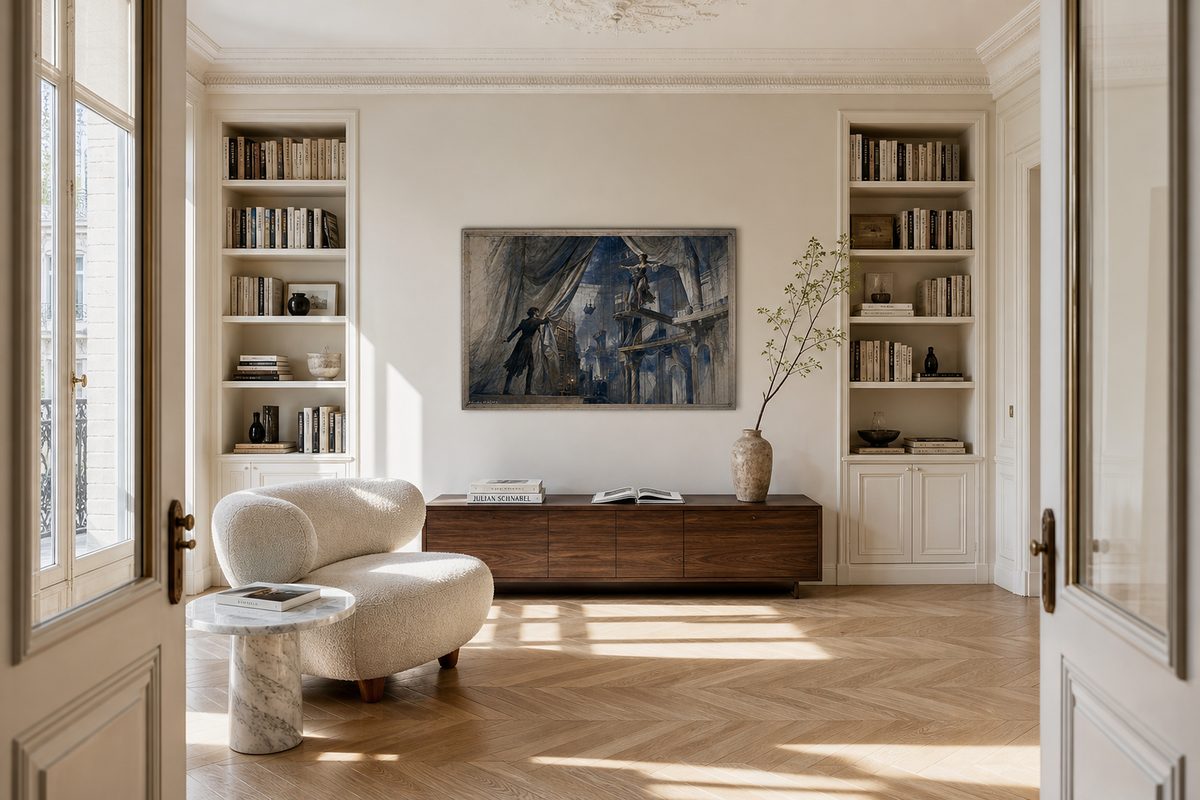
When we talk aboutart as heritage, we view a work not only as an aesthetic object, but also as a cultural asset that can be passed down, is well-documented, and is rooted in time. Contemporary art now plays an important role in this discussion: it allows for the creation of a living collection, connected to artists and galleries, while building a personal, family, or institutional heritage. Contrary to popular belief,investing in contemporary art is not merely about quick returns. It can be a long-term endeavor, based on quality, consistency, preservation, and transmission.
From this perspective, a gallery such as the Galerie d’Art L’Adresse des Maîtres® in Dreux plays an essential role as a cultural intermediary. It allows collectors to encounter works of art, identify techniques, compare artistic approaches, and gradually build a collection that serves as a legacy. The heritage value of a work often stems from this interplay between emotion, artistic rigor, documentation, and its place within the history of a collection.
Art as an Investment Asset: Market History and Statistics
Art has long been recognized as a heritage asset. Over the centuries, prominent families, patrons, religious institutions, and later museums and private collectors have assembled collections of works that have become cultural landmarks. Beginning in the 20th century, the art market became strongly structured around galleries, auction houses, international art fairs, foundations, and museums. Modern art, followed by contemporary art, gradually took on a major role in collecting strategies.
The global art market is now worth tens of billions of dollars a year. According to major international studies published in recent years, it generally hovers around $60 to $70 billion, depending on the period and economic cycles. The United States, the United Kingdom, China, and France are among the most important art markets. France maintains a strong position in continental Europe, driven by Paris, its art fairs, auction houses, galleries, and museum network.
Contemporary art accounts for a significant portion of this market, particularly because it offers a wide range of entry-level prices. A collector can acquire a work by a living artist at prices that are still affordable, long before the artist’s institutional or commercial recognition is established. This is precisely what makesinvesting in contemporary art both attractive and challenging: it requires discernment, time, and a solid understanding of the criteria for quality.
Speculation or the creation of a lasting artistic legacy?
Speculation involves purchasing a work of art primarily in the hope of reselling it quickly at a profit. This approach can be found in the contemporary art market, especially when certain artists enjoy high media visibility or achieve spectacular results at auction. However, it carries significant risks: passing trends, price volatility, lack of liquidity, transaction costs, taxation, and uncertainty about future demand.
Building a lasting artistic legacy requires a different approach. It prioritizes the coherence of the collection, the quality of the works, the thoroughness of the documentation, the condition of the works, and the ability to pass them on. The collector is not merely seeking financial returns; he or she is building a meaningful body of work. A work of artistic heritage is one that can be viewed for a long time, explained, preserved, loaned, passed on, or woven into a family’s history.
This distinction is fundamental. A speculative purchase may be isolated, impulsive, and market-driven. A collection-oriented purchase, on the other hand, is part of a broader strategy: Why this work? What role does it play in the collection? What technique does it employ? Is it well documented? Can it be insured, restored, and passed on? True art collecting is built over time, with patience and method.
Criteria for Selecting a Work of Cultural Heritage Significance
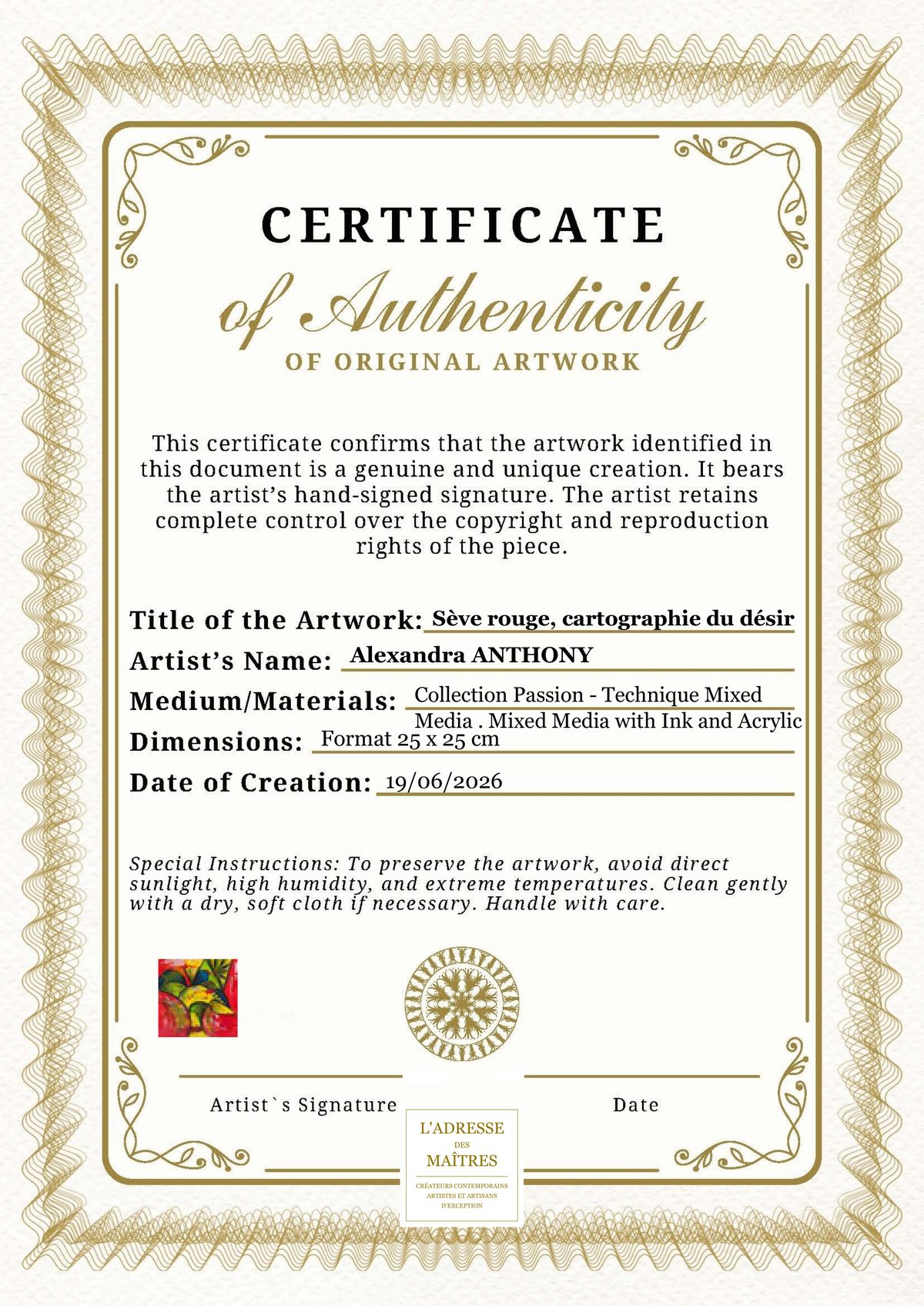
To select a work of art for inclusion in a collection, several criteria must be taken into account. The first is authenticity. The work must be clearly attributed, signed where applicable, and accompanied by an invoice, a certificate, or evidence of provenance. The second criterion is artistic quality: composition, technical mastery, visual impact, originality, and connection to a recognizable artistic approach.
Rarity also plays a role. A unique work, a piece characteristic of a particular period, or a creation representative of a coherent body of work may have greater heritage value. The condition of the work is just as essential: a fragile, poorly preserved, or damaged work may lose its aesthetic and financial value. Therefore, the conditions for storage, framing, display, and restoration must be planned in advance.
The coherence of the collection is another important criterion. A collection built around a theme, a technique, a generation of artists, or a region can become more accessible. It is with this in mind that a collector might take an interest in the groups of works presented by a gallery, noting the connections between techniques, formats, and artistic approaches. Heritage value lies not only in each individual work but also in the way the works interact with one another.
The L’Adresse des Maîtres® Art Gallery in Dreux: Artists and Techniques with a Focus on Cultural Heritage
The L’Adresse des Maîtres® Art Gallery in Dreux features, among others, several artists whose works can spark reflection on contemporary art as cultural heritage. When building a collection, it is helpful to consider the number of available works, the techniques used, and representative titles, as these elements help document a body of work.
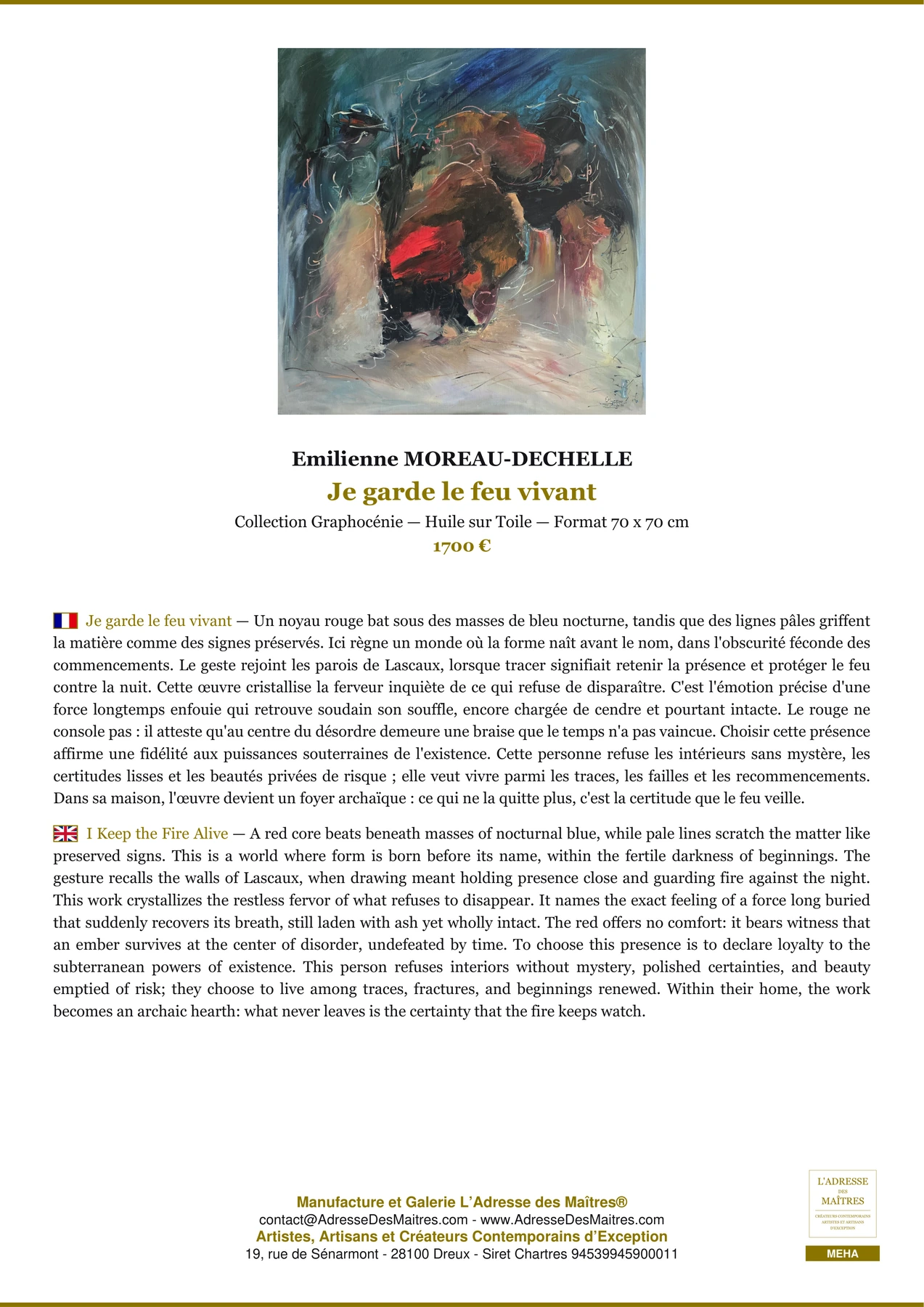
Emilienne MOREAU-DECHELLE has created 41 oil paintings, including *Passage sous les braises*. As a technique, oil painting offers a material depth, the ability to build up layers, and durability that are of particular interest from a heritage perspective. The number of works mentioned also suggests a body of work substantial enough for a collector wishing to track a recognizable body of work.
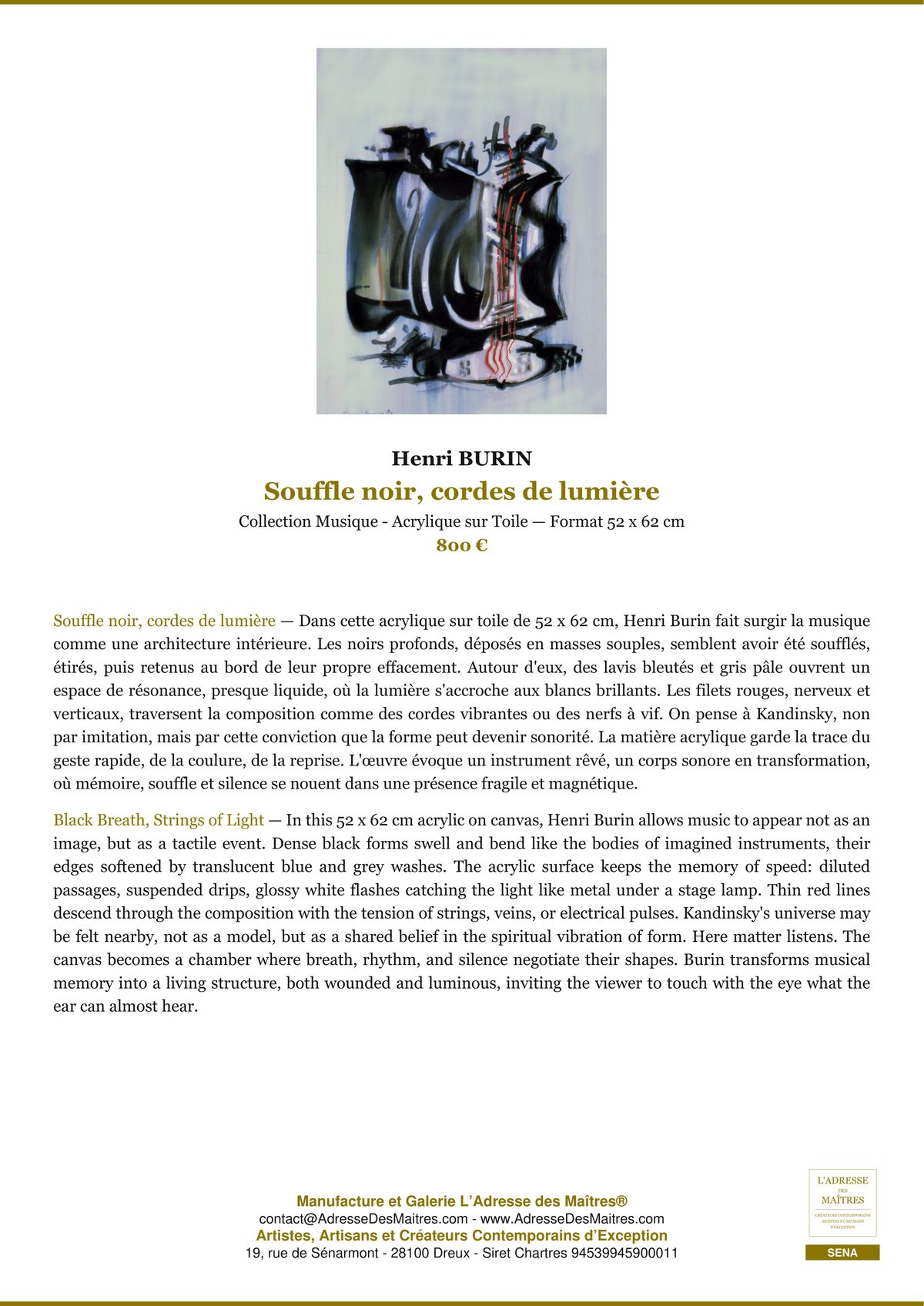
Henri BURIN is represented by 40 acrylic paintings, including *La contrebasse rêve sous rideau*. Acrylic, due to its quick drying time and stability, plays an important role in contemporary art. It can offer a different interpretation of the pictorial medium and fit well into a collection that values technical diversity. For an artistic legacy, the presence of a substantial body of work in acrylic allows for the study of the coherence of a body of work over time.
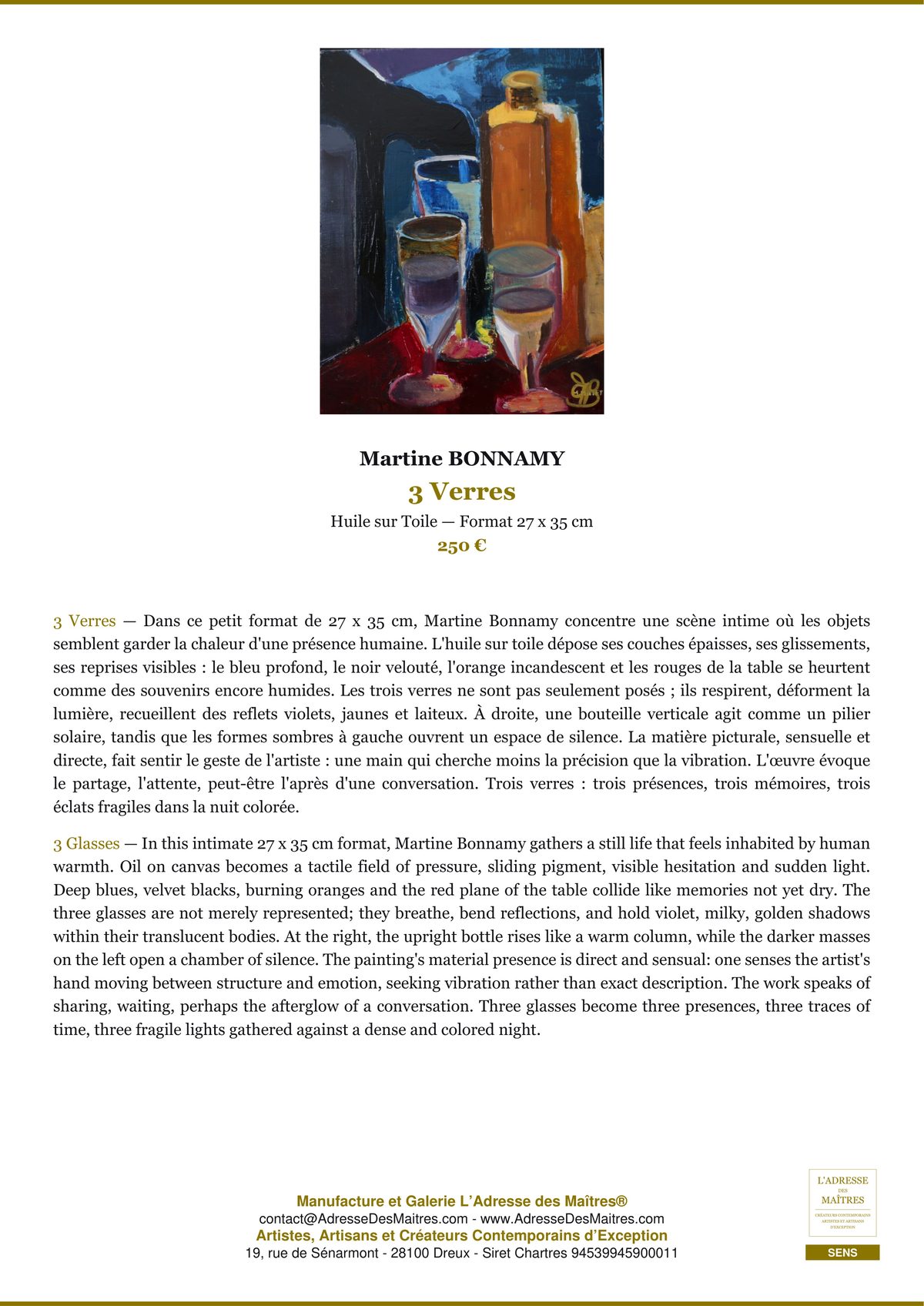
Martine BONNAMY has created 36 oil paintings, including *Céruléenne, mémoire d’un rivage*. Oil painting is historically linked to the great traditions of painting, yet it remains thoroughly contemporary when used by today’s artists. From the perspectiveof art as cultural heritage, this technique appeals for its chromatic depth, its potential for long-term preservation, and its continuity with the history of painting.
Joëlle METZGER-REVERDI is associated with 21 oil paintings, including *Visage de braise intérieure*. A heritage collection can draw on this type of body of work to explore the power of oil as a medium of density, texture, and permanence. The title cited—without the need to extrapolate its meaning—provides a precise reference point for documenting the work within an inventory.
Sylvia BEAUCHAIN presents 14 oil paintings, including *La mémoire des courants*. Here again, oil painting offers collectors a medium traditionally recognized for its durability. The number of works allows for the identification of a more cohesive group, which may appeal to a collector seeking a focused selection with a view to building a collection to be passed down through generations.
Legal and Tax Issues: Gifts, Inheritance, and the Malraux Law
In France, a work of art is considered personal property that can be bought, sold, donated, or passed down through inheritance. When a work of art is donated or inherited, its value must be carefully appraised, ideally by a professional: an auctioneer, appraiser, gallery owner, or recognized specialist. This appraisal serves as the basis for calculating any applicable gift or inheritance taxes, depending on the family relationship and the applicable tax exemptions.
A donation allows one to plan for the transfer of assets in advance. It can take the form of a simple donation, a shared donation, or a bequest in a will. For a significant collection, it is advisable to consult a notary to avoid conflicts among heirs and to plan for the distribution of the works. In certain specific cases, a work of art may also be used as payment in kind, when the government accepts a cultural asset of great significance as payment for tax liabilities. This procedure remains strictly regulated and selective.
From a tax perspective, the sale of a work of art may be subject to the tax regime for works of art or, optionally and under certain conditions, to the actual capital gains tax regime. The specific terms depend, in particular, on the price, the length of ownership, and the ability to prove the purchase price. It is therefore essential to keep invoices and purchase documents. For businesses, the acquisition of works by living artists may, under certain conditions, qualify for a spread-out tax deduction, particularly if the work is displayed to the public or in a location accessible to employees or visitors.
The Malraux Law, for its part, primarily concerns the restoration of buildings located in certain protected heritage areas. It is not a program for purchasing contemporary artworks. However, it is part of a broader effort to promote cultural heritage. A collector who owns a restored property in a heritage setting may incorporate considerations regarding the exhibition, conservation, and presentation of contemporary artworks into that property, provided that a clear distinction is made between the real estate arrangements and the management of the artworks.
How to Document and Preserve a Collection
A heritage collection must be thoroughly documented. Each work should have a record card listing the artist’s name, title, medium, dimensions, date (if known), provenance, purchase price, invoice, any certificate of authenticity, high-quality photographs, and a condition report. This documentation facilitates insurance, resale, donation, loan for exhibition, or transfer within the family.
It is also recommended that you keep all correspondence with the gallery, catalogs, exhibition descriptions, exhibition invitations, and any other materials that help contextualize the artwork. In the case of a purchase from the Galerie d’Art L’Adresse des Maîtres® in Dreux, information regarding the medium, title, and artist must be included in the inventory. A well-documented collection is easier to defend legally, for tax purposes, and in terms of estate planning.
Insurance is an often-overlooked step. A standard home insurance policy may not be sufficient to adequately cover a collection. It is best to declare valuable works, request a specific coverage extension, or purchase specialized insurance. Some policies cover theft, fire, water damage, transportation, or temporary exhibition. For valuable works, regular appraisals allow you to adjust the insured amounts.
Passing on a Collection: Museum, Auction, or Family Inheritance
Transferring ownership is the natural culmination of a cultural heritage strategy. Several options are available. Donating a work to a museum can help preserve it in a public setting, but it requires the institution’s approval, as it assesses the work’s relevance to its collections. A bequest can also be provided for in a will, with or without specific conditions.
An auction is another option. It offers visibility, a public appraisal, and competition among buyers. It may be appropriate when a family does not wish to keep the works or when an estate must be divided. However, the costs, time involved, and uncertainty of the outcome must be taken into account. A sale through a gallery or a private sale may sometimes be more discreet and better targeted.
Finally, passing a collection down through the family remains the preferred solution when descendants wish to preserve it. In such cases, it is helpful to pass on not only the works themselves, but also their history: why they were chosen, from whom they were acquired, and what role they played in the collector’s life. An inherited art collection is not limited to its financial value; it embodies memories, taste, and a connection to the creative process.
Building an artistic legacy with method and purpose
Contemporary art can become a solid part of one’s heritage when it is acquired with discernment, documented with precision, and passed on with foresight.Investing in contemporary art should not be confused with a promise of quick profits. Rather, it is a long-term commitment, where aesthetic emotion meets heritage-conscious rigor.
By relying on established galleries, such as the Galerie d’Art L’Adresse des Maîtres® in Dreux, collectors can organize their choices, compare techniques, and gradually build a cohesive collection. Whether it’s oil or acrylic painting, a large collection or a more select group of works, each piece can contribute to a lasting artistic legacy if it is chosen, preserved, and passed on with care.
Check out our gallery
Would you like to experience these artistic movements in person? Visit the online gallery of L’Adresse des Maîtres®—more than 606 original works by contemporary artists.

Leave a comment