The Fragility of Materials — When the Ephemeral Becomes a Subject in Contemporary Art
↓ Share this articleFragile Materials in Art: The Silent Power of What Might Disappear
In contemporary art, certain works seem to reach out to us with an almost disarming modesty: a veil of ash, a surface of sand, a plant fiber, raw wood barely tamed, silk knotted with extreme patience. They do not seek to defy time through monumentality, nor to proclaim their permanence through bronze, marble, or steel. On the contrary, they embrace a form of vulnerability. This fragility is not a weakness: it is a language. It shifts the gaze from the spectacular to attentiveness, from possession to presence.
Fragile materials in art are not merely a matter of a taste for the ephemeral. They embody a way of seeing. Ash does not need to explain that it was once fire; sand need not speak of erosion; mineral pigments carry within them the memory of the earth; plant fibers evoke growth, cutting, and weaving; raw wood reveals its grain like a slow form of writing; and silk, finally, gives light a tangible quality. In these works made of natural materials, the material is not merely a medium: it becomes an aesthetic subject.
Impermanence as an aesthetic choice, not as a discourse
Contemporary ephemeral art is often associated with a message: a critique of consumerism, a denunciation of illusory permanence, or a reflection on ecology or disappearance. These interpretations certainly exist. But they are not enough. We must also consider impermanence as a purely aesthetic choice, one that is almost classical in its demands. A fragile work can be just as powerful as a so-called eternal work because it imposes a different quality of presence.
Marble impresses with its durability; ash unsettles with its impermanence. One promises to last; the other demands to be viewed in the present moment. Sand, even when fixed in place, retains the image of a material prone to scattering. Mineral pigments, when they emerge without being overly tamed by the binder, retain something of their rocky origin. Plant fibers—linen, hemp, raffia, or paper—infuse the work with an organic vitality. Raw wood, with its irregularities, rejects industrial perfection. Silk, a noble yet delicate material, captures air, light, and moisture, reminding us that beauty is not always synonymous with invulnerability.
There is a lesson here in how to look. When faced with a fragile work of art, the viewer does not simply consume an image: he or she acknowledges a presence. The surface becomes an event. The slightest imperfection, the slightest variation in texture, the slightest shift in light—all matter. The work does not reveal itself as a certainty; it presents itself as an encounter.
The memento mori without fanfare
The tradition of memento mori runs through the history of Western art: skulls, wilted flowers, hourglasses, ripe fruit, and burned-out candles. It served as a reminder that all life comes to an end, that all splendor is fleeting. Contemporary art often draws on this tradition, but it shifts its focus. It no longer needs explicit symbols; the material itself is enough.
A trace of ash evokes time without representing it. An ink wash applied to an absorbent surface captures the moment when the gesture ceased. A ceramic piece retains the memory of the fire that transformed it. A textile preserves the tension of the thread, the rhythm of the hand, and sometimes even the fragility of use. A silk rug reveals, knot by knot, a duration that has become form. The contemporary memento mori is no longer necessarily a scene: it can be a texture.
That is precisely what makes these works so relevant today. They do not preach about time; they let it reveal itself. They do not tell us, “Remember that you are going to die.” Rather, they whisper, “Look how everything passes, and how beautiful that passing can be.” This nuance is essential. It distinguishes the sentimental work from the profound one, the overly explicit symbol from the apt representation.
In Dreux, a keen eye for materials and surfaces
From this perspective, the L’Adresse des Maîtres® Art Gallery in Dreux offers a particularly fascinating setting for collectors who pay close attention to surfaces, textures, and materials. Several artists featured by the gallery resonate with this aesthetic of fragility, each through their own unique technique, without the need to attribute intentions to them that lie outside the works themselves.
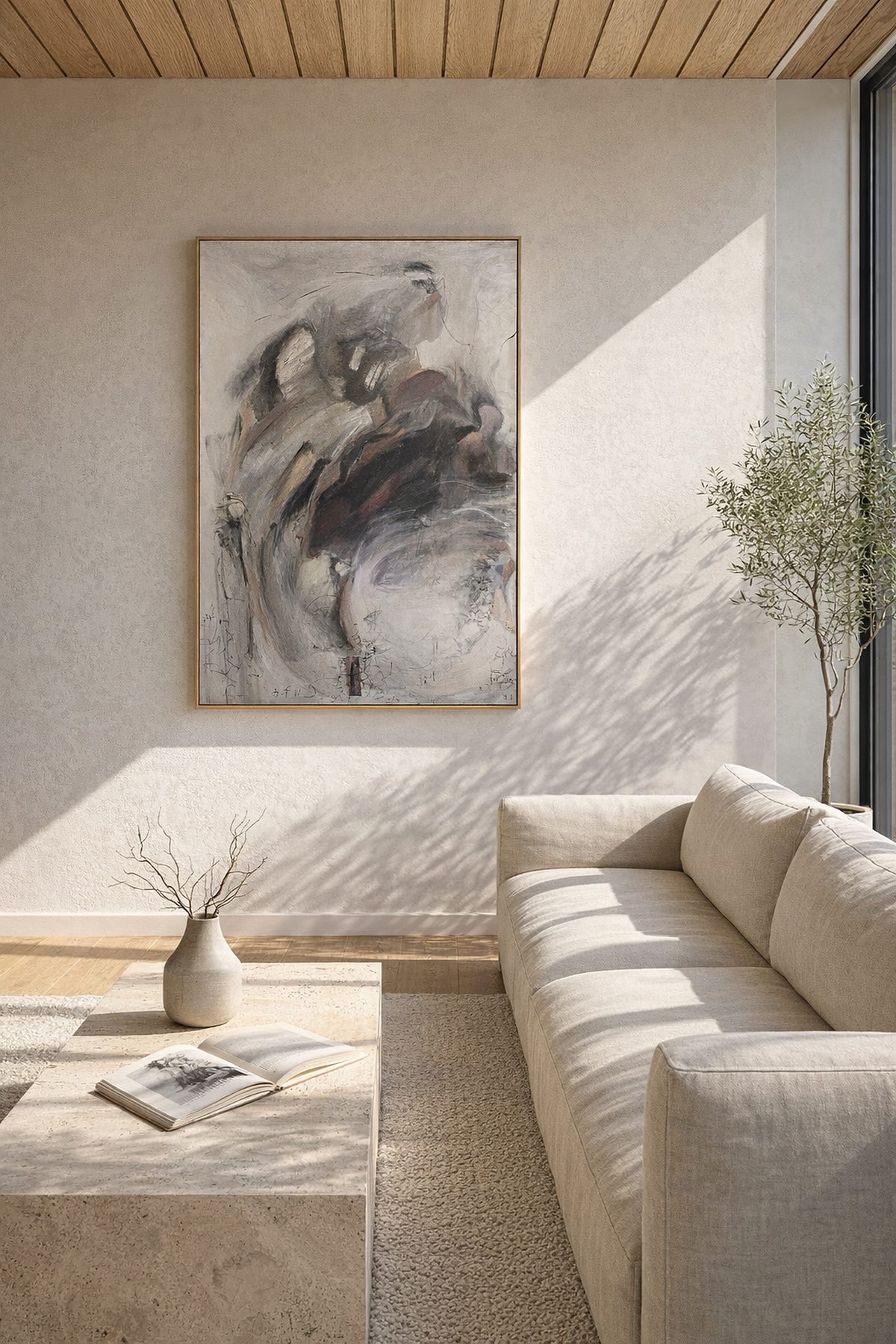
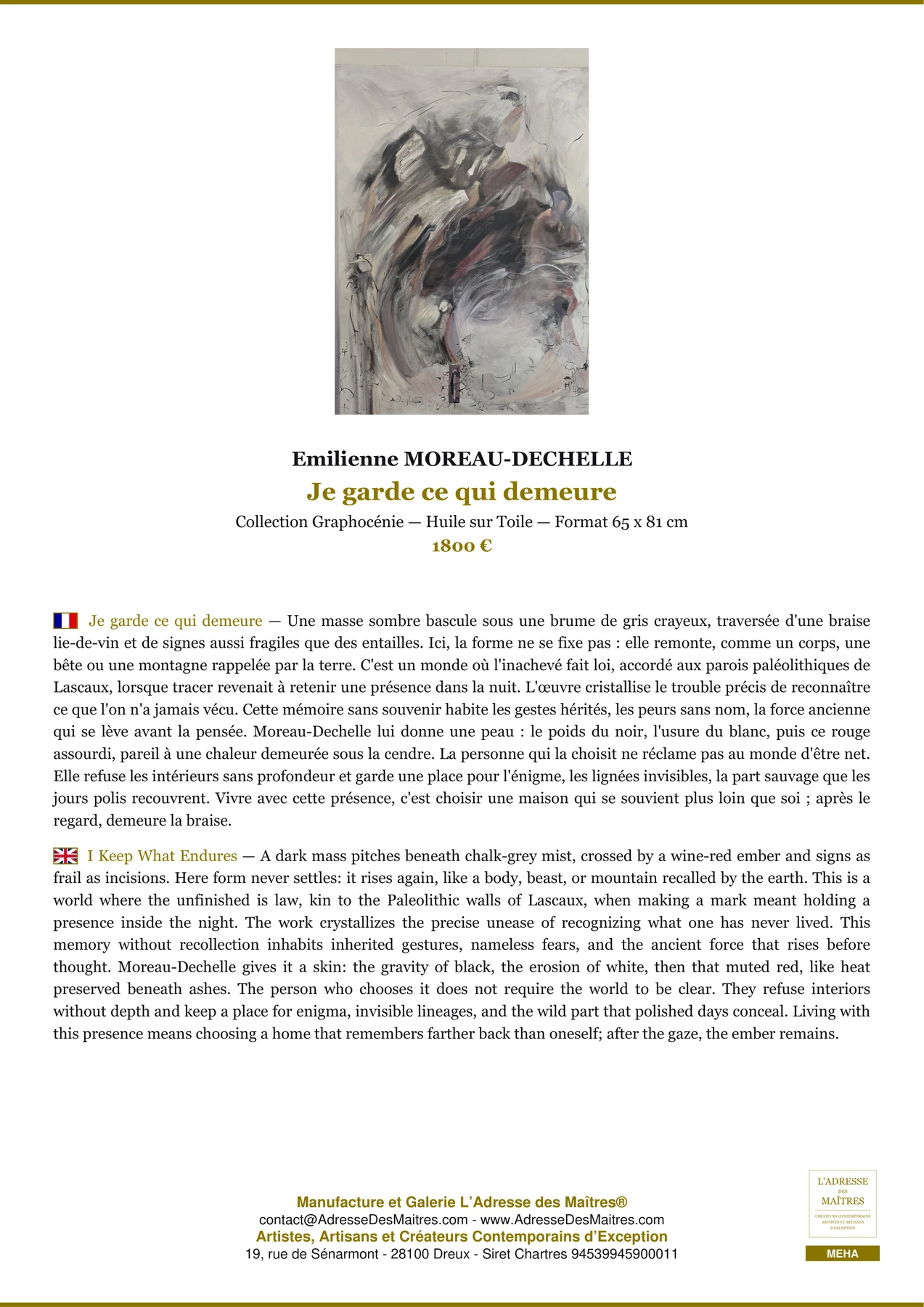
Emilienne MOREAU-DECHELLE, with three oil paintings—including *La mémoire des cendres*—brings the theme of ash into the realm of oil painting. The title evokes a residual, almost intangible substance, while the oil painting technique lends the work a sense of slowness, depth, and layering. This dialogue between pictorial density and the concept of ash places the work in a fruitful tension between the permanence of the medium and the fragility of memory.
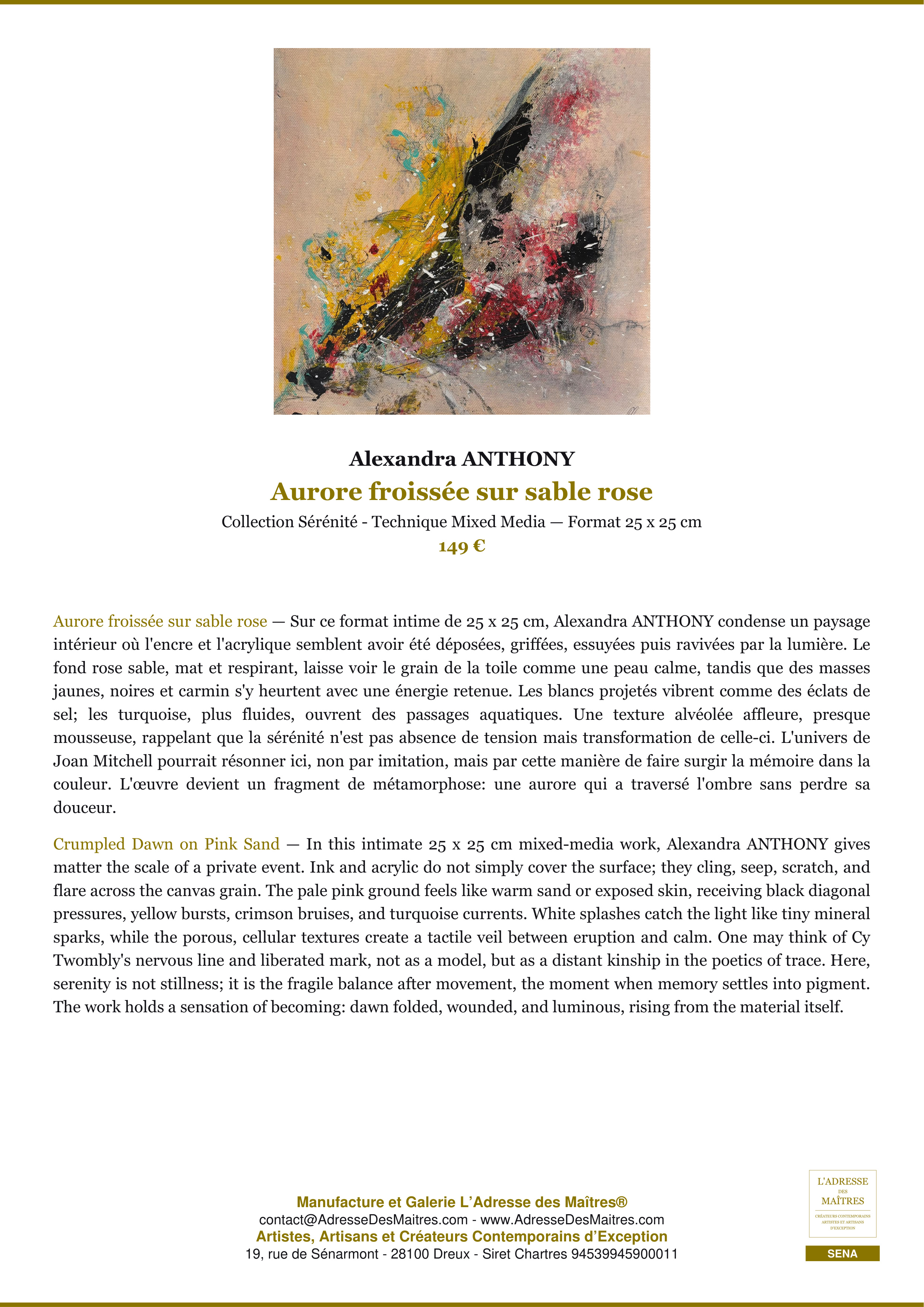
Alexandra ANTHONY, exhibiting two mixed-media works using ink and acrylic—including *Aurore froissée sur sable rose*—brings an approach rooted in layering, ink, acrylic, and the evocation of tactile surfaces. The title brings together the first light of dawn, crumpled texture, and sand: three elements that speak less of the monumental than of the fleeting moment. Here, mixed media allows the work to be viewed as a space of transitions, layers, and traces.
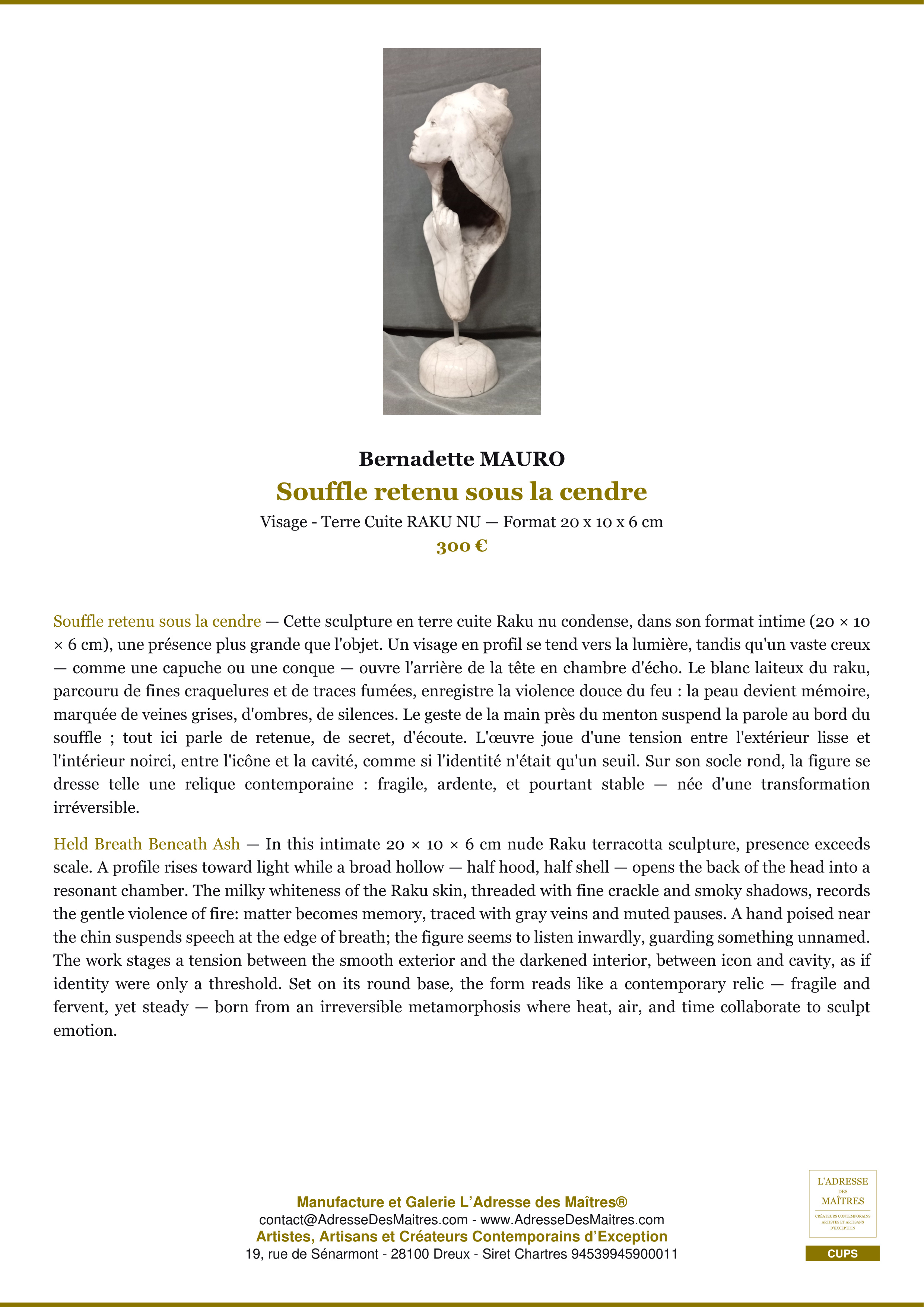
Bernadette MAURO, with two ceramic works—including *Souffle retenu sous la cendre*—introduces another form of fragility: that of ceramics. Born of earth and fire, it is at once resilient and breakable, archaic and delicate. The title, by associating breath and ash, brings to the surface a tension between that which breathes and that which remains after combustion. Ceramics thus become a material of the threshold.
Cécile KUSS-VARGAS, with two works in the Fine Textile Furniture category—including *Jardin d’ailes* on velvet—elevates textiles to an artistic and sensory dimension. Velvet, with its tactile depth, shifting sheen, and intimate relationship with light, is very much among those natural or textile materials that alter our perception depending on distance and lighting. Textile furniture thus becomes more than just a functional object: it is a presence shaped by the fiber.
Joëlle METZGER-REVERDI, with her oil painting *Cendre lente sur la peau* (*Slow Ash on the Skin*), also embraces this poetics of fragile materials. Oil, a medium traditionally associated with durability, is juxtaposed in the title with ash and skin—two images of vulnerability. The painting becomes a space where slowness is embodied, where the pictorial surface can be viewed as the skin of time.
Hereke silk: a noble, vibrant material, woven through time
Among the most striking examples of natural materials elevated to the status of art, the Hereke silk art rugs in the collection hold a unique place. Silk is not a neutral material. It possesses its own luminosity, suppleness, and delicacy that shift depending on the angle from which it is viewed. In a Hereke silk art rug, each knot encapsulates a gesture, a moment of attention, and a span of time. It is not merely a decorative object: it is a surface crafted through the patient repetition of a manual act.
The tradition of Hereke carpets is associated with exceptionally fine craftsmanship. But what matters here, beyond technical virtuosity, is the transformation of natural fiber into a work of art. Silk, fragile in appearance, becomes structure. It bears the design, holds the color, and reflects light. It is not static: it comes alive with the space, with the viewer’s movement, and with the quality of the light. A silk rug is never seen exactly the same way in the morning as in the evening, or under cool light as under warm light.
In the Hereke silk art rugs of the collection, the craftsman becomes an artist through the precision of his movements and his understanding of the material. Knot by knot, the hand gives shape to an image that is not merely superimposed on a surface: it is the surface itself. This fusion of material, technique, and motif resonates with the most current concerns of contemporary art, where the surface is no longer secondary but central.
Preserve what seems vulnerable
The apparent fragility of these works does not mean they are doomed to disappear quickly. The field of conservation has developed precise methods for preserving works made of natural materials without altering them. The first rule is to understand the nature of the material. A work containing mineral pigments is not conserved in the same way as a textile; a ceramic is not treated the same way as a sandy surface; and an oil painting is not treated the same way as silk.
For powdery materials—ash, sand, and pigments that are not fully bound—fixation techniques can be used, employing appropriate resins, binders, or fixatives applied in a way that stabilizes the surface without stifling its vibrancy. Framing also plays a major role: American-style frames, museum-grade glass, UV-protective glass, and mounting methods that avoid direct contact with the surface help protect the artwork while preserving its visual presence.
Textiles, plant fibers, and silk require special attention to environmental conditions. Relative humidity, temperature, and light must be controlled. Excessive UV exposure can cause colors to fade; excessive humidity can weaken the fibers; and air that is too dry can make them brittle. Hereke silk art rugs, like any precious textile work, benefit from being displayed under stable conditions, with occasional rotation of the display and appropriate supports.
Raw wood also requires a stable environment: it reacts to changes in humidity and can expand, contract, or split. Ceramics, often perceived as stable, remain susceptible to impact. As for oil paintings, their preservation depends on the quality of the support, the paint layer, the framing, and protection against climatic variations. Thus, fragility is not inevitable; it is a factor that must be managed.
The Collector's Paradox
Choosing a fragile work of art means accepting a paradox. Collectors often seek longevity, the ability to pass a work on to future generations, and sometimes even a sense of timelessness. Why, then, acquire a work that embodies the very idea of its own finitude? Precisely because that finitude creates a different kind of attachment. A vulnerable work of art calls for care. It transforms the collector into a guardian, not merely an owner.
There is something almost intimate about this relationship. A bronze sculpture can endure through the centuries with relative indifference to the goings-on of daily life. A work made of set sand, a precious textile, antique or contemporary silk, or a surface of delicate pigments demands attention. They establish a kind of discreet dialogue: where to place them, how to light them, how to protect them, how to look at them without reducing them to their fragility?
This also explains the growing appeal of fragile materials in art. They respond to a weariness with the spectacular and the permanent. They invite a more sensitive, more embodied approach to collecting. In an art gallery, the collector’s gaze is no longer focused solely on the subject depicted or the signature; it is drawn to the way the material exists. At the L’Adresse des Maîtres® Art Gallery in Dreux, this focus on the works, their textures, and the Hereke silk art rugs in the collection allows us to view the collection precisely as a relationship with time.
A fragile work, then, is neither a minor work nor a doomed one. It is a work that acknowledges that all beauty depends on a balance: between form and disappearance, between preservation and transience, between control and surrender. It reminds us, without fanfare, that art does not always need to last forever to be unforgettable. Sometimes, its power lies in this delicate truth: what is fleeting deserves to be viewed with even greater attention.
Check out our gallery
Vous souhaitez découvrir ces courants artistiques en vrai ? Visitez la galerie en ligne de L’Adresse des Maîtres® : plus de 1633 œuvres originales d’artistes contemporains.

Leave a comment