Christian Georges PINSON — Artist Profile
↓ Share this articleThere are images that do more than simply show a face: they capture a presence. In Christian Georges PINSON’s photographic work, the portrait becomes a sensitive realm where celebrity, visual memory, and the intensity of the gaze intersect. Presented through a remarkable collection of 400 works at the Galerie d’Art L’Adresse des Maîtres® in Dreux, his approach to fine art photography invites viewers to rediscover familiar figures from a more intimate, graphic—and at times almost cinematic—perspective.
Christian Georges PINSON: The Portrait as the Art of Presence
To engage with Christian Georges PINSON is to explore a form of photography that goes beyond mere documentary capture. His portraits are not limited to identifying a famous subject; they explore how an attitude, a gaze, a posture, or a frozen moment can become artistic material. In the field ofcontemporary art, this approach holds a special place: it engages with collective memory while upholding the aesthetic standards unique to fine art photography.
The power of these works lies in their ability to create an immediate connection between the viewer and the subject. Whether they are actors, singers, or media personalities, the figures photographed are not merely recognized—they are reinterpreted. Here, celebrity becomes a visual medium, a starting point for exploring the public image, the element of mystery, and the construction of an aura.
A collection of 400 works of fine art photography
With 400 works on display, the exhibition dedicated to Christian Georges PINSON offers a rare immersion into a body of photographic work centered on portraiture and the human condition. The techniques of fine art photography lend these images a distinctive quality: the high quality of the prints, the depth of contrast, the attention to detail, and the balance between documentary value and aesthetic ambition.
Art photography is defined not only by its subject, but by the perspective that shapes it. In PINSON’s work, each image seems to be conceived as a composition. Bodies, faces, the directions of the gaze, and relationships to space all contribute to a visual language. This construction gives the photographs a lasting presence, far removed from the ephemeral image or mere media archive.
Alain Delon and Mireille Darc in 1971: The Elegance of a Photographic Legend
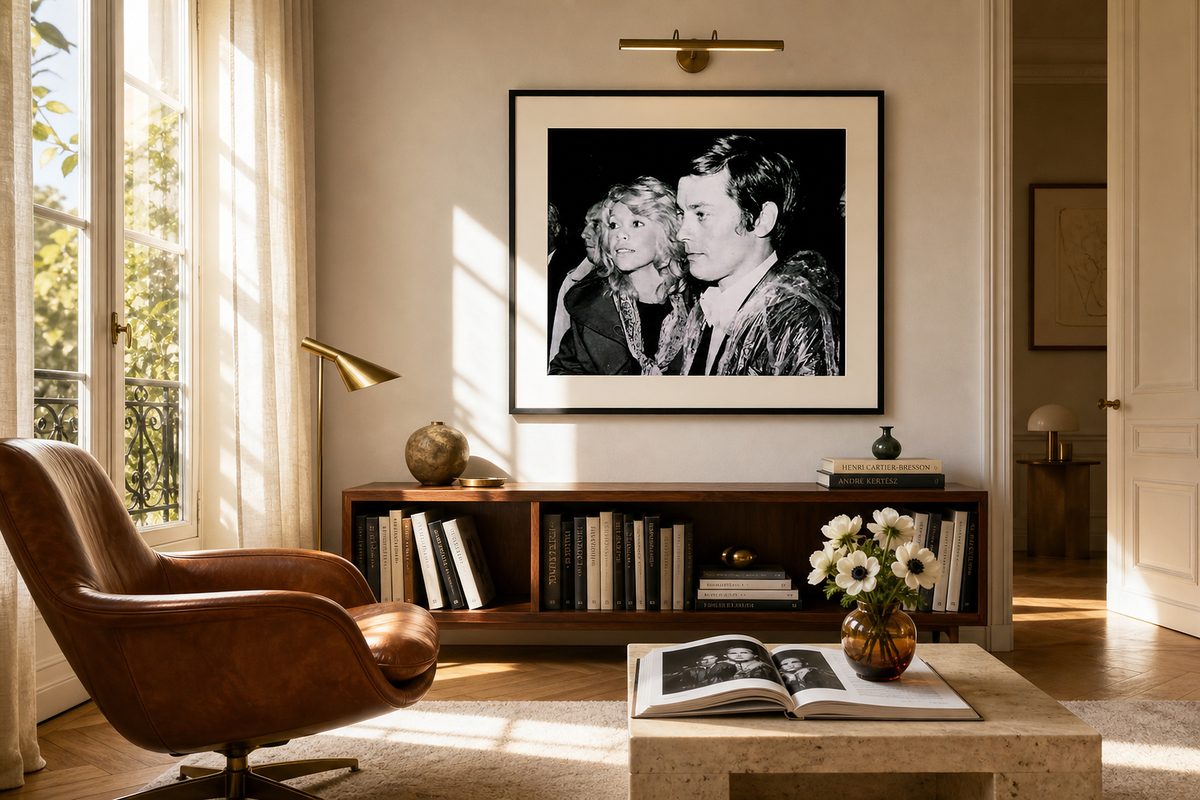
Among these iconic works, the 1971 photograph of Alain Delon and Mireille Darc holds a special place. The title alone evokes a whole world of imagery: that of French cinema, of the iconic couple, and of an era associated with elegance, restraint, and the power of glamour. But the artistic value of such a photograph does not rest solely on the fame of the subjects.
What catches the eye is the way the image can capture the tension between distance and closeness. When portraying figures so deeply embedded in the collective memory, the photographer must avoid two pitfalls: clichéd illustration and passive fascination. Christian Georges PINSON, on the contrary, seems to strive for balance: he depicts well-known figures while allowing their humanity to shine through, without reducing their presence to their status as icons.
Tahiti 1977: Antoine, Light, and the Imagination of Travel
The works centered onAntoine—notably *Antoine and a Miss Tahiti in Tahiti in 1977* and *Antoine, Welcomed in Tahiti in 1977*—reveal another dimension of PINSON’s perspective. Here, the portrait unfolds within an evocative context, rich in imagination: Tahiti, travel, hospitality, and encounters. Without the need for a biographical narrative, these titles alone are enough to guide the viewer’s interpretation toward a photograph in which the environment plays a full part in shaping the image.
The figure of Antoine—sometimes described as a charmer, the singing sailor—allows us to observe how Christian Georges PINSON weaves together his public persona and his everyday life. The image does not seem to seek a spectacular effect, but rather the authenticity of a single moment. The portrait thus becomes a meeting point between the subject, the setting, and the photographer’s gaze.
Famous faces, a consistent photographic style
The inclusion of works dedicated to Annie Cordy, Anthony Hopkins, Angie Dickinson, and Mel Gibson attests to the breadth of the visual realm explored by Christian Georges PINSON. These names come from different worlds—film, theater, and popular culture—but the series’ appeal lies precisely in this diversity. It allows us to gauge the consistency of an artistic vision when confronting highly recognizable figures.
In this type of photography, the challenge is significant: how does one photograph a face that has already been seen, discussed, and mythologized? PINSON responds by focusing on presence rather than anecdote. The photographic portrait becomes a form of silent dialogue. The viewer is not presented with a mere image of a celebrity, but with a carefully crafted apparition, in which expression, light, and framing come together to form a language.
An aesthetic that blends memory, cinema, and contemporary art
Christian Georges PINSON’s photographs lie at the intersection of several realms: artistic portraiture, cultural memory, the cinematic imagination, andcontemporary art. They explore our relationship with famous images, as well as how we recognize an era through a face. A photograph of Alain Delon, Mireille Darc, Anthony Hopkins, or Annie Cordy does not merely document a person: it triggers a network of memories, references, and emotions.
This dimension of memory should not overshadow the technical rigor of the work. Fine art photography demands careful interpretation: it invites viewers to observe the nuances, the balance, and the visual density of each print. In an art gallery, these works take on a different significance than they do in a purely media-based context. They become objects of contemplation, works in their own right, capable of engaging in a dialogue with other forms of contemporary art.
Why visit Christian Georges PINSON in Dreux?
Discovering Christian Georges PINSON in Dreux means gaining access to a substantial body of work built around a distinctive photographic vision. The L’Adresse des Maîtres® Art Gallery in Dreux provides an ideal setting to appreciate these works not merely as images of public figures, but as creations rooted in an artistic vision. The sheer volume—400 works—allows visitors to move beyond a one-off discovery and engage in a true appreciation of the body of work as a whole.
For collectors, photography enthusiasts, film buffs, or those curiousabout contemporary art, this selection offers an opportunity to reflect on the power of the photographic portrait. Each image acts as a threshold: it opens a window onto an era, a presence, a style—but also onto the central question of all great photography—what does a face reveal when viewed with insight?
An Invitation to See Things Differently
Christian Georges PINSON’s work reminds us that celebrity photography can attain true artistic nobility when driven by a strong visual vision. His portraits do not merely seek to captivate through the prestige of his subjects; they offer a visual experience that lies somewhere between recognition and rediscovery. It is precisely this tension that gives his works their value in a fine art photography collection.
Want to discover the works of Christian Georges PINSON? Visit the online gallery of Galerie d’Art L’Adresse des Maîtres® in Dreux today and explore a unique selection of art photographs that blend portraiture, cultural memory, and contemporary art.
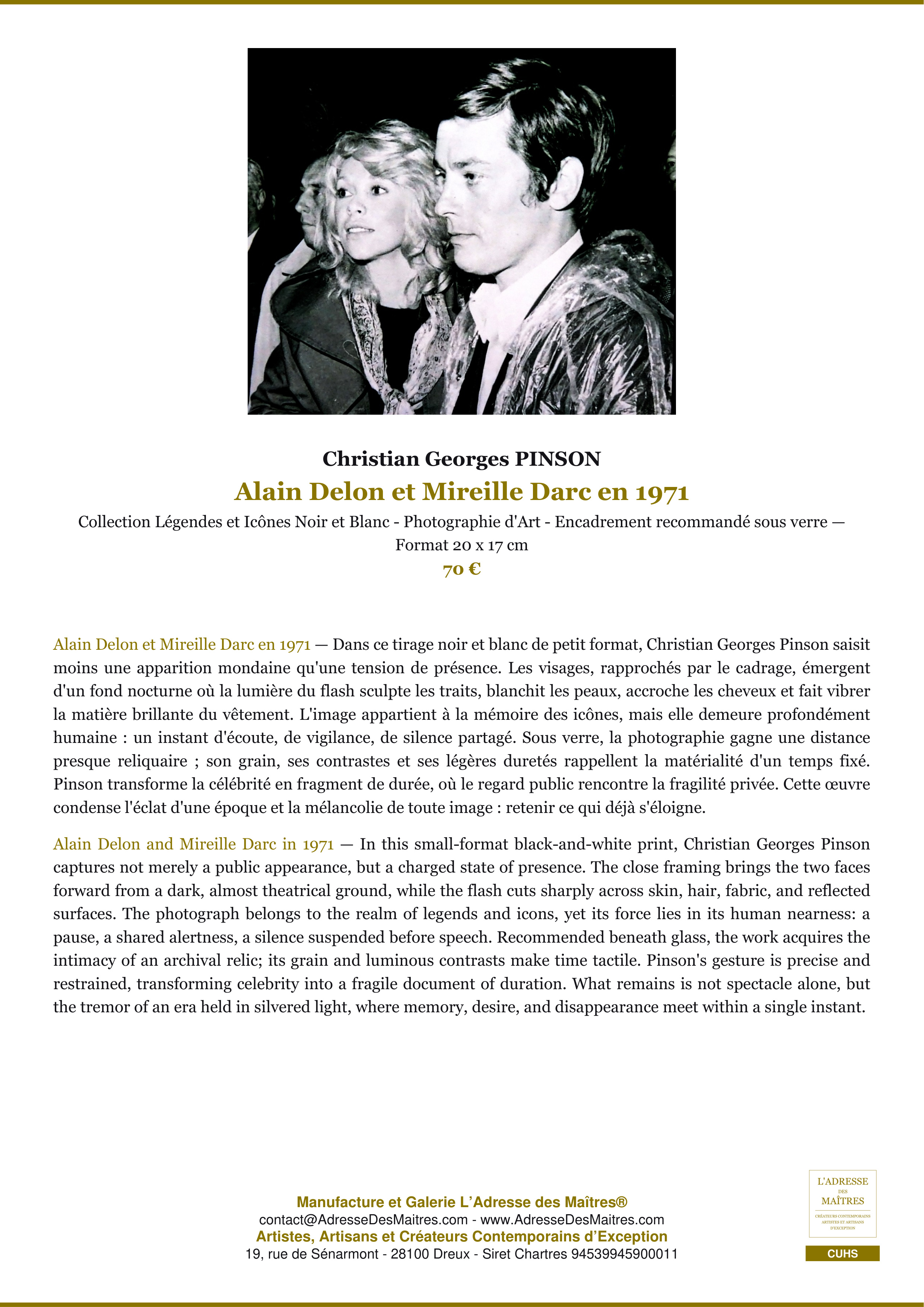
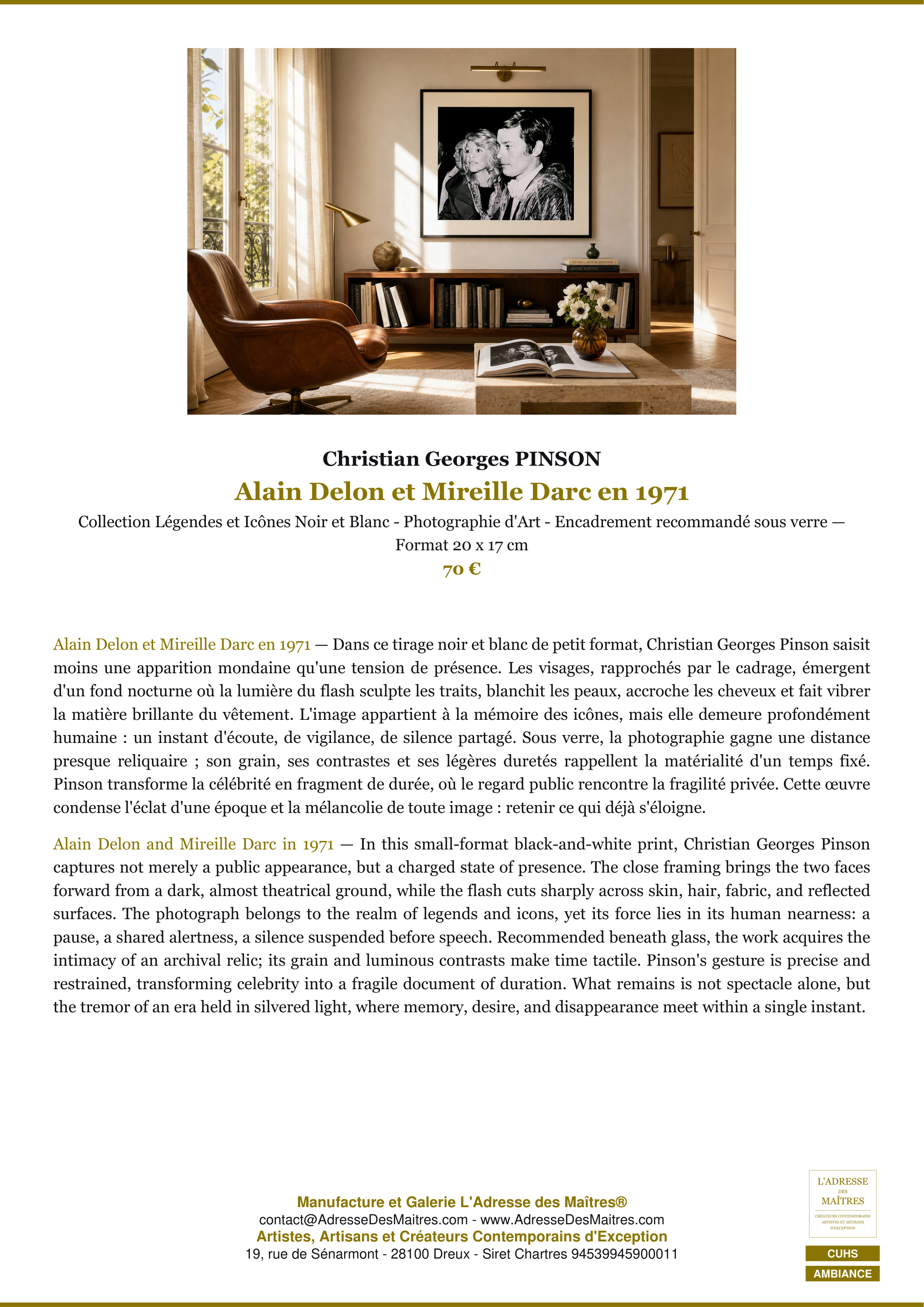
Discover the works of Christian Georges PINSON: Alain Delon and Mireille Darc in 1971 · Antoine and a Miss Tahiti in Tahiti in 1977—the charming sailor and singer · Annie Cordy
Christian Georges PINSON a 2 catalogues numériques, un par collection (PDF à feuilleter ou à télécharger) :
Explore Christian Georges PINSON's complete collection in our online gallery —more than 401 original works available.
Comments
-
Rey Jeannot
Great article, Christian… You deserve it…

Dominique DGC
C, you're the best, Christian ✨👌