Vincent PASCAL — Artist Profile
↓ Share this articleThere are works that do more than simply capture light: they seem to organize it, filter it, and translate it into a language of the senses. With Vincent PASCAL, the eye enters a realm where light becomes matter, where color becomes vibration, and where each composition evokes stained glass, contemporary abstraction, and a form of visual meditation. Featured at the Galerie d’Art L’Adresse des Maîtres® in Dreux with four works, the artist invites viewers to a unique aesthetic experience, blending transparency, interior architecture, and the poetry of thresholds.
Vincent PASCAL: A Writing of Light
To engage with Vincent PASCAL’s work is, first and foremost, to allow oneself to slow down one’s gaze. His compositions do not immediately reveal their depth: they are discovered in layers, in passages, and through successive intensities. Within the context ofcontemporary art, his work stands out for its particularly attentive relationship to light—not merely as a visual effect, but as a true pictorial subject.
The technique used here— Fine Art Stained Glass—plays an essential role. It evokes the legacy of stained glass while breaking free from it through a resolutely contemporary approach. Far from being merely decorative, this technique allows Vincent PASCAL to create spaces where color seems to radiate from within. Light is not merely depicted: it appears to circulate within the work, revealing tensions, balances, and areas of silence.
The four works on display in the art gallery thus form a cohesive whole, characterized by a constant focus on transitions: between night and day, interiority and openness, the material and the immaterial, human gesture and symbolic language.
Fine Art Stained Glass: Between the Legacy of Stained Glass and Contemporary Art
The term “Fine Art Stained Glass” suggests a connection to the art of colored glass, but Vincent PASCAL’s work goes beyond this historical reference. It is not a matter of reproducing the conventions of traditional stained glass, nor of strictly replicating its architectural function. Rather, the artist seems to extract its essence: the ability of color to become light, and that of light to open up a spiritual or emotional space.
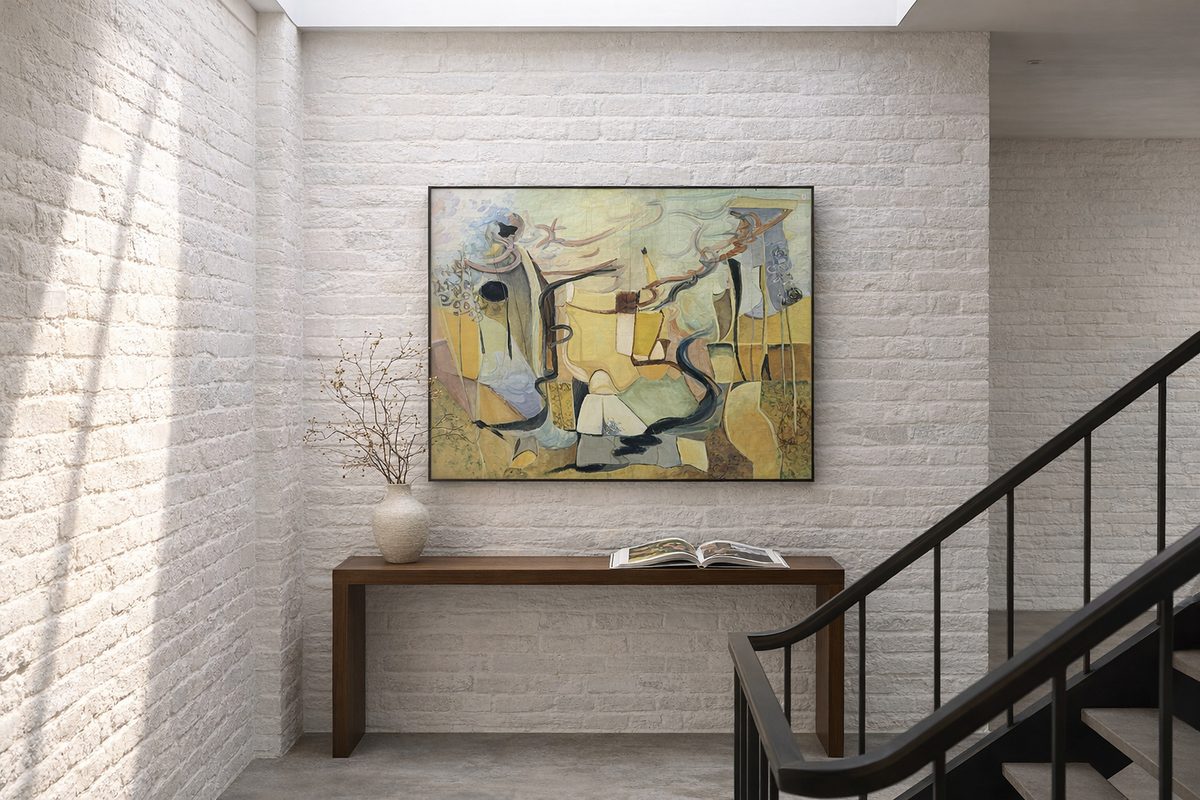
In his works, solid blocks of color, lines, and colorful fragments come together to form a kind of sensory map. The eye moves across them as if across a luminous facade or an interior landscape. The forms may evoke networks, hands, invisible architectures, or symbolic dawns. They never settle on a single interpretation; instead, they invite the viewer to project their own visual memory onto them.
This aspect is particularly important in an age saturated with fast-moving images. Vincent PASCAL, on the other hand, offers a slow, structured, almost contemplative image. His art requires a certain openness: to look, and then look again, until one perceives what is unfolding in the play of light.
Four Works to Discover in Dreux
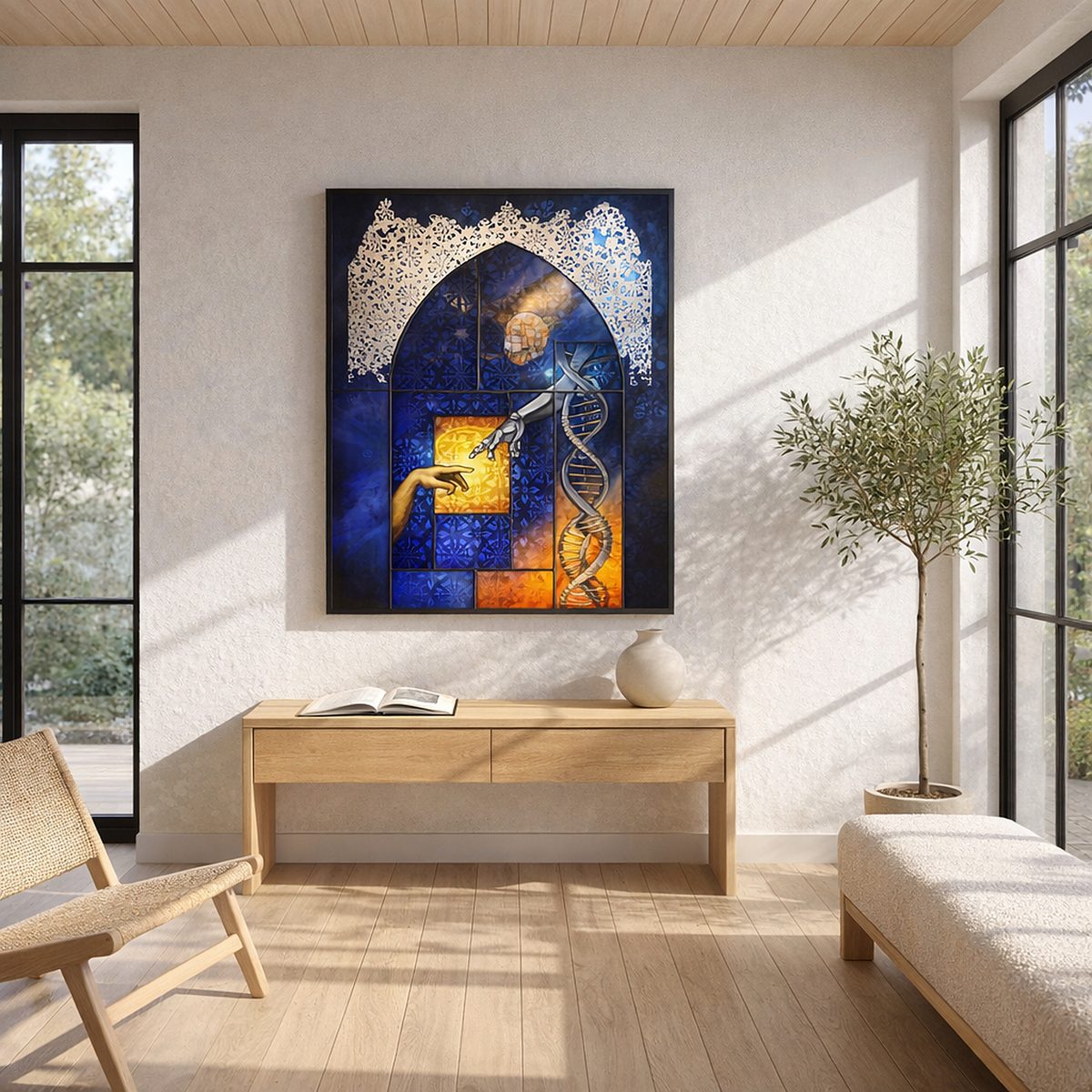
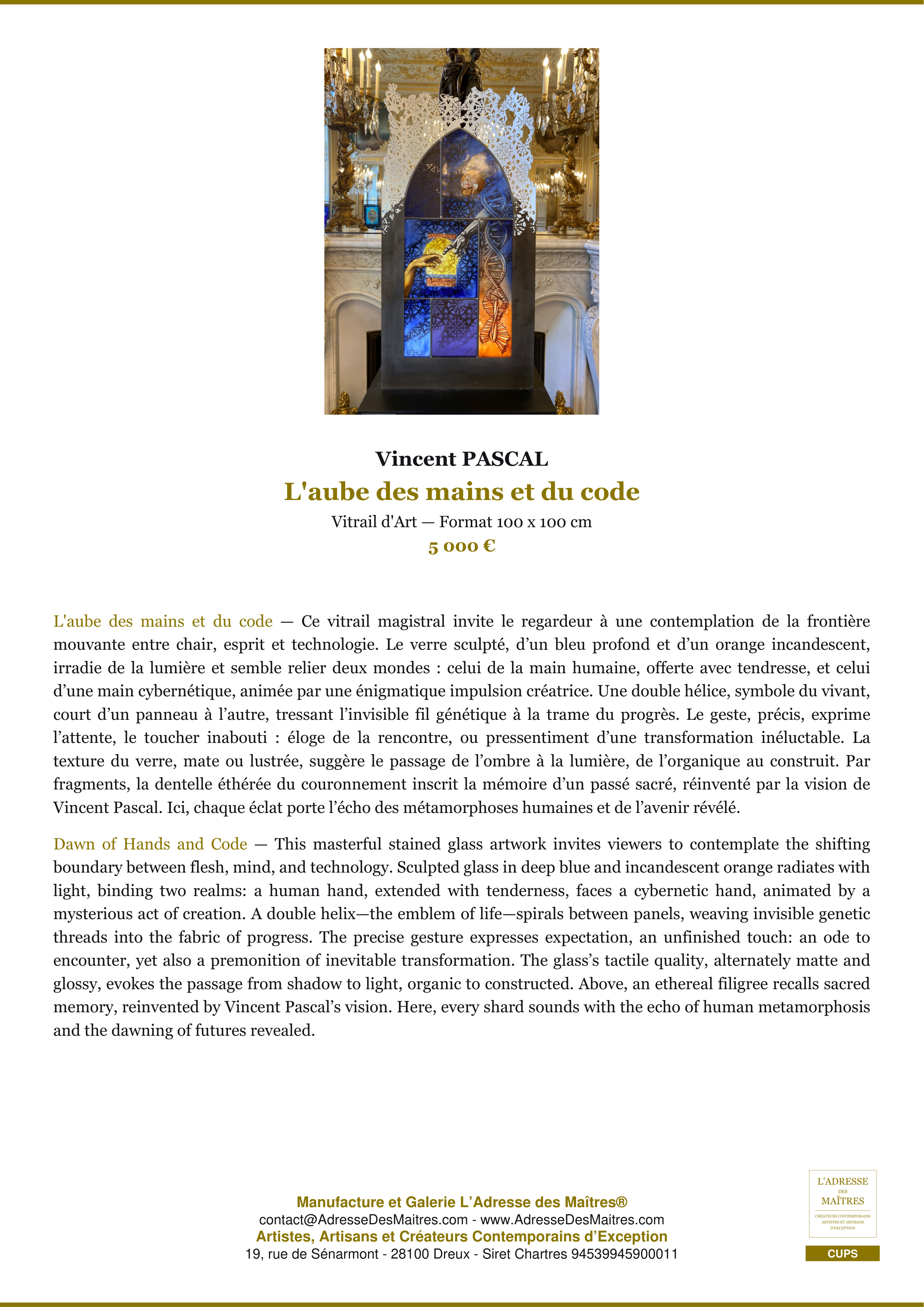
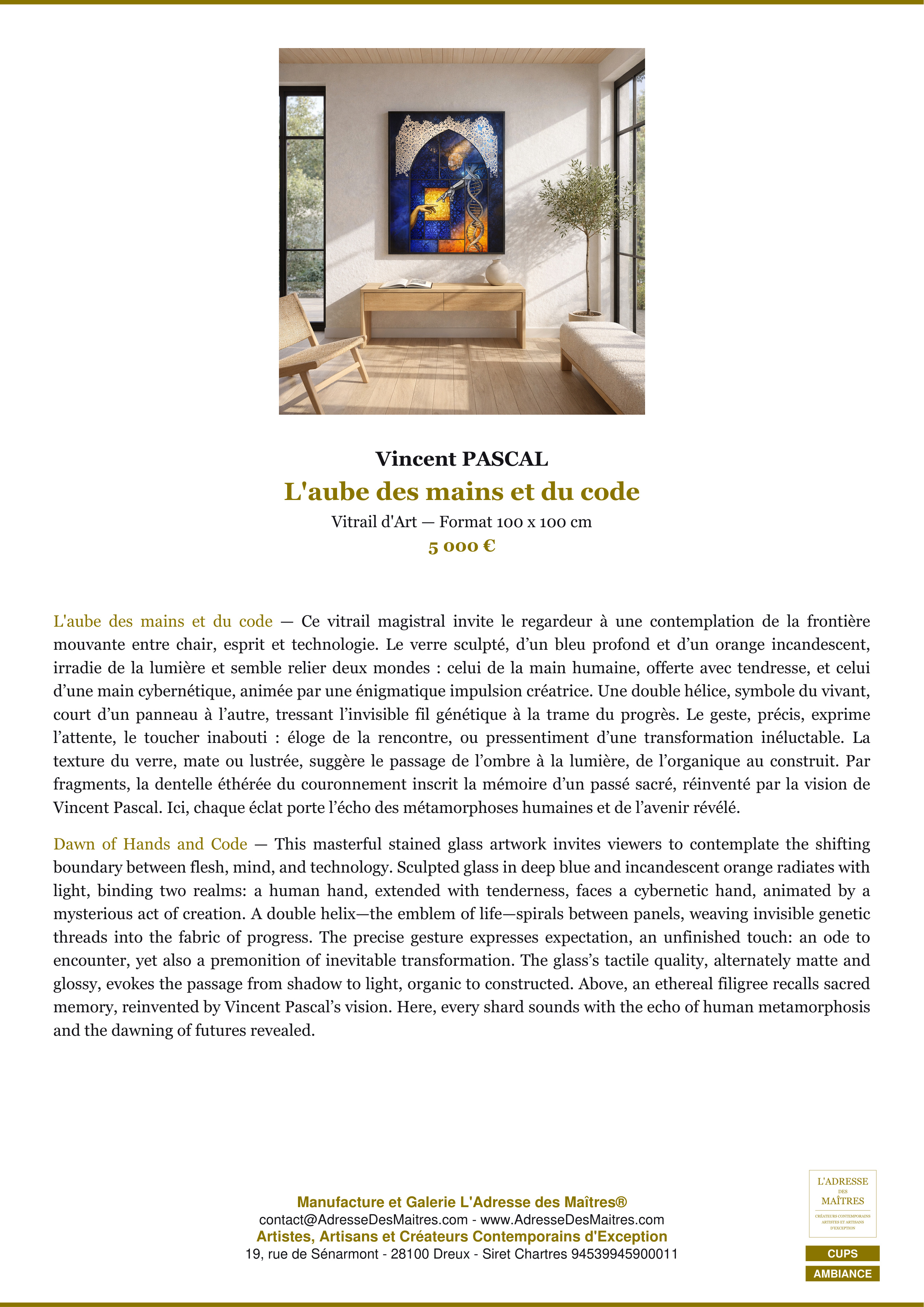
The L’Adresse des Maîtres® Art Gallery in Dreux is currently exhibiting four works by Vincent PASCAL. Each piece explores, in its own way, a subtle relationship between clarity, connection, and transformation. The titles themselves offer a poetic introduction to the artist’s world: *The Dawn of Hands and Code*, *The Dawn of New Bonds*, *Light of the Inner Dawn *, and *Light of Transfigured Days*.
These recurring themes of dawn and light are no coincidence. Dawn is a moment of transition, a fragile threshold between darkness and light. It embodies the idea of a beginning, but also that of a gradual revelation. In Vincent PASCAL’s work, this notion seems to take on a visual form: shapes emerge, colors intensify, and lines define a transition.
The choice of the word “light” reinforces this impression of a work rooted in transformation. It is not a spectacular or external light, but often an inner, transfiguring light, capable of altering our perception of reality.
The Dawn of Hands and Code: Humanity and Contemporary Language
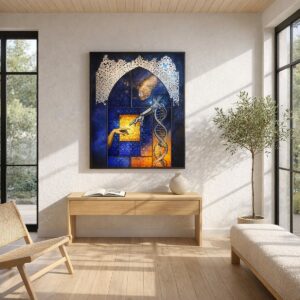
*The Dawn of Hands and Code* is a title that particularly reveals the tensions running through Vincent PASCAL’s work. “Hands” refer to gesture, humanity, touch, and artisanal creation. “Code,” on the other hand, evokes organization, digital language, and the invisible systems that structure our contemporary world.
In this encounter between the hand and the code, the artist seems to examine our era without resorting to an explicit narrative. The composition can be perceived as a space of mediation between sensibility and structure. Fine Art Stained Glass thus becomes an ideal technique: it combines a sense of architectural precision with a luminous depth that defies any mechanical coldness.
This work can thus be interpreted as a visual reflection on the place of humanity in an increasingly codified environment. Light acts as an element of reconciliation: it passes through the symbols, softens the structures, and reveals a possible harmony.
The Dawn of New Connections: Art as a Space for Connection
With *L’aube des liens nouveaux*, Vincent PASCAL continues this exploration of transition, but directs it toward the concept of relationship. The title suggests the emergence of a living network, a renewed connection between beings, forms, or ideas. In the field ofcontemporary art, this work can be approached as a reflection on what connects us beyond the visible.
The artist’s light compositions are not limited to an aesthetic exploration: they create flows. The lines, colors, and transparencies give the impression of a space in the process of being built. Nothing seems fixed. Everything appears to be in the making, as if the work were capturing the precise moment when a connection emerges.
This dynamic quality, combined with great chromatic subtlety, lends the work as a whole a quiet power. The viewer is not presented with a static image, but rather with a field of possible relationships.
Inner Dawnlight: A Meditative Abstraction
*Lumière de l’aube intérieure* places Vincent PASCAL’s work more directly within an introspective framework. The title signals a shift: dawn is no longer merely a phenomenon of the external world; it becomes an intimate experience. Light becomes an inner state, a personal transformation, and an expansion of consciousness.
Stylistically, this approach manifests as an abstraction that does not seek to break with the sensory experience, but rather to deepen it. The colors seem to carry an emotional charge, while the forms structure a space for contemplation. Here we find a quality unique to stained glass: the ability to create an atmosphere—almost a mental space—through the interaction of light and color alone.
In an art gallery, a work like this calls for close contemplation. It does not command attention through spectacle, but through a gradual presence. It draws the viewer in, holds their attention, and then invites them to engage in a form of visual listening.
Light of Transfigured Days: Color as Metamorphosis
*Lumière des Jours Transfigurés* embodies a powerful, luminous vision. The term “transfigured” suggests that ordinary days can be transformed by the gaze, by art, and by color. Here, Vincent PASCAL seems to remind us that light is never neutral: it alters forms, reveals details, and lends new intensity to everyday life.
This work can be understood as a celebration of metamorphosis. The visual imagery does not depict the world literally; rather, it offers an enhanced version of it, filtered through a chromatic sensibility. This is precisely where the power of Fine Art Stained Glass lies: in its ability to shift perception toward a more vibrant state.
Through this work, the artist expresses a vision in which abstraction is not a departure from reality, but rather an intensification of it. Days are transformed because light passes through them in a different way.
A Unique Presence in the Art Scene of Dreux
Vincent PASCAL’s presence at the L’Adresse des Maîtres® Art Gallery in Dreux enriches the dialogue between visual heritage and contemporary art. In a city like Dreux, where history, architecture, and artistic sensibility find numerous echoes, his work resonates particularly strongly. The reference to stained glass—even when reimagined—naturally dialogues with a memory of light embedded in the spaces and in the viewers’ perceptions.
But the appeal of his work lies not only in this lineage. It also stems from his ability to speak to our times—an era of networks, transformations, and inner realignments. Vincent PASCAL does not convey a single, unambiguous message; rather, he creates spaces of perception where everyone can experience light in their own way.
His four works thus invite us to rediscover color as an experience, transparency as depth, and abstraction as an accessible language. They confirm that challenging contemporary art can remain sensitive, accessible, and deeply human.
Discover Vincent PASCAL's works online
Forcontemporary art enthusiasts, collectors, or anyone curious to discover new art in Dreux, Vincent PASCAL ’s works offer a rare visual experience, at the intersection of reinvented stained glass and luminous abstraction.
Discover Vincent PASCAL’s four works now in the online gallery and let yourself be guided by the unique light of Fine Art Stained Glass.
Discover the works of Vincent PASCAL: The Dawn of Hands and Code · The Dawn of New Bonds · Light of the Inner Dawn
Explore Vincent PASCAL's complete collection in our online gallery —more than 4 original works available.
Leave a comment