Contemporary Sculpture — Materials, Techniques, and Artists to Discover
↓ Share this articleUnderstanding Contemporary Sculpture: Between Tradition, Innovation, and Emotion
Contemporary sculpture occupies a unique place in thecontemporary art scene. At the intersection of material, space, and the viewer’s gaze, it is no longer limited to monumental statues or classical busts. Today, it fills interiors, gardens, public spaces, and art galleries in an extremely wide variety of forms: bronze, resin, glass, assemblage, installation, and even 3D printing.
Long associated with marble and the faithful representation of the human form, sculpture has evolved over the centuries into a realm of experimentation. Contemporary artists play with volume, texture, materials, and sometimes even with light, space, or narrative. This freedom makes sculpture a particularly dynamic medium, capable of both moving and provoking thought.
In Dreux, the L’Adresse des Maîtres® Art Gallery is part of this movement, showcasing artists whose work engages with contemporary sculptural practices, ranging from bronze to narrative assemblages.
The Evolution of Sculpture: From Classical Marble to Modern Installations
To understand contemporary sculpture, we must go back to its origins. In the classical tradition, sculpture was often created using noble materials such as marble or stone. The primary goal was to depict reality—the human body, religious or mythological figures—with technical mastery. Technical skill was paramount, and sculptures were generally presented as standalone objects, placed on a pedestal.
With the advent of modernity, this concept has gradually evolved. Artists began to move away from strictly imitating reality. Forms became simpler, fragmented, or abstract. The pedestal sometimes disappeared, the sculpted object opened up to the surrounding space, and sculpture became an experience as much as a physical form.
Incontemporary art, this evolution has accelerated. Sculpture is no longer defined solely by the carving or shaping of a solid material. It can take the form of an immersive installation, an assemblage of objects, a suspended structure, or a hybrid piece at the intersection of design, architecture, and art. This shift in perspective is essential: modern and contemporary sculpture does not merely represent; it establishes connections.
This diversity is reflected in the current practices on display in art galleries. Some works build on the legacy of traditional techniques, while others explore more conceptual avenues. It is precisely this coexistence of the legacy of craftsmanship and formal innovation that gives contemporary sculpture its richness.
Contemporary materials: bronze, resin, glass, and recycled materials
The material is at the heart of every sculpture. In contemporary sculpture, it does more than simply give form; it also conveys meaning, atmosphere, and a physical presence. The choice of material influences how the work is perceived—its light, its visual weight, its fragility, or its permanence.
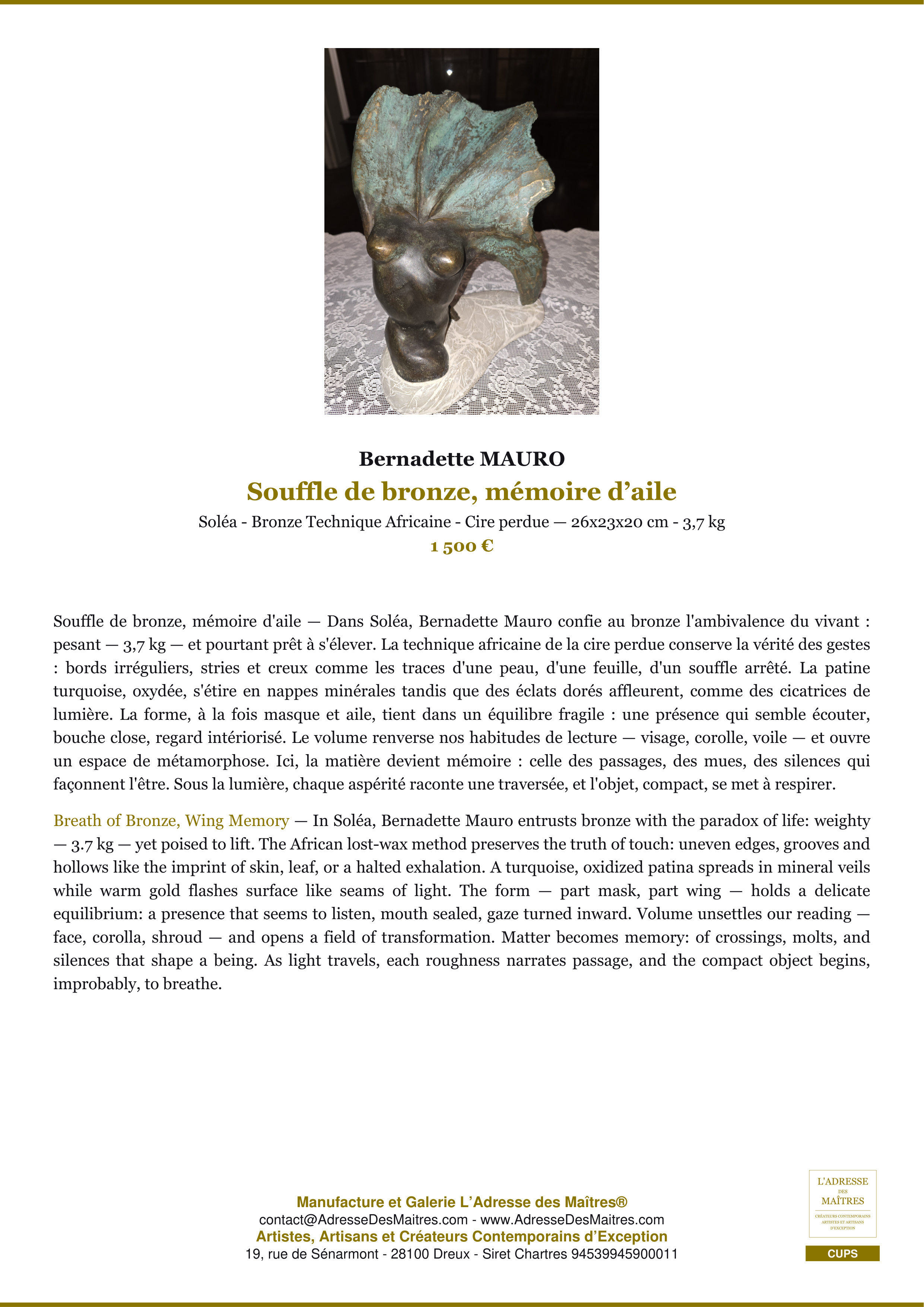
Bronze remains a major medium. Rooted in a long tradition, it retains strong symbolic value incontemporary art. Solid, durable, and refined, it lends itself to expressive works, whether detailed or minimalist. At the Galerie d’Art L’Adresse des Maîtres® in Dreux, Bernadette MAURO presents two works in Fine Art Bronze Sculpture, including “Souffle de bronze, mémoire d’aile.” Through their explicit use of bronze sculpture, these works remind us how much this material continues to enrich contemporary creation through its nobility and its ability to convey a sensitive presence.
Resin has emerged as a highly popular alternative. Lighter, more versatile, and sometimes available in colored or translucent varieties, it offers great creative freedom. It works equally well for figurative pieces and more abstract forms. In interior design, it often strikes an excellent balance between visual impact and ease of installation.
Glass, for its part, brings a unique luminous quality to a space. Whether transparent, opaque, blown, polished, or textured, it interacts with the space in a way that opaque materials do not. A glass sculpture can appear almost ethereal, yet still command a strong presence. In current design trends, it is often sought after for its ability to interact with natural light.
Recycled materials are also playing an increasingly prominent role. Their use reflects not only an ecological consciousness but also a penchant for transformation. Salvaged metal, reclaimed wood, industrial scraps, and repurposed objects become artistic materials. They give rise to works in which the history of the assembled elements enriches the overall meaning of the piece.
This compositional approach is evident in the work of Yves CAILLAUD, presented at the Galerie d’Art L’Adresse des Maîtres® with two works in the Narrative Assemblage Sculpture series, including “La cité suspendue des incorruptibles.” Through narrative assemblage, his works illustrate a strong trend in contemporary sculpture: constructing meaning from the combination of elements, and making the composition itself a language.
Sculpture Techniques Today
Contemporary sculptural techniques are diverse and often complementary. Some are rooted in a long tradition, while others make use of the latest digital tools.
Modeling involves shaping a malleable material, such as clay or wax. This approach allows for intuitive, sensitive work based on the continuous addition and modification of form. It is often used as a preparatory step for bronze casting, but can also stand on its own as a work of art.
Direct carving involves removing material from a block of stone, wood, or another solid material. This technique requires precision and foresight, as every stroke is final. Although historically associated with the classical tradition, it remains a prominent feature of contemporary sculpture, often reinterpreted in more modern approaches.
Assemblage is one of the major techniques incontemporary art. It involves bringing together disparate materials, objects, or fragments to create a new work. This practice allows for the introduction of a narrative, poetic, or critical dimension.Yves CAILLAUD’s work clearly follows this path through his “Narrative Assemblage Sculpture,” contributing to this movement an approach in which visual construction also becomes the construction of meaning.
3D printing is gradually transforming artistic practices. It allows artists to create complex shapes from a digital model with a high degree of precision. Some artists use it to produce a finished work directly, while others use it as a prototyping step prior to casting or assembly. This technique opens up new possibilities for sculpture, enabling the fusion of traditional craftsmanship with technological innovation.
Amid this diversity of approaches, contemporary sculpture demonstrates that it is not defined by a single method, but by a freedom of invention. Technique is no longer an end in itself; it becomes a tool in the service of a vision.
Artists to Discover at the L’Adresse des Maîtres® Art Gallery
The L’Adresse des Maîtres® Art Gallery in Dreux showcases several artists whose work directly addresses the challenges of contemporary sculpture and related forms.
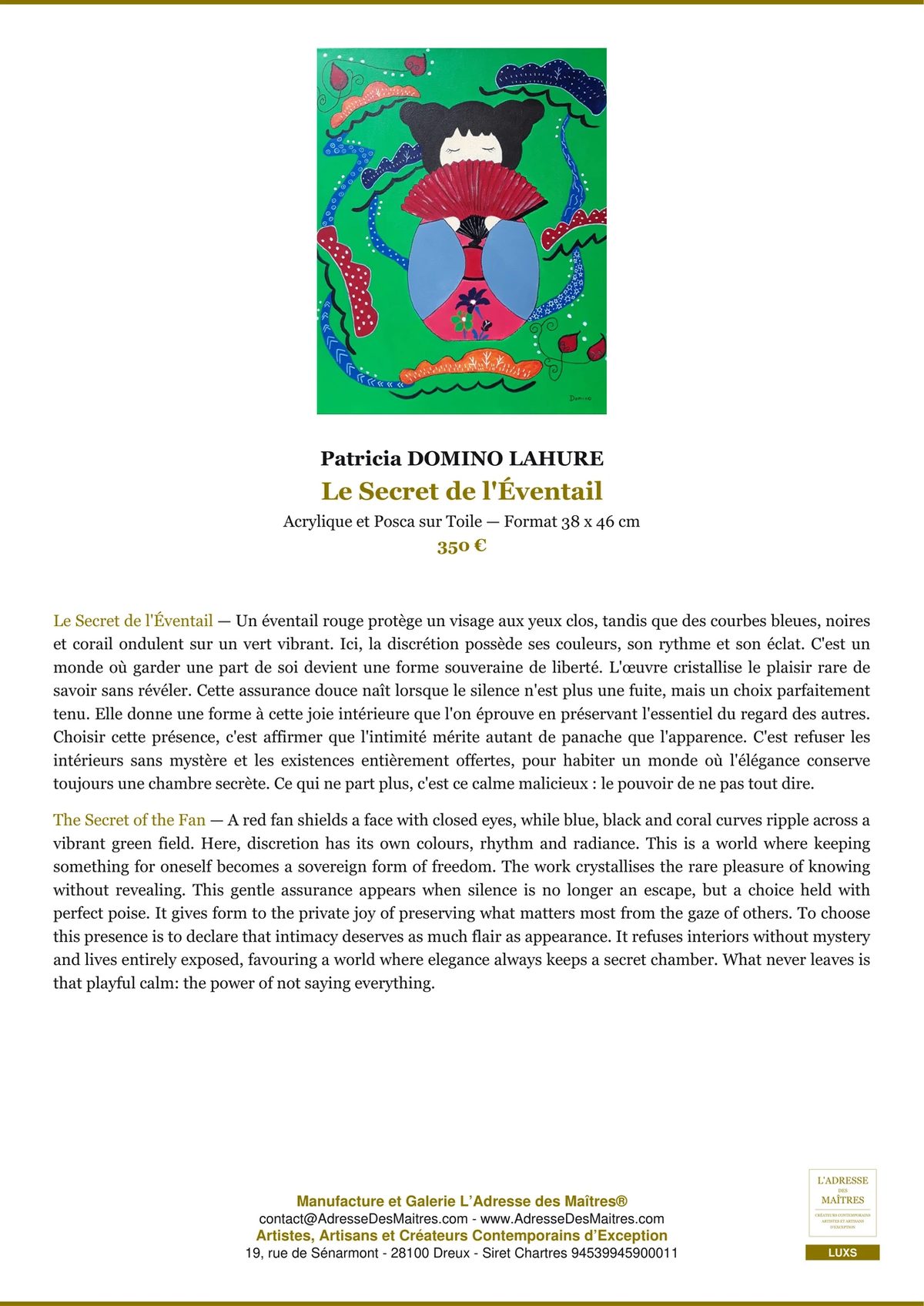
Patricia DOMINO LAHURE presents four sculptural works, including “Le secret de l’éventail.” Through their explicit place within the realm of sculpture, these works contribute to the diversity of the contemporary art scene and remind us of the mystery, presence, and evocative power that form can convey.
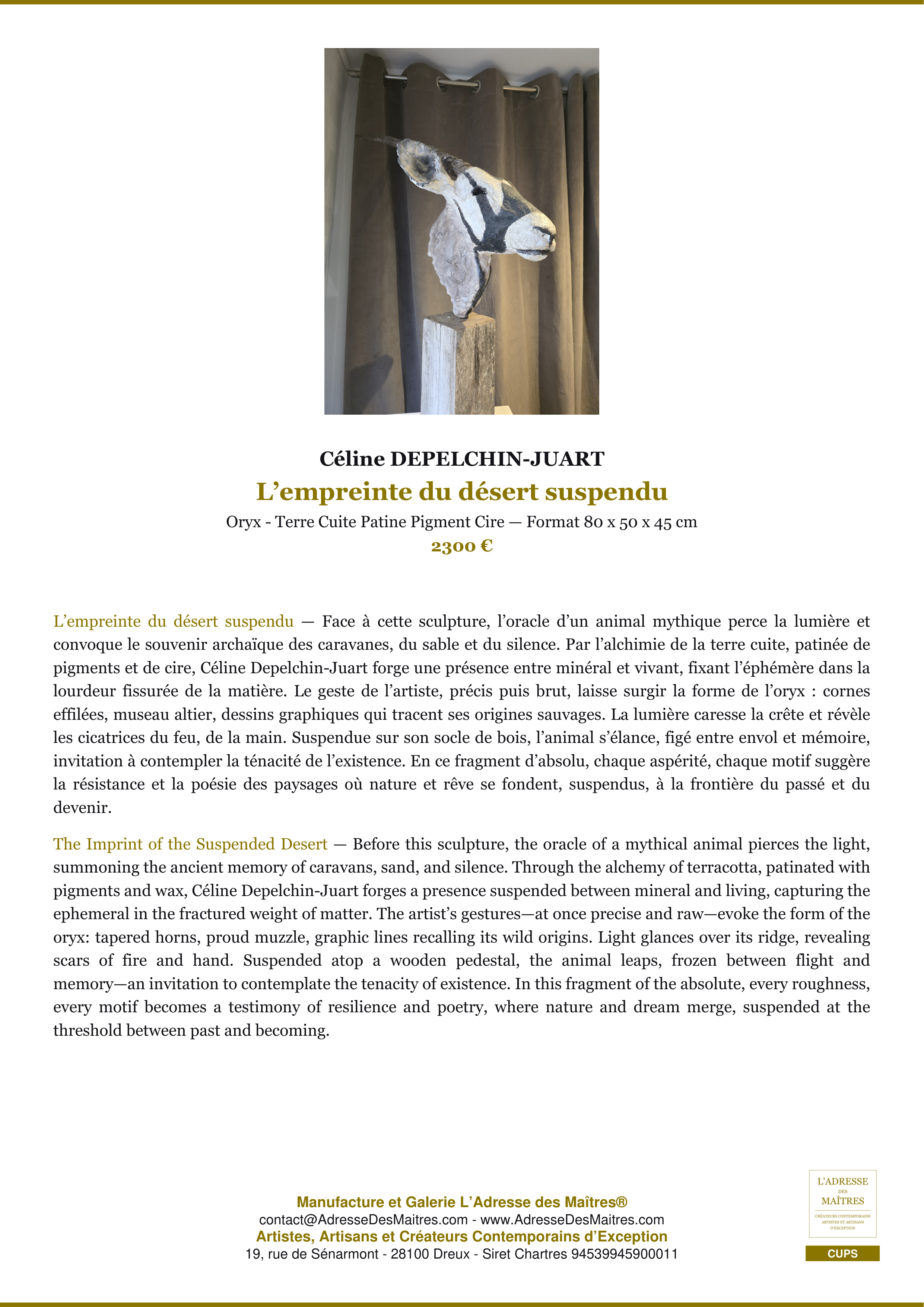
Céline DEPELCHIN-JUART is exhibiting three sculptural works there, including “L’empreinte du désert suspendu” (The Imprint of the Suspended Desert). Through this sculptural practice, her work illustrates how contemporary sculpture has opened up to sensitive and evocative forms, with the title itself suggesting a subtle relationship to space and suspension.
Bernadette MAURO, with her two works in fine art bronze sculpture —including “Souffle de bronze, mémoire d’aile”—brings to the contemporary art scene the enduring legacy of a historic material that remains fully alive in today’s creative practice. Here, bronze demonstrates its ability to blend tradition, refinement, and sculptural intensity.
Yves CAILLAUD, with two works in the field of Narrative Assemblage Sculpture—notably “The Suspended City of the Incorruptible”—embodies a key trend incontemporary art: assemblage as visual narrative. His contribution lies in this narrative dimension, which creates a dialogue between structure, imagination, and composition.
Finally, Jean-Pierre BLONDIN presents one work of fine art photography, “Hands Sculpt Silence.” Although it is not a sculpture in the literal sense, this work enriches our reflection on the sculptural gesture itself. By evoking hands and silence, it offers a photographic perspective on the act of creation, serving as a sensitive echo of sculptural practices.
How to Incorporate a Sculpture into an Interior
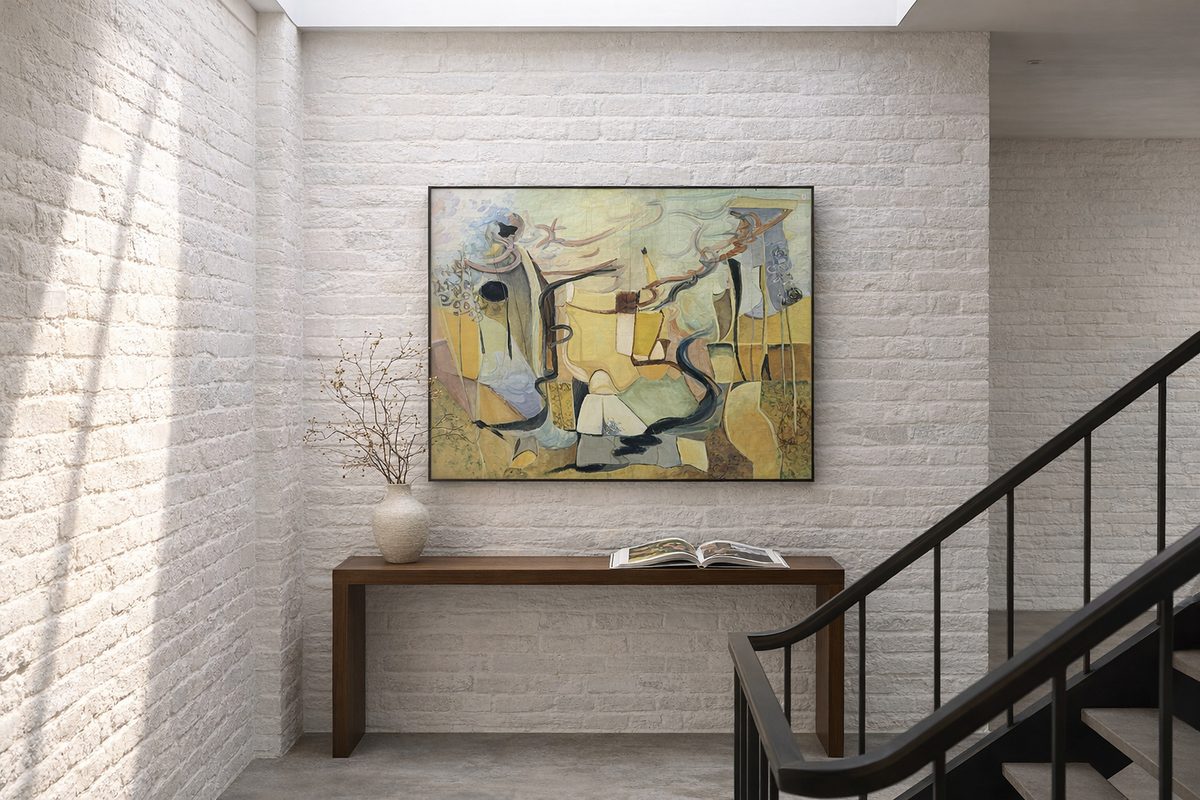
Bringing a contemporary sculpture into your home helps define a space and give it a strong identity. Contrary to popular belief, you don’t need a large room to display a sculpture. A well-chosen piece can transform a living room, an entryway, a library, or even an office.
The first consideration isscale. A small sculpture can serve as a focal point on a console table, a niche, or a coffee table. A larger piece will require open space so it can be viewed from multiple angles. In sculpture, the relationship to negative space is just as important as the object itself.
The second point is lighting. Natural side lighting will highlight contours, while focused lighting will emphasize textures and shadows. This is particularly true for bronze, glass, or textured surfaces.
It’s also important to consider how the artwork interacts with its surroundings. In a minimalist interior, an expressive or textured sculpture can provide a striking contrast. In a more traditional setting, a contemporary piece often creates a fascinating aesthetic tension. The key is to avoid overcrowding the space and to give the room enough room to “breathe.”
Finally, the choice of material matters in everyday use. A lightweight resin will be easy to move, whereas bronze will require a stable base. Glass will require more care, and certain assemblage pieces will need a protected yet prominent location.
Leading Contemporary Sculptors and Current Trends
The contemporary sculpture scene is characterized by great diversity. Some artists explore formal aspects related to the body, abstraction, or materials; others focus on installation art, repurposed objects, the blending of techniques, or environmental considerations.
Among current trends, several key themes stand out: a return to traditional craftsmanship with a modern twist, an interest in recycled materials, the development of assembly techniques, the rise of digital processes such as 3D printing, and a greater focus on the relationship between the artwork and its environment. Sculpture is no longer merely an object to be contemplated; it often becomes a spatial experience, sometimes an immersive one.
There is also a growing preference for works that blend seamlessly into the home. This trend brings the art gallery closer to the living space and encourages new collectors to take an interest incontemporary art. In this context, artists working in sculpture, bronze, or assemblage naturally find their place within discerning selections such as those offered in Dreux by the Galerie d’Art L’Adresse des Maîtres®.
Tips for Starting a Sculpture Collection
Starting a collection of contemporary sculpture doesn’t necessarily require a large budget. The key is to buy with curiosity, consistency, and enjoyment.
First tip: Look around a lot. Visit exhibitions, studios, and art galleries. Take note of the materials, formats, finishes, and the way the works occupy the space. This visual familiarity will help you refine your preferences.
Second tip: Learn about the medium. A sculpture made of bronze, resin, or mixed media has different requirements when it comes to preservation, transportation, and display. Understanding how it was made helps you appreciate the work more fully and ensure it’s installed properly.
Tip #3: Start with a piece that truly speaks to you. In contemporary art, a work’s value isn’t limited to its potential market value. A lasting collection is built first and foremost on a personal connection.
Tip #4: Consult with professionals. A reputable art gallery can guide you toward artists, techniques, and formats that suit your project. It plays a vital role in supporting both novice and experienced collectors.
Finally, keep the overall coherence in mind. Your collection can be built around a material, a theme, a technique, or simply a sensibility. For example, you might be interested in bronze, narrative assemblage, or the dialogue between sculpture and imagery, as suggested by the joint presence of sculptors and photographers at the Galerie d’Art L’Adresse des Maîtres®.
Conclusion
Contemporary sculpture is a constantly evolving field. Building on the tradition of classical marble sculpture, it now embraces an infinite variety of forms, materials, and techniques—from bronze to 3D printing, and from modeling to assemblage. It engages with space, architecture, the viewer, and the issues of our time.
Whether you’re looking for a piece of art to enhance your home, seeking to better understand trends incontemporary art, or starting a collection, sculpture offers a direct, physical, and lasting experience. In Dreux, the L’Adresse des Maîtres® Art Gallery is a valuable destination for such exploration, particularly thanks to the presence of artists such as Patricia DOMINO LAHURE, Céline DEPELCHIN-JUART, Bernadette MAURO, Yves CAILLAUD, and Jean-Pierre BLONDIN, whose works shed light on various facets of this evolving artistic field.
Check out our gallery
Vous souhaitez découvrir ces courants artistiques en vrai ? Visitez la galerie en ligne de L’Adresse des Maîtres® : plus de 1633 œuvres originales d’artistes contemporains.

Leave a comment