Charcoal Drawing on Paper — Contemporary Art
↓ Share this articleCharcoal Drawing on Paper: The Power of Charcoal in Contemporary Art
Charcoal Drawing on Paper is one of the oldest and most direct techniques in the history of art. Yet, far from being confined solely to traditional studios or preparatory studies, it now occupies a unique place incontemporary art. At once raw, sensitive, and deeply expressive, this technique allows artists to explore light, texture, gesture, and emotion with rare intensity. At the L’Adresse des Maîtres® Art Gallery in Dreux, this practice is represented by eight works, notably by the artist Henri BURIN.
What is the "Charcoal Drawing on Paper" technique?
Charcoal Drawing on Paper involves drawing with charcoal, commonly known as fusain, on a sheet of paper. Fusain can be natural, made from charred wood, or compressed, mixed with a binder that makes it denser and blacker. It comes in the form of sticks, pencils, or powders. It offers a wide variety of effects: fine lines, deep solid areas, hazy gradients, velvety shadows, or intense blacks.
What makes charcoal so fascinating is its flexibility. Unlike ink, which leaves a permanent mark, charcoal can be smudged, erased, or moved. The artist often works with their fingers, a smudge stick, a cloth, a breadcrumb eraser, or even directly with the palm of their hand. The drawing then becomes a true physical dialogue between the paper, the black powder, and the artist’s gesture. This tactile dimension gives charcoal works a special, almost organic presence.
An accessible but demanding technique
At first glance, charcoal drawing seems simple: a black stick, a white sheet of paper, and you’re ready to start drawing. Yet this apparent simplicity masks a high level of skill. The paper must be chosen carefully, as its texture affects how well it holds the charcoal. Smooth paper allows for crisp lines, while textured paper grips the charcoal and creates more vibrant effects. The artist must also master values—that is, the nuances between the white of the paper and the deep black of the charcoal.
In a successful charcoal drawing on paper, light often emerges from what is not drawn. The white of the paper becomes an active element of the composition. The areas left untouched or partially erased create flashes of light, breathing room, and contrasts. This is why charcoal is particularly prized for depicting faces, bodies, landscapes, architecture, and abstract forms. It allows the artist to suggest as much as it does to describe.
A Brief History of Charcoal Drawing
The history of charcoal dates back to the very origins of artistic expression. Long before art academies and museums existed, early artists were already using charcoal to sketch shapes on cave walls. This primitive material has thus accompanied humanity since its very first creative acts. Later, during the Renaissance, charcoal became a favored tool for preparatory studies. Artists use it to construct a composition, explore a pose, study drapery, or prepare for a painting.
In the 18th and 19th centuries, charcoal gained greater independence. It was no longer merely a tool for sketching but became an artistic technique in its own right. Romantic and Symbolist artists used it for its atmospheric qualities, its evocative power, and its ability to create mysterious moods. The black of charcoal is not just a color: it becomes depth, silence, and sometimes dramatic tension.
In the 20th century, with the advent of the avant-garde movements, charcoal drawing became even more liberated. It accompanied explorations of movement, abstraction, the expression of the body, and the spontaneity of the gesture. Modern and contemporary artists see it as a way to return to the essentials: the line, the shadow, the mark, and the energy of the hand. This historical continuity explains why charcoal drawing on paper remains so relevant in today’s artistic practices.
Charcoal in Contemporary Art
Incontemporary art, charcoal holds a special place because it stands apart from the glut of digital images. In this age of screens, industrial printing, and computer-aided design, charcoal drawing affirms the value of the human touch. Every stroke carries a hesitation, a pressure, a breath. Every work reveals something about the time it took to create.
Contemporary artists use charcoal drawing on paper in a variety of ways. Some work in a figurative style, exploring portraiture, the human body, or memory. Others use it to create abstract compositions made up of dark masses, taut lines, or clouds of material. Charcoal can also be combined with other mediums: pastel, graphite, ink, paint, and collage. This blending fits perfectly with the contemporary spirit, where the boundaries between techniques are becoming more fluid.
Charcoal drawing is also prized for its emotional power. It can evoke fragility, transience, and disappearance, but also power, intensity, and depth. Its powdery texture always seems to be in motion, as if the image could still change. This instability is part of its charm: charcoal gives the drawing a living, almost breathing quality.
Henri BURIN and His Charcoal Drawings in Dreux
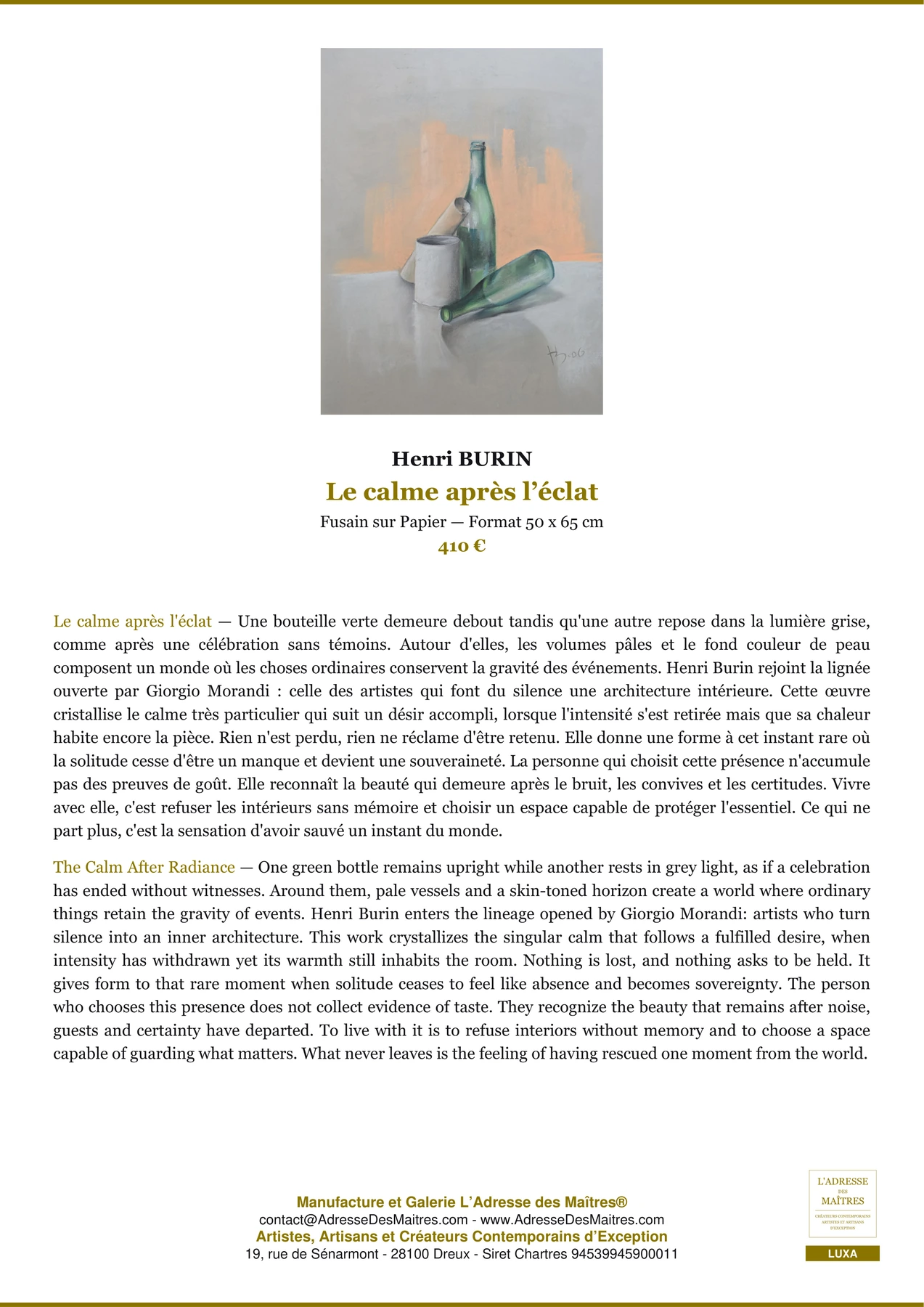
At the L’Adresse des Maîtres® Art Gallery in Dreux, the “Charcoal Drawing on Paper” technique is represented by 8 works. The artist Henri BURIN plays a central role there. His approach to charcoal reveals a particular focus on the construction of forms, contrasts, and the intensity of the line. In his works, the paper is not merely a medium; it becomes a space of tension between appearance and disappearance.
Henri BURIN draws on the richness of charcoal to explore the depths of black and the subtlety of grays. His drawings invite the viewer to slow down. One can perceive the precision of his brushwork, but also a sense of restraint, as if each line were meant to find its perfect balance. This mastery lends the works a sober yet powerful presence, particularly appealing to enthusiasts of drawing, contemporary art collections, and reinvented traditional graphic techniques.
For an art gallery, exhibiting works created using the “Charcoal Drawing on Paper” technique serves as a reminder that drawing is not a minor art form. It can be central, ambitious, and fully independent. The eight works available in this medium offer visitors and collectors an opportunity to discover the expressive power of charcoal in a contemporary context, right in the heart of Dreux.
Why collect a charcoal drawing on paper?
Collecting a charcoal drawing on paper means choosing a work that captures the artist’s original creative process. Charcoal drawings on paper possess a unique intimacy: you can see the artist’s hand, the pressure applied, the revisions, the erased areas, and sometimes even the corrections. Unlike some very polished works, charcoal retains a certain vitality and imperfection that makes it deeply human.
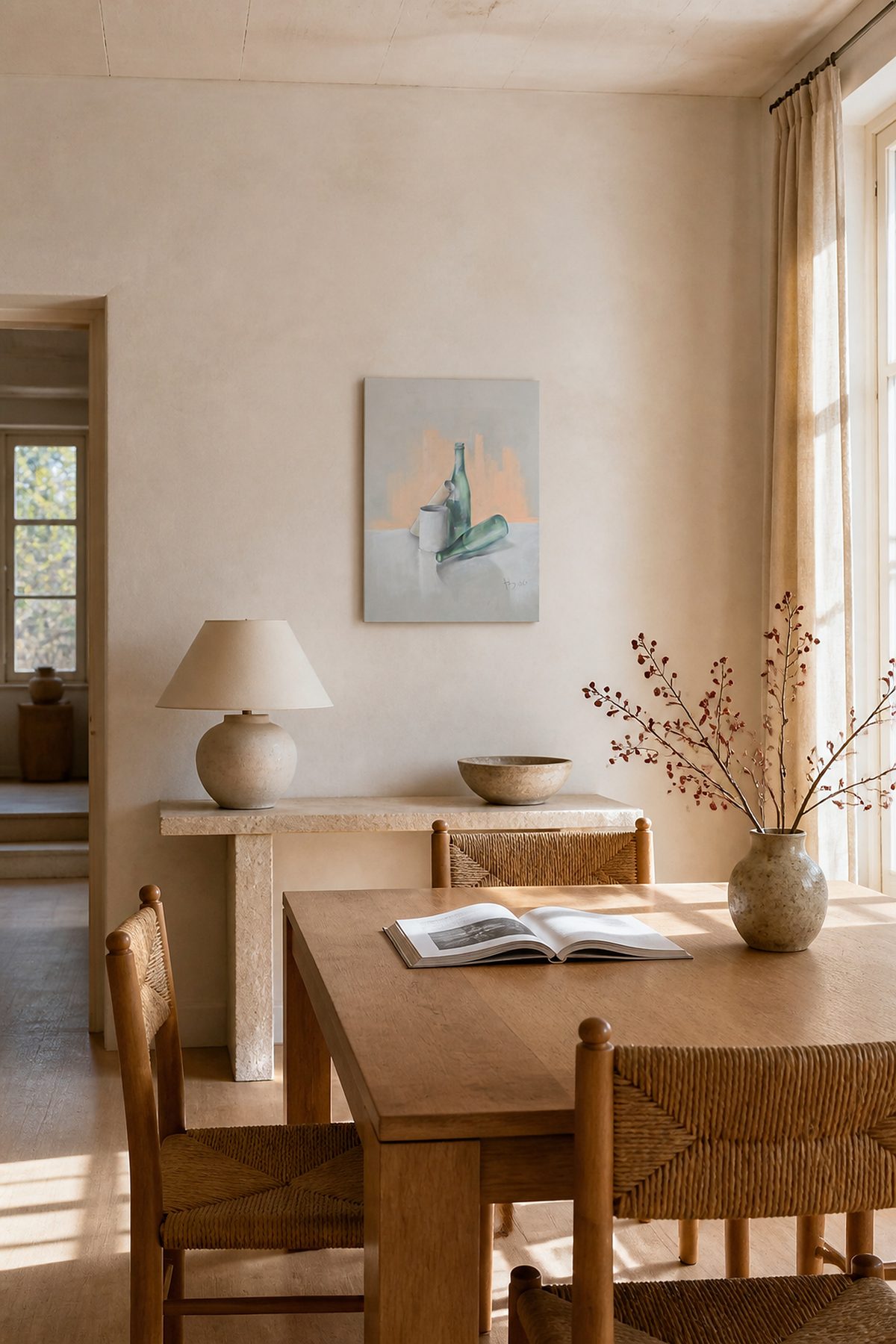
These works blend easily into contemporary interiors. Their palette of blacks, grays, and whites complements a wide range of settings, from the most minimalist to the most classic. But their simplicity does not mean they go unnoticed: a charcoal drawing can create a very strong focal point in a room. It captivates with the depth of its contrasts and the immediate emotion it evokes.
However, care must be taken to ensure proper preservation. Since charcoal is a powdery medium, the works are generally fixed with a suitable product and then protected under glass. High-quality framing helps preserve the surface of the paper while highlighting the delicacy of the drawing. For collectors, it is a medium that is at once delicate, elegant, and durable when properly displayed.
An ancient technique with an eye toward the future
The current popularity of charcoal drawing on paper shows that traditional techniques have lost none of their relevance. On the contrary, they offer contemporary artists a rich ground for experimentation. Charcoal bridges the earliest history of art with its most contemporary forms. It reminds us that an image can arise from a simple gesture, a humble medium, or a contrast between light and shadow.
By showcasing the works of Henri BURIN and this technique, represented by eight creations, the L’Adresse des Maîtres® Art Gallery in Dreux is helping to establish charcoal drawing as a major form of expression in contemporary art. For art lovers, the curious, and collectors alike, this is an invitation to rediscover the depth of black, the delicacy of paper, and the timeless power of the artistic gesture.
Découvrez 13 œuvres en Charcoal Drawing on Paper dans notre galerie en ligne.
Leave a comment