
Minimalist Art — When Less Becomes More
↓ Share this articleUnderstanding Minimalist Art: A Language of the Essential
Minimalist art occupies a central place in the history ofcontemporary art. Emerging in the 1960s, it marked a break with the narrative, emotional, or decorative excesses of certain earlier movements. Minimalism seeks to reduce the artwork to its fundamental elements: form, material, space, light, and perception. This aesthetic of simplicity does not imply visual poverty; on the contrary, it invites the viewer to a more subtle, slower, and more conscious observation.
Even today, Minimalist art continues to influence painting, sculpture, and installation art, as well as design, architecture, and interior design. Its enduring success stems from its ability to create simple, powerful, and timeless works that engage directly with the space around them and with the viewer.
The Origins of Minimalism in the 1960s
Minimalism truly took shape in the United States in the 1960s. It emerged within an artistic context dominated by Abstract Expressionism, a movement in which the artist’s gesture, emotion, and subjectivity played a central role. Minimalist artists chose a different path: they rejected spectacular expressiveness and favored simple, objective, and repetitive structures.
Among the key figures of this movement, Donald Judd plays a decisive role. His work features clean geometric forms, often crafted from industrial materials. He seeks to create self-contained objects that do not imitate anything and tell no story other than their own. The work exists through its physical presence, in its relationship to space, scale, and light.
Dan Flavin, for his part, radically transformed the use of light in contemporary art. Using industrial fluorescent tubes, he created installations in which light became the primary medium. Minimalism thus took on an environmental dimension: the artwork was no longer confined to a single object; it transformed the perception of the space.
Sol LeWitt brings a significant conceptual dimension to the field. His modular structures, series, and systems of variation demonstrate that the idea, the rule, or the protocol can lie at the heart of the artwork. In his work, formal simplicity is paired with an intellectual rigor that would have a lasting influence oncontemporary art.
By bringing these approaches together, minimalism upholds several principles: a rejection of ornamentation, the use of basic forms, the use of materials that are often raw or industrial, and a particular focus on the viewer’s direct experience.
The philosophy of minimalism: stripping things down to the essentials
The essence of minimalism lies in a simple idea: removing the superfluous to reveal the essential. Inminimalist art, every element must justify its presence. The composition is often pared-down, the color palette limited, the lines clean, and the forms clear.
This philosophy is based on several key principles. First, the pursuit of pure forms: squares, cubes, lines, grids, and modular repetition. These universal forms facilitate immediate interpretation and minimize distracting details. Second, the emphasis on raw or exposed materials: metal, glass, light, wood, concrete, ceramics, and plastic. The material is not necessarily transformed to be appealing; it is often shown in its simplest form.
Minimalism also places great value onspace. A minimalist work is understood not only through its form, but also through its relationship to the room, the wall, the floor, the visitor’s movement, and the ambient light. Empty space becomes just as important as the solid elements. This subtle relationship to space partly explains the movement’s influence on architecture and design.
Finally, minimalism invites a perceptual experience. When viewing a stripped-down work, the eye is not distracted by narrative or ornamentation. It focuses on dimensions, rhythms, surfaces, shadows, gaps, and repetitions. What seems simple at first glance often reveals a wealth of perceptual depth.
Minimalism in painting
In painting,minimalist art is characterized by a reduction in artistic elements. Artists often favor uniform surfaces, geometric compositions, repetitions of simple patterns, or basic contrasts. The goal is not to depict a scene or represent the world, but to establish the painting as an autonomous visual object.
Color may be used sparingly here, sometimes in monochrome, sometimes arranged in bands or modules. The medium, format, and structure take on central importance. In this approach, the painting is no longer merely an imaginary window; it becomes a tangible presence in space.
Minimalism in painting has helped change the public’s perception of modern art. It has demonstrated that a work of art can evoke a powerful emotional response using very few elements, provided that their arrangement is carefully controlled and fully intentional.
Minimalism in Sculpture
Sculpture is undoubtedly one of the most iconic forms of expression in minimalism. Artists use it to create simple geometric forms—often repeated or aligned—that interact with the surrounding architecture. The traditional pedestal is gradually disappearing: the artwork shares the same space as the viewer.
This direct presence profoundly transforms the experience of sculpture. It is no longer simply a matter of looking at an object, but of moving around it, of sensing its scale, its visual weight, its density, or its balance. The material plays an essential role here. Whether metallic, luminous, ceramic, or otherwise, it contributes to the overall sense of clarity, precision, and restraint.
In this vein, simplicity does not preclude poetry. On the contrary, a form stripped down to the essentials can focus the mind and create a particularly powerful space for contemplation.
Minimalism in Installation Art
The installation allowed the minimalist movement to further expand its scope. Thanks to it, the artwork is no longer confined to a single painting or isolated object: it becomes a spatial arrangement. Light, repetition, emptiness, the movement of the body, and the perception of time thus take on a central role.
Minimalist installations can subtly transform a space by focusing on just a few elements: a series, an arrangement, a light source, a rhythmic pattern of shapes, or a single material. This economy of means often creates a powerful impact. The viewer does not take in the work at a single glance; instead, they discover it as they walk through the space, shifting their perspective, and physically experiencing the environment.
This is one of the reasons why minimalism remains so relevant incontemporary art: it lends itself perfectly to immersive exhibitions, dialogues between art and architecture, and research on perception.
A major influence on contemporary design and architecture
The legacy of minimalism extends far beyond the confines of museums and galleries. In contemporary design, it inspires objects with clean lines, clear functions, and bold use of materials. Sleek furniture, neutral color palettes, balanced proportions, and the absence of unnecessary ornamentation: these are all principles inherited fromminimalist art.
In architecture, this influence is just as evident. Many contemporary projects emphasize open spaces, natural light, the continuity of surfaces, raw materials, and the relationship between interior and exterior. Architectural minimalism is not simply about “creating emptiness,” but about crafting a serene, coherent, and precise environment.
This aesthetic appeals to a wide audience because it reflects current aspirations: visual clarity, serenity, sustainability, and the quality of everyday life. In a world saturated with images and stimuli, minimalist design offers a breath of fresh air.
How to incorporate a minimalist piece of art into your home
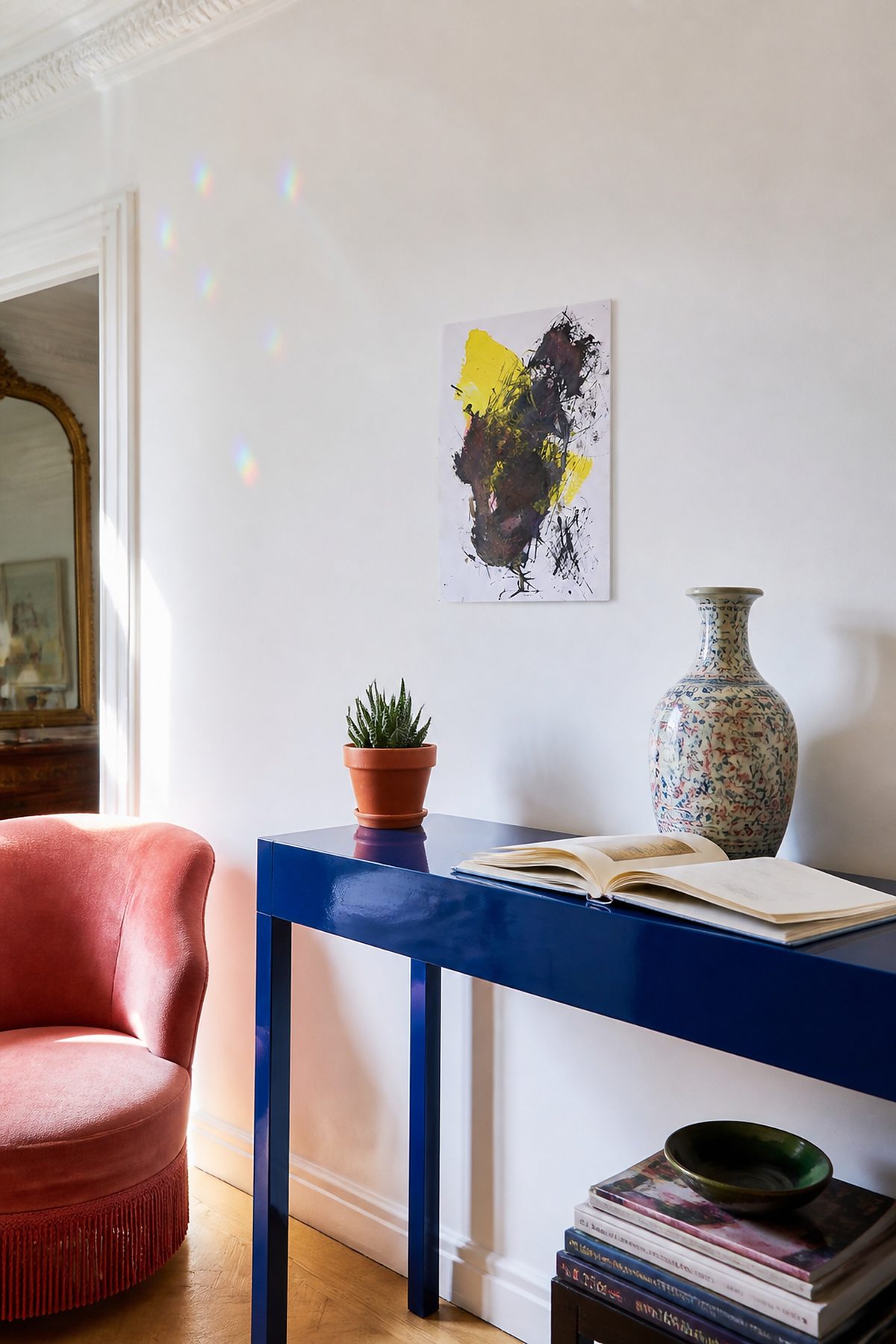
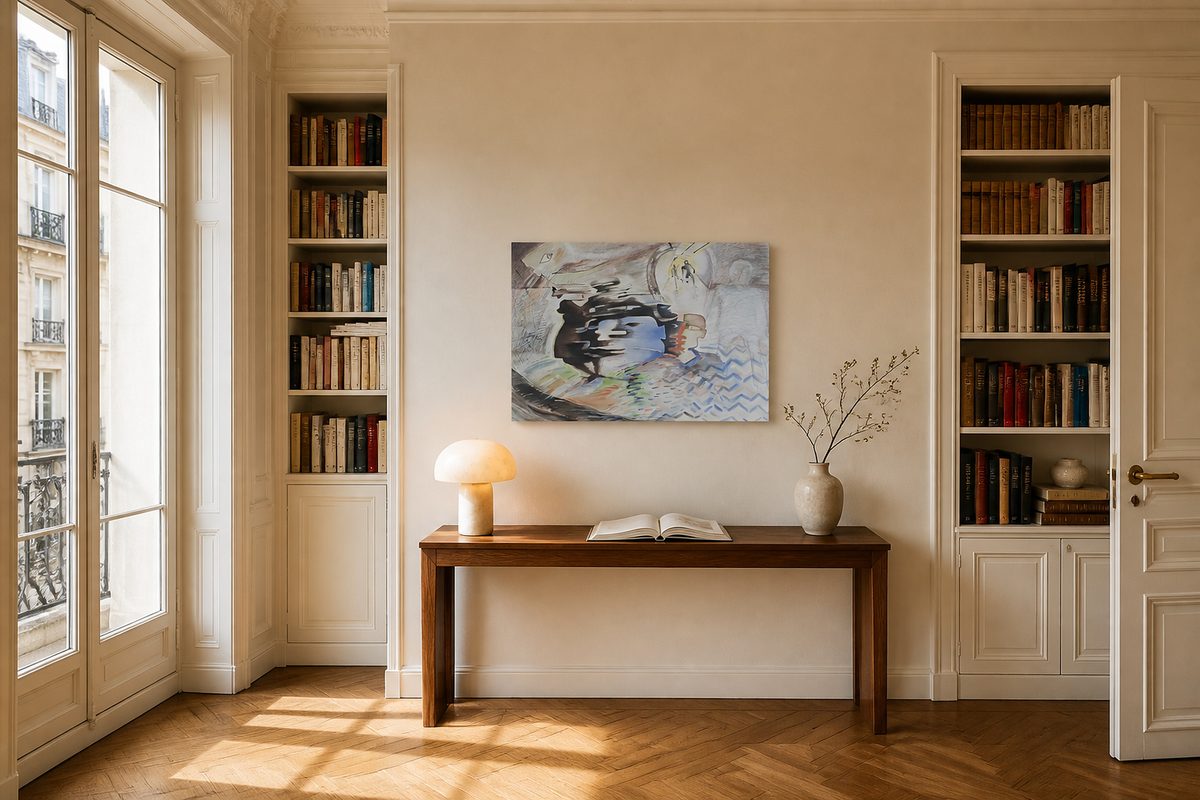
When incorporating a piece ofminimalist art into an interior, the most important thing is to respect the space around it. A minimalist piece is most effective when it has room to breathe. It is therefore best to avoid cluttering the area around it with decorative items.
On a wall, a simple, geometric piece can become a focal point as long as it is displayed with ample space around it. With sculpture, it is important to leave enough space so that the form can be viewed from multiple angles. Lighting—whether natural or artificial—also plays a key role: it highlights textures, shadows, and the character of the materials.
To seamlessly incorporate a minimalist piece of art, you can follow a few simple guidelines:
Choose a clear, visible location;
Limit competing decorative objects;
Opt for a cohesive interior color scheme;
Consider the artwork’s scale in relation to the room;
Allow the eye to wander.
Minimalism doesn’t have to mean a cold interior. A clean, uncluttered design can complement warm materials like wood, ceramic, linen, or stone. The key is to maintain a visual balance.
"Resonances" at the L’Adresse des Maîtres® Art Gallery in Dreux
In Dreux, the L’Adresse des Maîtres® Art Gallery also explores artistic practices that resonate with the themes of minimalism, particularly through its focus on materials, form, volume, and simplicity.
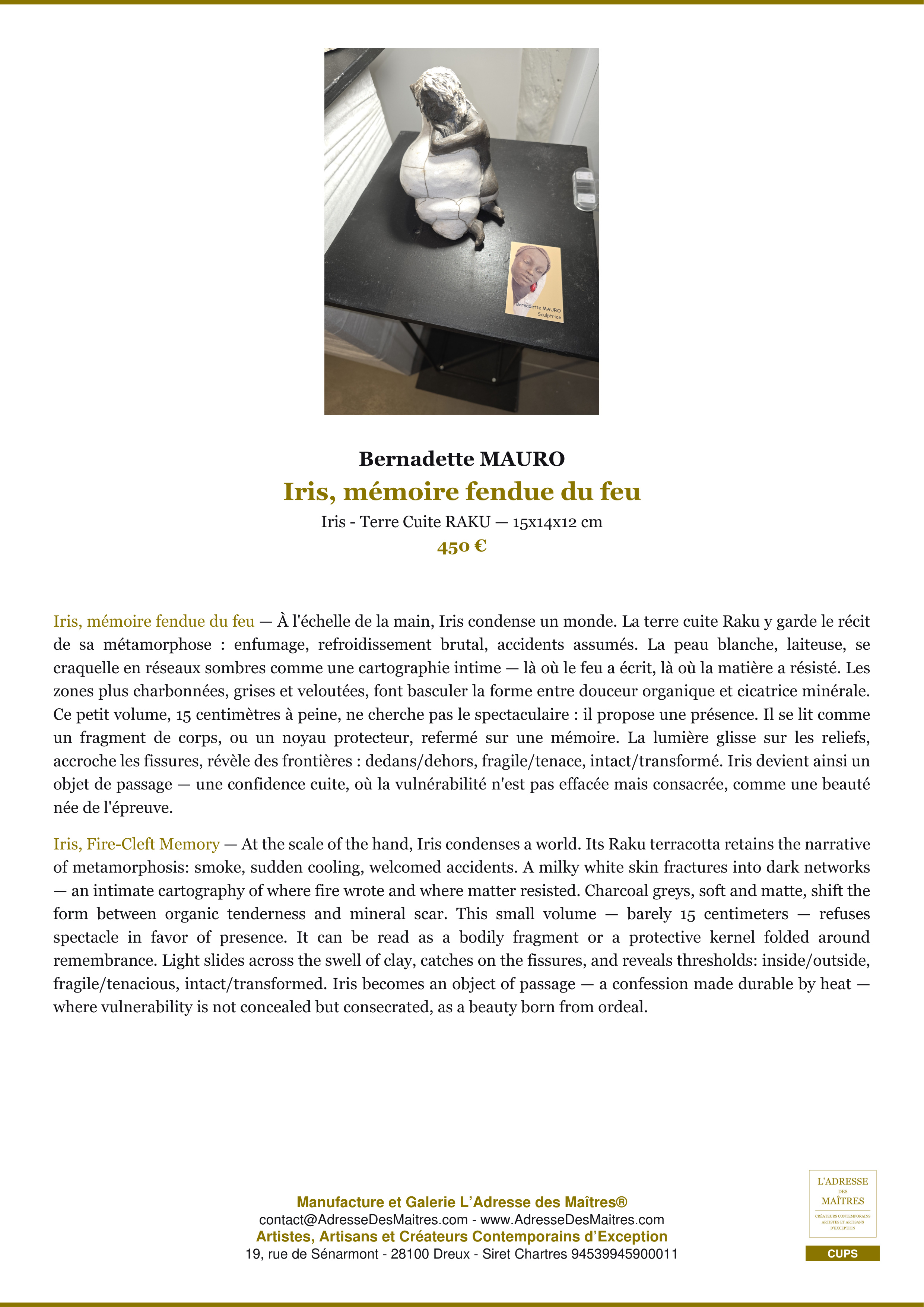
Bernadette MAURO presents 17 ceramic works, including “Iris, mémoire fendue du feu.” In an approach reminiscent of certain minimalist sensibilities, the ceramics highlight the work’s material presence, its density, and its direct relationship to form. Here, the ceramic technique underscores how raw or essential materials can possess great visual power.
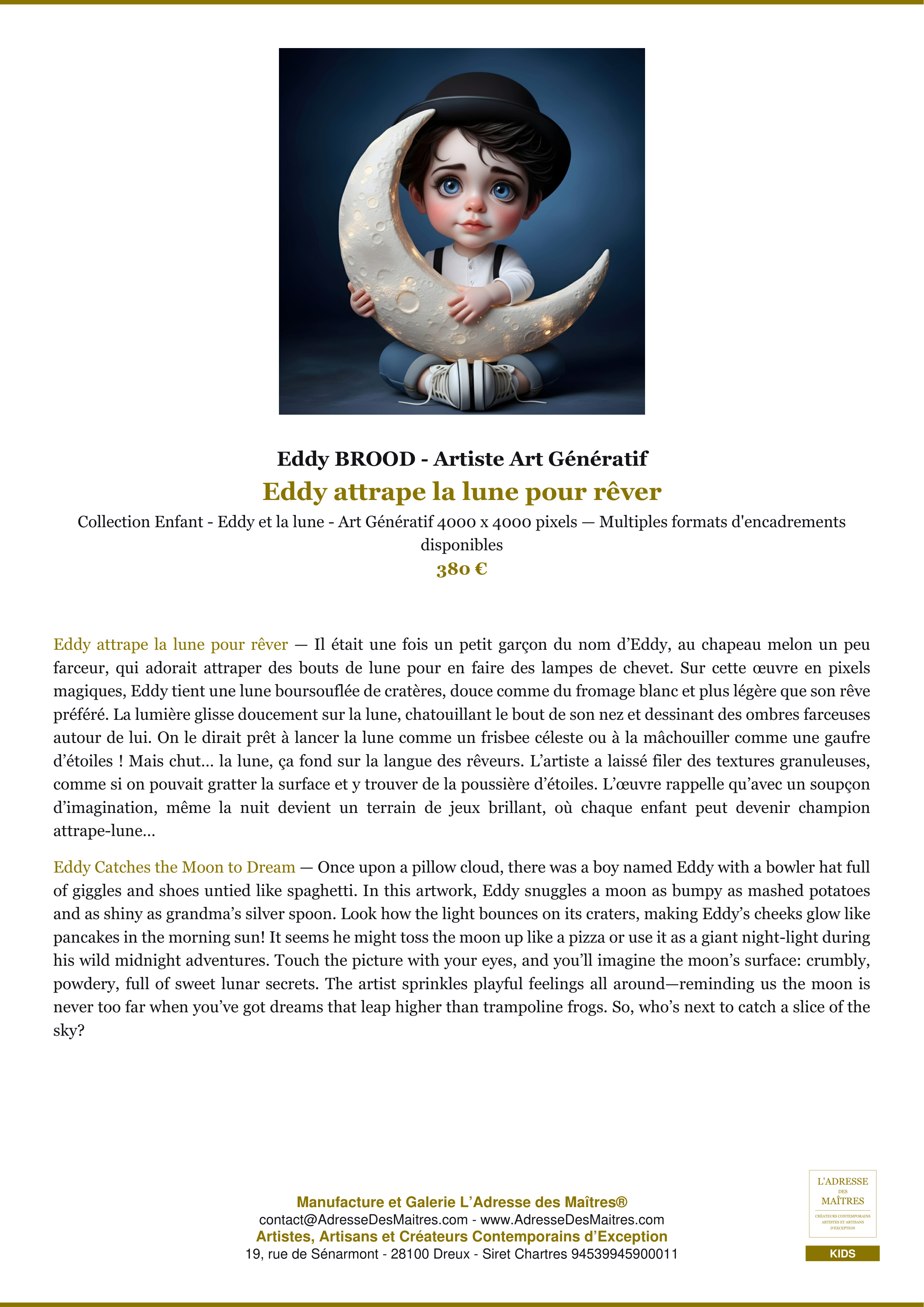
Eddy BROOD – Generative Artist has created 14 works of generative art, including “Eddy Catches the Moon to Dream.” The connection to minimalism can be seen in his interest in systems, structures, and creative processes. Generative art, through its logic of construction and variation, can echo the conceptual and serial heritage of minimalistcontemporary art.
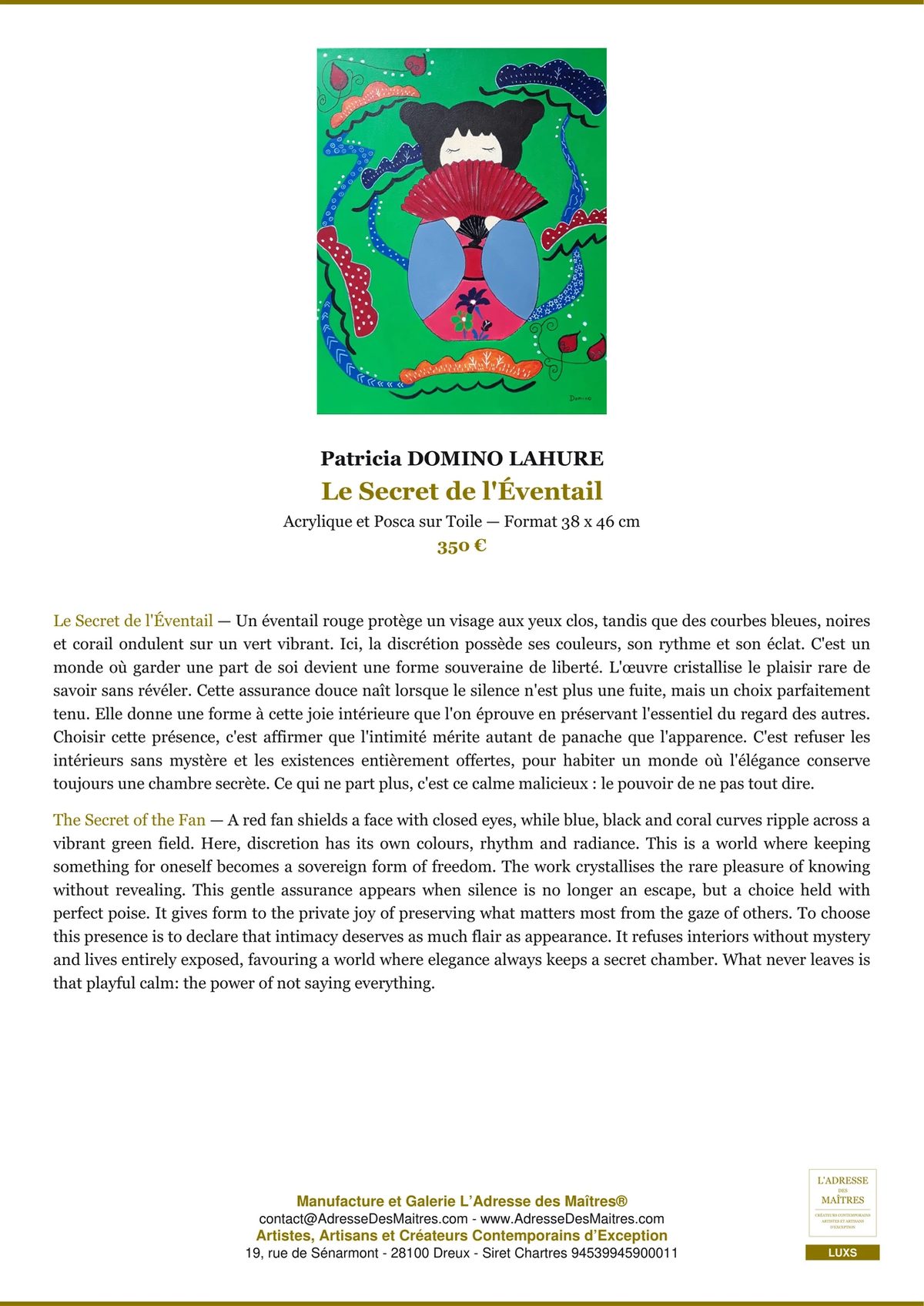
Patricia DOMINO LAHURE presents four sculptural works, including “Le secret de l’éventail.” Through a minimalist lens, the sculpture highlights the importance of volume, spatial presence, and the viewer’s relationship to the object. Sculpture is one of the mediums most directly linked to the history of minimalism.
Céline DEPELCHIN-JUART presents three sculptural works, including “L’empreinte du désert suspendu.” Through sculpture, her work also contributes to this exploration of form and the occupation of space—two fundamental dimensions of minimalism. The medium allows for a physical and immediate perception, which is essential to this aesthetic.
Nicolas PERAL is exhibiting two ceramic works, including “Le rêve prend chair d’argile.” His use of ceramics also underscores the importance of the material in the contemporary approach to minimalist design. Through its material foundation, ceramics can offer a sensory interpretation of forms reduced to their essence.
These artists do not all necessarily fall under the umbrella of minimalism in the strict historical sense, but their techniques—ceramics, sculpture, generative art—shed light on some of the major themes of this movement: material, volume, structure, apparent simplicity, and the experience of space.
The Minimalism Market: Collectors and Trends
The market forminimalist art remains strong, driven by the movement’s historical significance and its ongoing influence oncontemporary art. Major figures such as Donald Judd, Dan Flavin, and Sol LeWitt continue to be highly sought after by collectors, institutions, and foundations. Their place in art history, combined with the rarity of certain works, provides lasting support for their value.
But the market for minimalism is not limited to historical figures. Many collectors today are interested in contemporary artists whose works carry on this legacy through simplicity, repetition, light, understated materials, or spatial arrangements. This trend can also be explained by minimalism’s compatibility with contemporary interiors, offices, hotels, and high-end architectural spaces.
Buyers often appreciate these works for several reasons: their timelessness, their ability to blend into different settings, their quiet power, and their natural harmony with the architecture. In the market, the quality of execution, provenance, condition, and the artist’s place in the history of the movement remain key criteria.
Minimalism thus retains its enduring appeal. It appeals both to seasoned collectors, who see it as an essential part of 20th-century art history, and to younger art lovers, who are drawn to its visually understated forms that resonate with contemporary sensibilities.
Why Minimalist Art Remains So Relevant Today
Ifminimalist art continues to fascinate, it is because it offers a profound response to enduring questions: How do we truly see? How do we inhabit space? How do we create with little, yet with precision? Minimalism is not merely an aesthetic of emptiness; it offers a discipline of the gaze and a form of clarity.
In a world wherecontemporary art is constantly exploring new mediums, minimalism remains an essential reference point. It reminds us that the power of a work of art does not depend on its apparent complexity, but on the precision of its presence. Pure forms, raw materials, light, and space: using these simple elements, minimalist artists have created one of the most influential visual languages of our time.
Whether encountered in museums, galleries, design, or architecture, minimalism teaches us to see things differently. And that is perhaps what makes it so modern.
Check out our gallery
Vous souhaitez découvrir ces courants artistiques en vrai ? Visitez la galerie en ligne de L’Adresse des Maîtres® : plus de 1633 œuvres originales d’artistes contemporains.

Leave a comment