The Tree, the Light, the Ash — Landscape Reinvented by Contemporary Art
↓ Share this articleThe Contemporary Landscape: An Old Genre, a New Concern
For a long time, the landscape was regarded as mere scenery. It surrounded the action and provided a backdrop for religious, mythological, or historical scenes, but did not yet claim the leading role. Then, slowly, it moved toward the center of the painting. In the history of Western art, this emancipation owes much to Flemish painting, where the attention to detail, atmosphere, skies, paths, villages, and horizons gave the visible world a new pictorial dignity. The landscape was no longer just a background: it became a subject in its own right.
This shift is essential to understanding the vitality of the contemporary landscape today. For this genre—which is sometimes perceived as peaceful or traditional—has consistently addressed the major questions of its time: our place in the world, our relationship with living things, our need for a horizon, and our fear of disappearance. Collecting a landscape painting today is not simply about acquiring a pleasant view. It is about embracing a sensitive way of thinking—an image that breathes, that shifts, and that engages in a dialogue with the light of day and with the inner state of the viewer.
From Flemish Painting to the Romantics: The Birth and Establishment of a Genre
In Flanders, the precision of the gaze allowed the landscape to gain its own identity. There, painters observed the earth, the water, the trees, and the seasons with an almost scholarly acuity. The horizon broadens, space takes shape, and the eye wanders. This emergence of landscape as a genre is not merely technical: it reflects a new way of inhabiting the world. Nature is no longer a mere abstract symbol; it becomes experience, territory, climate, and depth.
With the Romantics, the landscape achieved its emotional consecration. It is no longer merely observed: it is felt. Mountains, the sea, forests, ruins, and storms become mirrors of the soul. The vastness of the external world reveals inner intensity. For the Romantics, nature is never neutral: it uplifts, threatens, comforts, and overwhelms. The landscape becomes the stage for the sublime—that blend of beauty and vertigo where humans experience both their spiritual greatness and their physical fragility.
This is where an intuition that remains active in today’snature art takes root: a successful landscape does more than simply represent a place. It creates a sense of presence. It opens up a mental space. It transforms a fragment of the world into a visual experience.
The 20th Century: The Crisis of Landscape and the Interlude of Abstraction
The 20th century radically shifted the priorities of art. After the avant-garde movements, after the wars, after the photographic revolution and the questioning of figurative art, the landscape seemed to lose its obviousness. Abstraction, for a time, set it aside. Not that it destroyed it: it merely suspended its immediate legibility. Lines, forms, colors, and rhythms took precedence over recognizable trees, skies, or hills.
But this crisis was also an opportunity. Freed from the obligation to resemble reality, landscape painting was able to return in a different form. It no longer had to imitate nature. It could convey its vibration, its memory, its energy, its erosion, and its instability. Where the landscape of the past sometimes sought fidelity to the subject, the contemporary landscape seeks rather the accuracy of a sensation. It no longer asks simply, “What did I see?” It asks, “What did this place stir within me?”
This transformation explains why the boundary between figuration and abstraction is so fruitful today. A landscape can emerge from a trace, a photographic overlay, an oily substance, a stained-glass window, or a flash of light. It can be clearly identifiable or nearly erased. It can retain the imprint of a forest without depicting every branch. It can evoke an inland harbor without mapping out the exact contours of a shoreline. The landscape has become an interpretation.
The Return of the Landscape: Interpreting Nature Rather Than Copying It
In contemporary art, the landscape is making a strong comeback because it fulfills a need. In the face of rapid urbanization, the ecological crisis, and the saturation of digital images, it offers a breath of fresh air. But this resurgence is by no means a nostalgic retreat. The contemporary landscape does not merely celebrate unspoiled nature, as if the world had not changed. On the contrary, it challenges the way we see, preserve, lose, and rebuild.
The contemporary artist does not necessarily paint “from life” in the classical sense. He composes using memories, fragments, mental images, accidental effects of the medium, layers of photography, and transparencies. Nature becomes a language. The landscape is no longer a double of reality: it is a poetic proposition. This nuance is decisive for the discerning collector. A landscape painting does not need to be descriptive to be evocative. It can be all the more powerful for allowing the viewer the freedom to wander within it.
The L’Adresse des Maîtres® Art Gallery in Dreux specifically fosters this kind of perspective: one that pays close attention to technique, but also to the way in which a work transforms nature into an inner experience. Here, the landscape is not presented as a fixed category, but as a living field, open to painting, composite photography, stained glass, and the imaginative possibilities of light.
The Tree: Roots, Verticality, Memory, Cycle
Among the elements of the landscape, the tree holds a unique place. It is undoubtedly one of the most universal symbols in human history. It plunges into the earth and soars toward the sky. It connects the visible and the invisible, the underground and the aerial, the past and the future. Through its roots, it speaks of being rooted; through its trunk, of verticality; through its growth rings, of memory; through its leaves, of cycles and metamorphosis.
The tree is also a symbol of time. It does not merely exist in space: it marks the passing of the seasons. It sheds, regrows, grows, twists, and endures. It bears the marks of what it endures. In landscape painting, it often becomes an indirect portrait of humanity: the solitude of a solitary tree, the strength of a grove, the mystery of a forest, the foreboding of a charred or bleached trunk.
That is why the tree remains such a prominent presence in contemporarynature art. It allows us to express both permanence and vulnerability at the same time. It is a monument—but a living one. It embodies what we would like to believe is enduring, while reminding us that nothing in the living world is timeless.
Light, a co-creator of the landscape
We often talk about the subject of a landscape: a path, a forest, the sea, a garden. But sometimes the true subject is light itself. It does more than simply illuminate—it creates. It chooses what appears, what fades, and what shimmers. In a landscape, light is a co-author.
The golden hour, for example, envelops the world in an almost reconciling softness. It lengthens shadows, warms contours, and lends things a suspended presence. Winter light—lower, colder, and more precise—reveals structures instead: bare branches, pale earth, and mineral-like skies. As for backlighting, it transforms the landscape into a threshold. It simplifies forms, dramatizes silhouettes, and creates a tension between dazzling brightness and darkness.
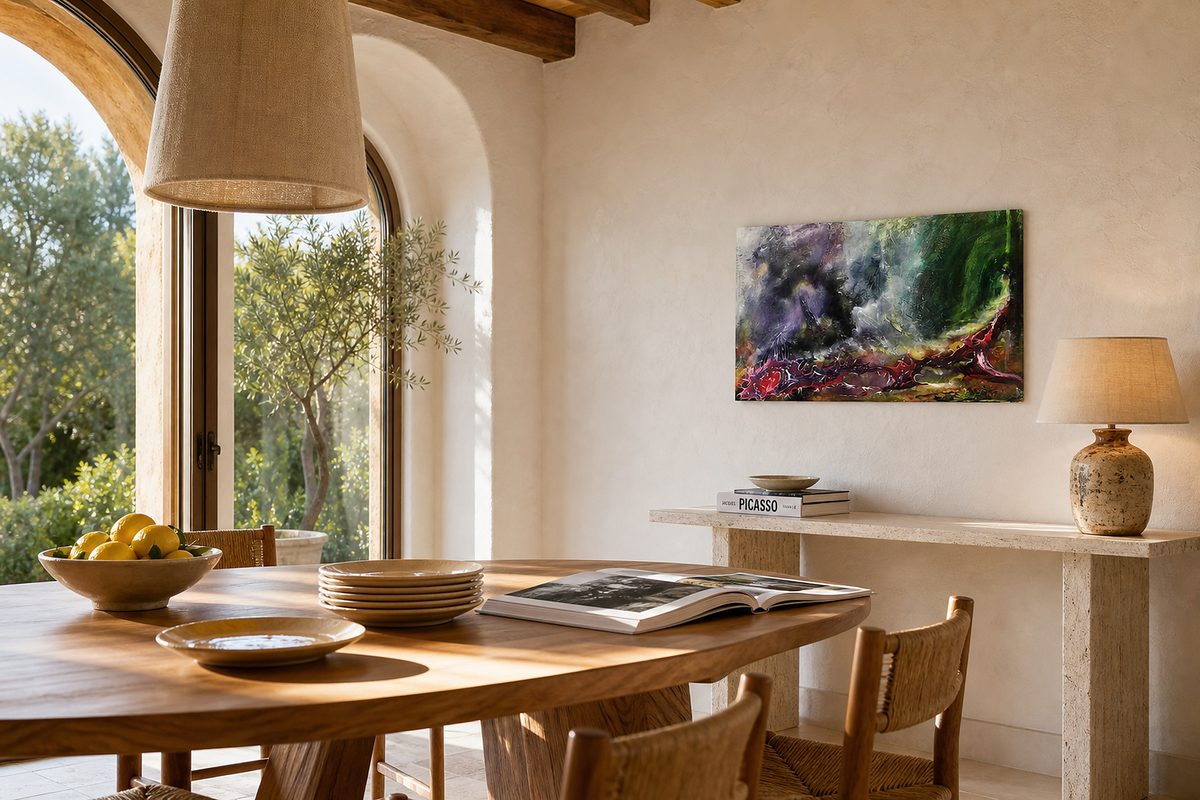
This dimension of light is essential to the experience of collecting. A landscape painting changes as the day goes on. In the morning, it may seem bright, almost open; in the evening, more dense, more mysterious. In an interior, a contemporary landscape is not a static image: it is a presence that shifts with the actual light in the room. It responds to the outside world while inhabiting the interior.
Scorched, bleached, ashen landscapes: the fragility of life
Contemporary landscape art cannot ignore the era to which it belongs. Yet our era is marked by the experience of ecological fragility. Burning forests, parched soil, vanishing glaciers, polluted horizons: nature no longer appears merely as a refuge, but as a threatened organism. This is why so many artists today are creating landscapes of ash—scorched, bleached, and depleted.
These works do not necessarily fall within the realm of explicit activist discourse. Their power may be more subtle. An excess of white can evoke erasure. A dark material can suggest combustion. A barren, almost deserted surface can convey the absence of life. The landscape then becomes a form of sensory warning. It does not demonstrate; it evokes a feeling.
From this perspective, the landscape is no longer merely a subject of contemplation. It is a question that calls upon our sense of responsibility. What are we looking at when we look at nature? A reservoir of images? A backdrop for our leisure activities? Or a shared, vulnerable world of which we are a part? Art has this rare ability to transform a collective concern into an intimate experience.
At the L’Adresse des Maîtres® Art Gallery in Dreux: Five Approaches to the Landscape
Several artists featured by the L’Adresse des Maîtres® Art Gallery in Dreux offer insight into the current diversity of the art scene and its techniques. Their appeal lies precisely in this diversity: oil painting, composite photography, and Tiffany stained glass do not evoke the same relationship to nature, light, and memory.
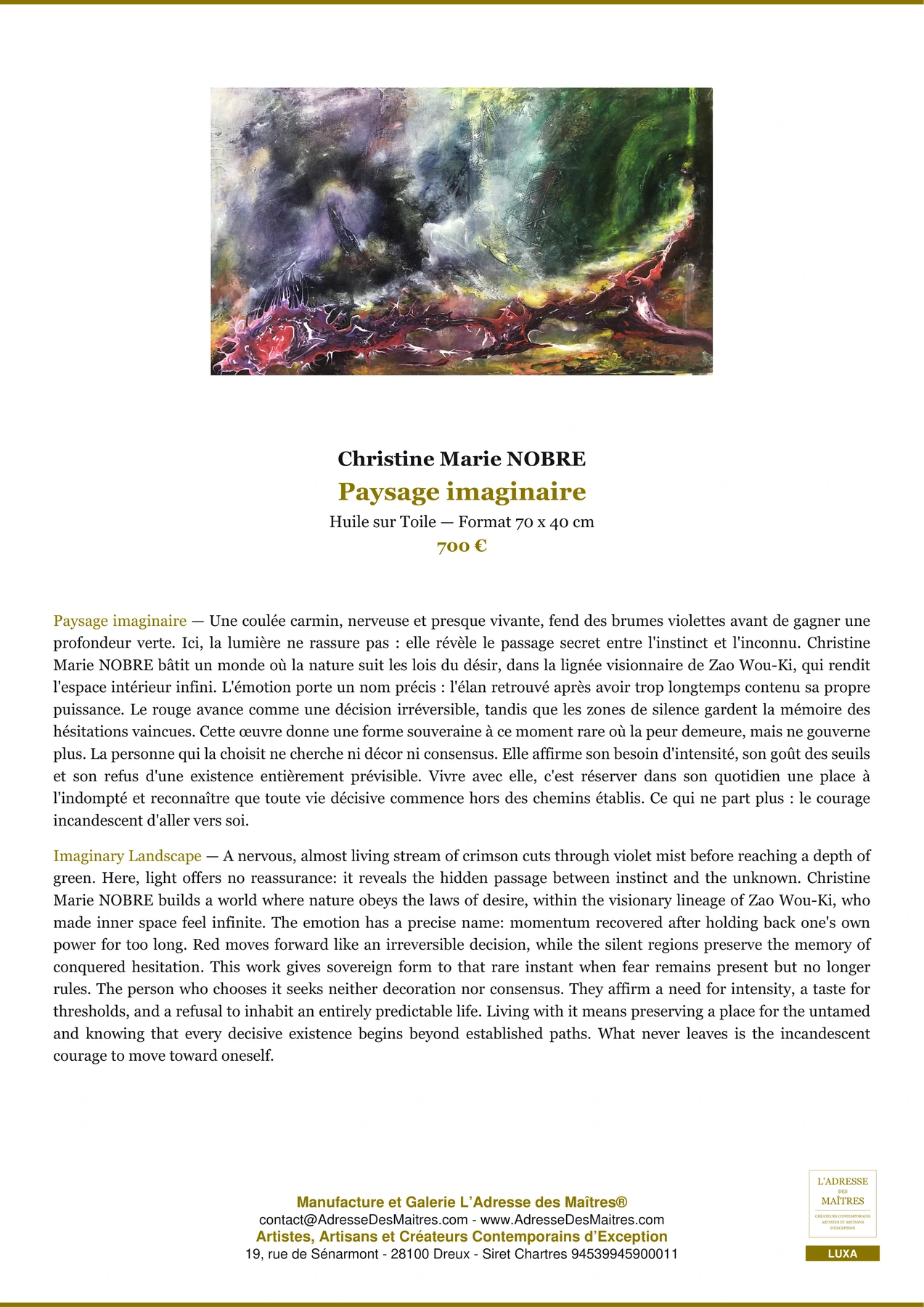
Christine Marie NOBRE, with six oil paintings—including “Paysage imaginaire”—positions the landscape within the realm of pictorial invention. The very title of this work signals a fundamental shift: it is not merely a matter of depicting a recognizable site, but of opening up a mental landscape. Oil paint, with its density and depth, allows the landscape to exist as the substance of vision as much as it does as an image.
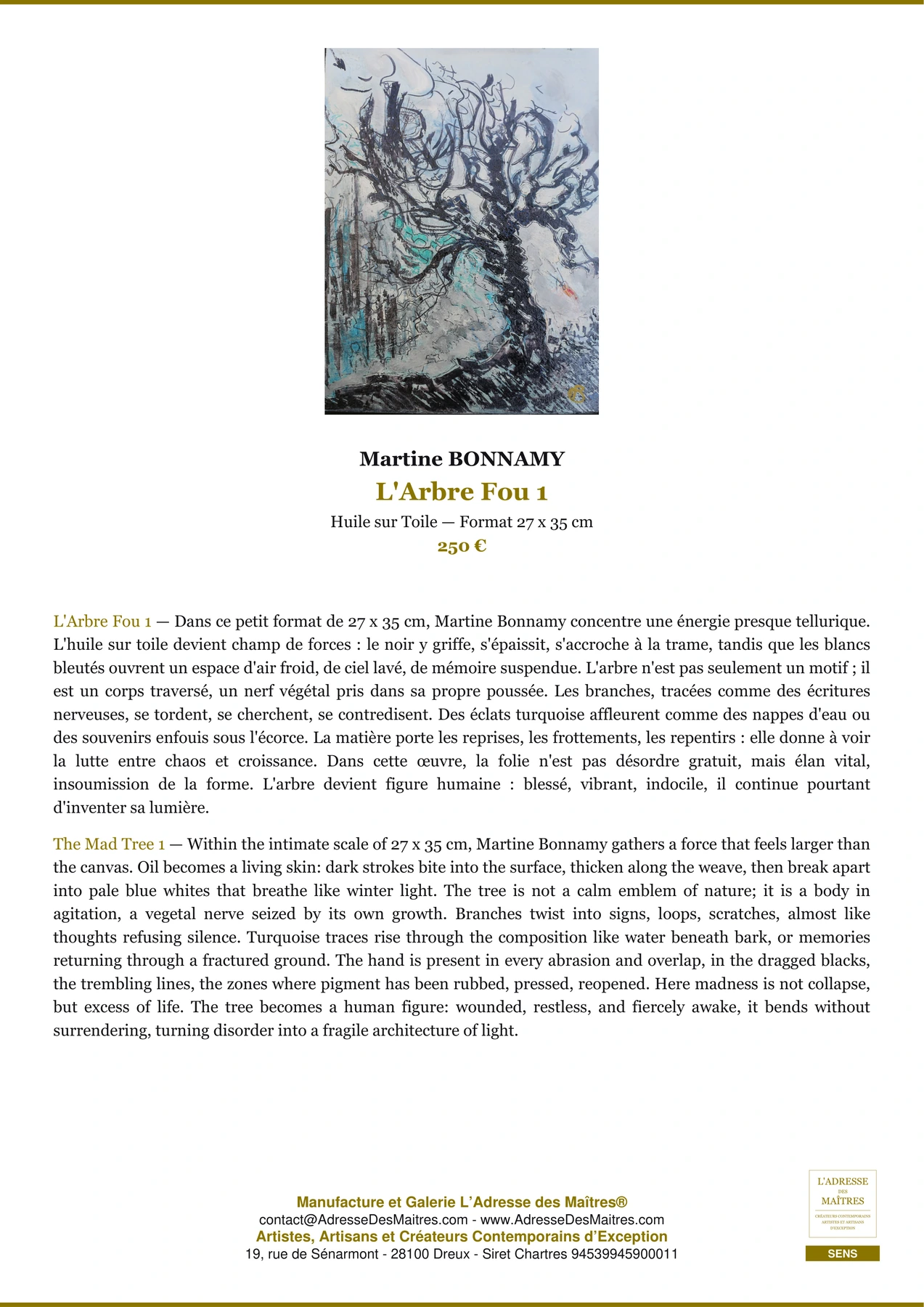
Martine BONNAMY, with five oil paintings—including “L’Arbre Fou 1”—brings the figure of the tree into an expressive dimension. Without reducing the work to its title, the title itself reminds us of how much the tree can become a character, a surge of energy, a source of tension, and a living verticality. In the realm of contemporary landscape art, this presence of the tree resonates with the great symbols of rootedness and the cycle of life.
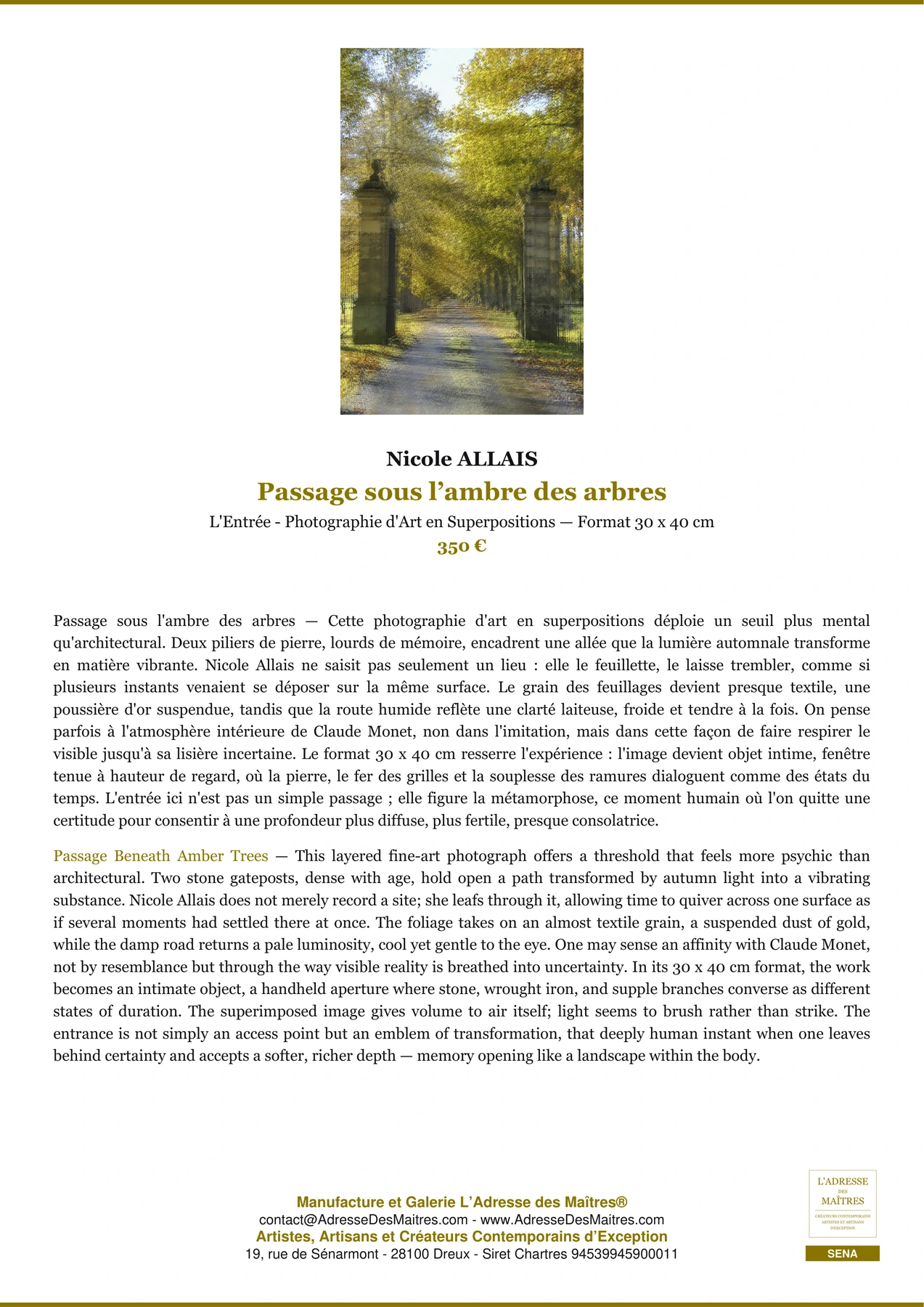
Nicole ALLAIS, with four works in Layered Image Composite Photography, including “Passage sous l’ambre des arbres, ” brings a sense of stratification to the landscape. Composite photography using superimposed images allows us to question perception itself: the landscape is no longer merely captured; it is reconstructed layer by layer, like a visual memory or a journey. The title suggests a passage—that is, an experience of the gaze in motion.
Arnaud de Chartres, with three Tiffany stained-glass works, including “Voiles de lumière, ports intérieurs, ” reminds us that a landscape can also emerge from transparency and stained glass. The Tiffany technique directly engages with light: it transforms light not merely into illumination, but into an active component of the artwork. With a title such as “Voiles de lumière, ports intérieurs, ” the landscape exists at the intersection of evocation, interiority, and luminous vibration.
Emilienne MOREAU-DECHELLE, with two oil paintings, including “Forêt des mémoires liquides” (Forest of Liquid Memories), links landscape to memory and fluidity. Here again, without revealing what the work depicts, the title suggests a strong poetic direction: the forest is not merely a collection of trees; it becomes a reservoir of time, of traces, and perhaps of transformations. Oil paint lends this idea a materiality that lends itself to depth and transitions.
Collecting a Contemporary Landscape: A Daily Presence
For the collector, a landscape possesses a rare quality: it becomes a constant companion. Some works make an immediate impression; others gradually find their place in everyday life. A contemporary landscape often falls into the latter category. We rediscover it depending on the time of day, the season, the weather, and our mood. It does not reveal itself all at once. It fosters a lasting connection with the viewer.
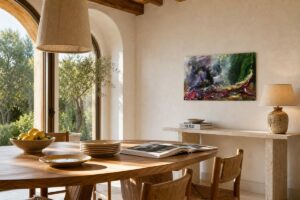
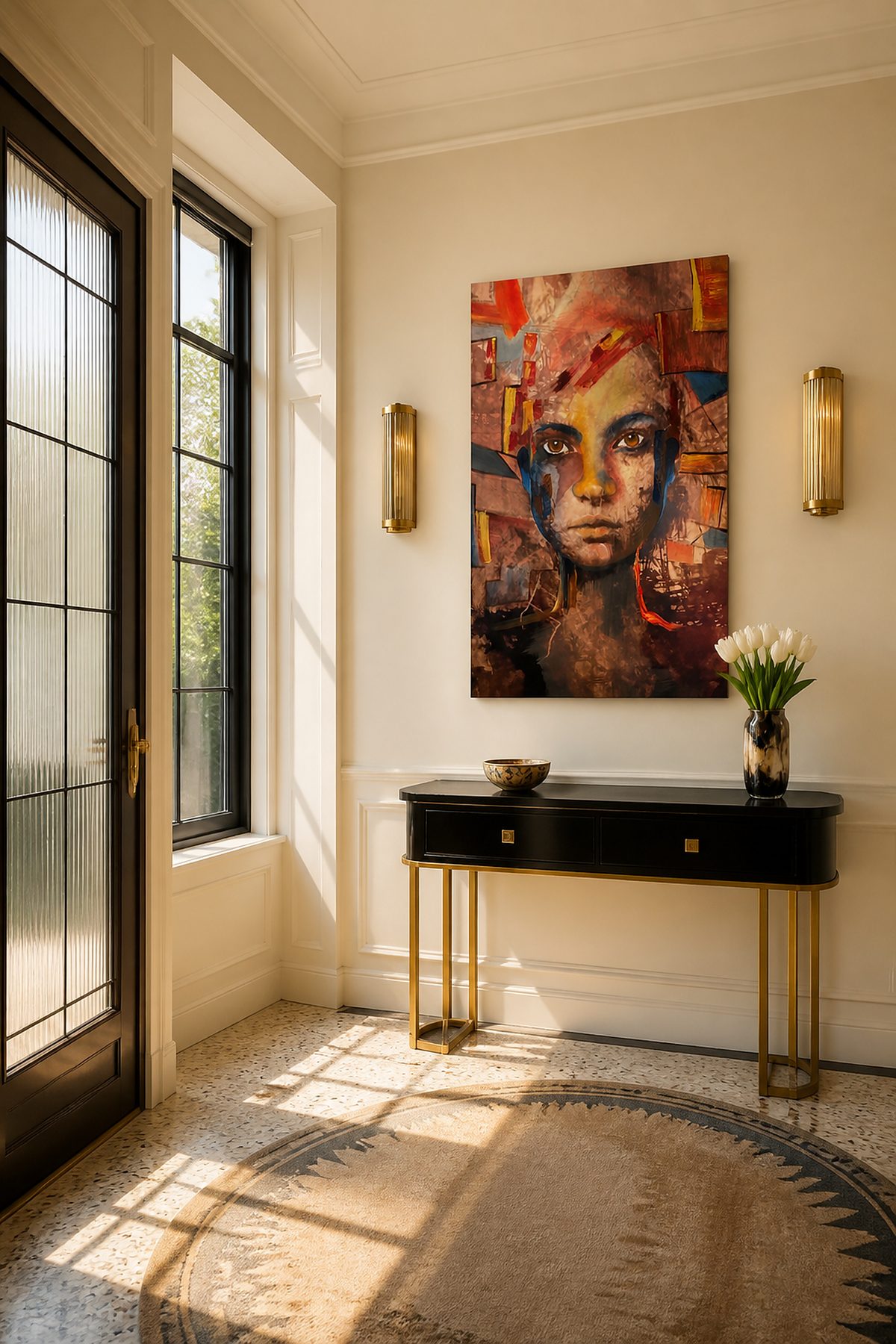
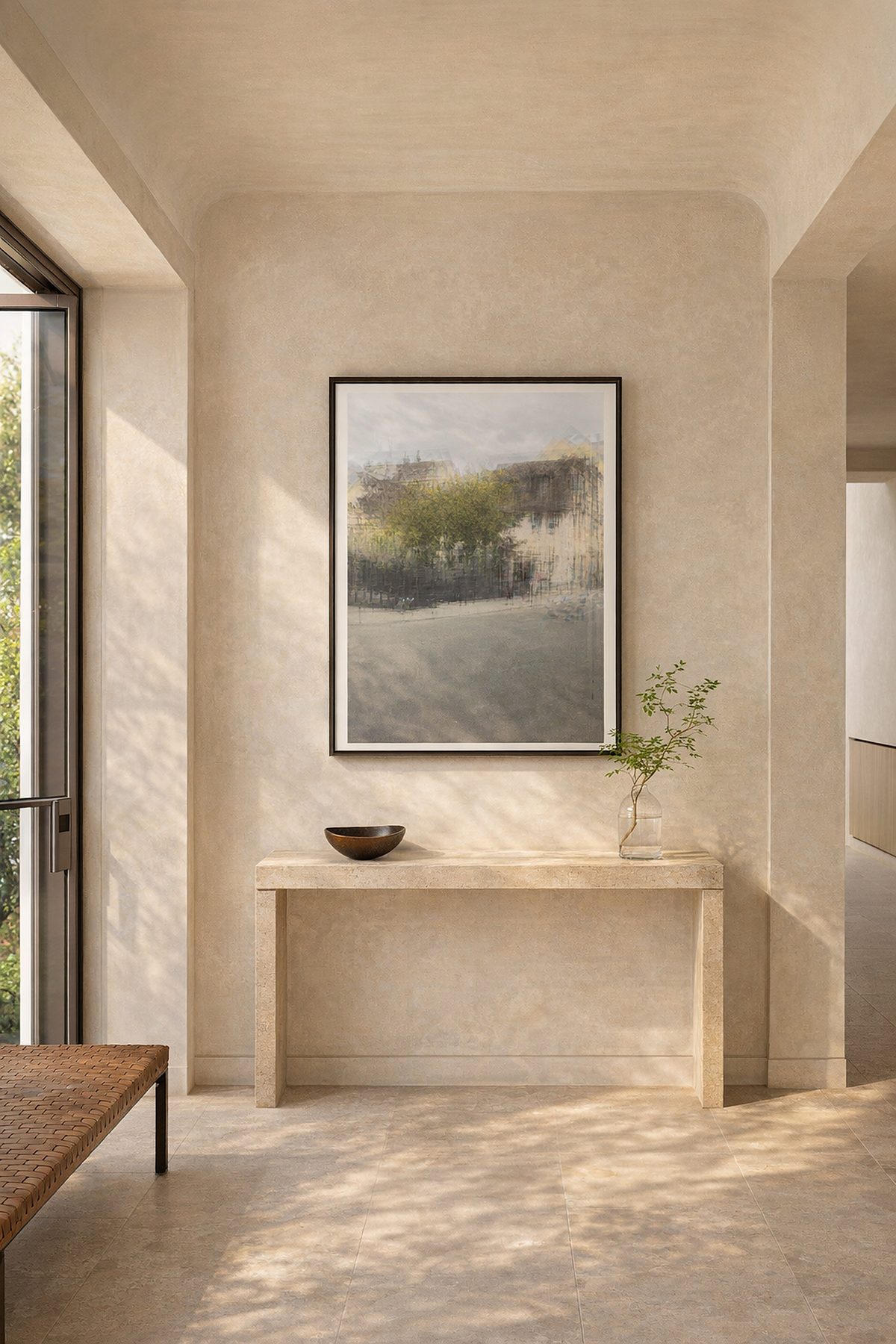
In a living room, an office, a library, or an entryway, a landscape painting acts as a window that is more than just the illusion of an opening. It does not necessarily imitate the outdoors; it brings a sense of breathing space. It can soothe without being decorative, provoke thought without being austere, and structure a space without overwhelming it. This is one of the great strengths of landscape painting and, more broadly, of contemporarynature art: offering a presence that is both sensory and thoughtful.
Acquiring a contemporary landscape also means choosing a work that can interact with light. A painted surface, a composite photograph, or a Tiffany stained-glass window do not react in the same way to natural or artificial lighting. This variation is part of the work. It enriches the collector’s experience, as the collector possesses not just an image, but a constantly evolving relationship with it.
The L’Adresse des Maîtres® Art Gallery in Dreux, by bringing together diverse approaches to landscape painting, reminds us that this genre remains one of the most fruitful in contemporary art. Born as a way to captivate the eye, elevated by Romantic emotion, and tested by abstraction, it returns today imbued with a new awareness. Contemporary landscape art is neither a step backward nor a mere celebration of nature. It is a way of reflecting on our connection to life, light, and time. And perhaps, in the silence of a work hanging on the wall, it is a way of relearning how to look at the world.
Check out our gallery
Vous souhaitez découvrir ces courants artistiques en vrai ? Visitez la galerie en ligne de L’Adresse des Maîtres® : plus de 1633 œuvres originales d’artistes contemporains.

Leave a comment