

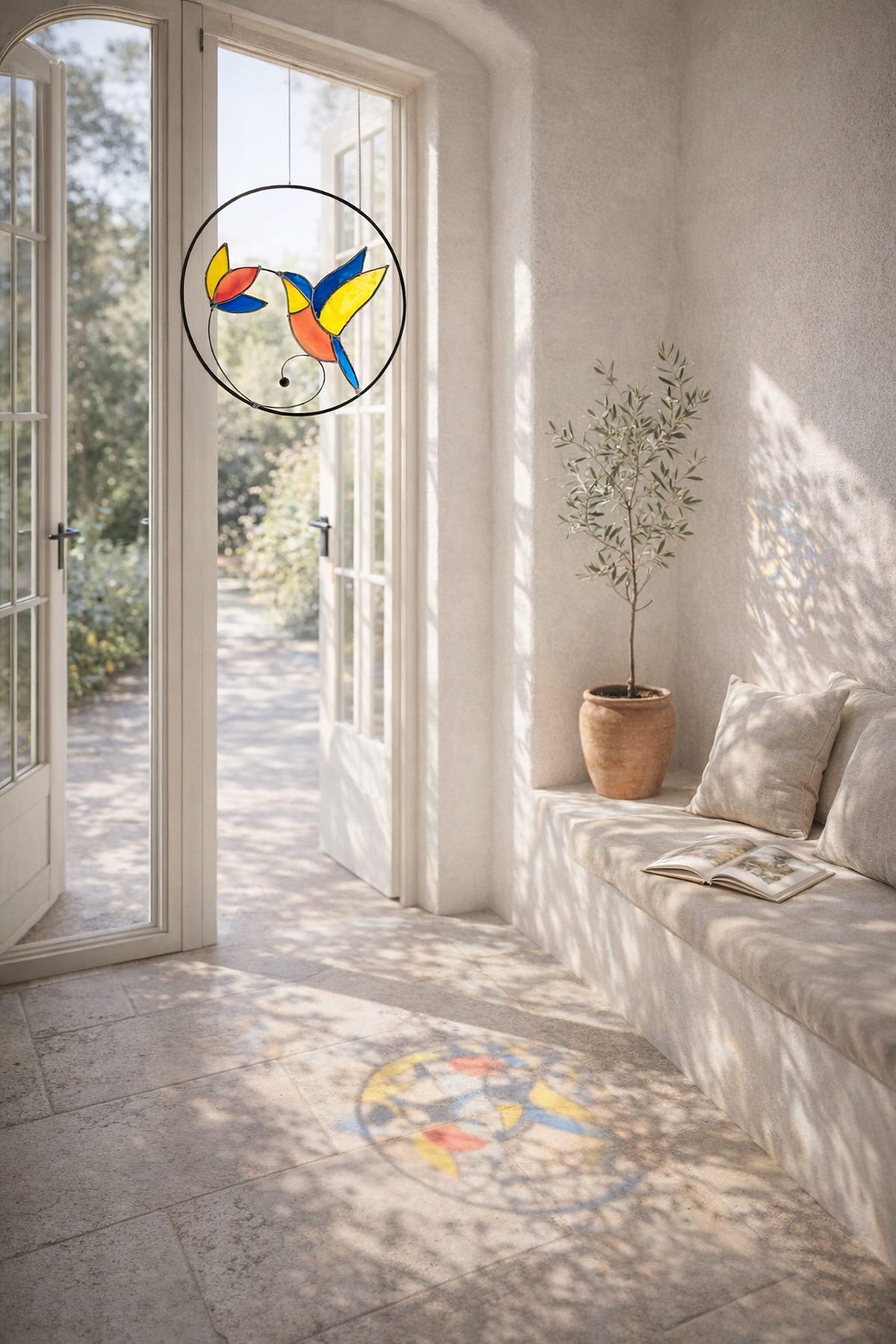
Tiffany Stained Glass — Contemporary Art
↓ Share this articleTiffany Stained Glass: When Glass Becomes Contemporary Art
In the world of the decorative arts, the term “Tiffany Stained Glass” immediately evokes light, color, and the artistry of assembled glass. But this technique, often associated with the legendary lamps and American stained-glass windows of the late 19th century, is now undergoing a true reinterpretation in contemporary art. At the intersection of sculpture, stained glass, design, and luminous painting, it offers artists a living, ever-changing medium capable of transforming a space depending on the time of day, the lighting, and the viewer’s perspective.
At the L’Adresse des Maîtres® Art Gallery in Dreux, this technique is showcased through nine works, all connected to the world of Arnaud de Chartres. This collection reveals just how much Tiffany stained glass transcends mere artisanal tradition: it becomes a visual language in its own right, in which each fragment of glass contributes to a sensitive, contemporary, and deeply expressive composition.
Understanding the Tiffany Stained Glass Technique Made Simple
Tiffany stained glass is based on the principle of assembling pieces of colored glass. Unlike traditional stained glass, which typically uses fairly thick lead came to join the pieces, the Tiffany method uses a thin strip of copper wrapped around each piece of glass. These elements are then soldered with tin, resulting in finer, more flexible, and more precise lines.
This technical finesse offers great creative freedom. The artist can work with curved shapes, delicate details, and more fluid compositions. Glass isn’t just colored: it can be opalescent, textured, striated, marbled, translucent, or nearly opaque. It reacts to light in subtle ways, creating effects of depth, vibration, and movement. A Tiffany stained glass piece is therefore never completely static: it changes with its surroundings.
For the viewer, the technique is accessible through visual experience. One does not need to know the secrets of the workshop to appreciate the effect it creates. The eye follows the weld lines just as it would follow the lines of a drawing, while the light passes through or caresses the glass like a painterly medium. It is this combination of structure and transparency that gives the technique its poetic power.
A story born at the intersection of art, craftsmanship, and modernity
The name Tiffany refers to Louis Comfort Tiffany, an American artist and designer born in 1848. The son of the founder of the famous Tiffany & Co., he developed an interest in the decorative arts, painting, interior design, and glass research at an early age. In the late 19th century, against the backdrop of the Art Nouveau movement, he created stained-glass windows and illuminated objects characterized by a rich palette of colors.
Tiffany’s greatest innovation lies in his relationship with the material. He did not merely seek to paint on glass, but to make the glass itself a painting. Internal variations in color, accidental textural effects, opacities, and transparencies become the equivalents of a paintbrush. This approach is revolutionary: it brings stained glass closer to Impressionist and Symbolist painting, while simultaneously situating it within the spatial arts.
The famous Tiffany lamps, with their lampshades made up of hundreds of glass fragments, have popularized this aesthetic. However, it would be a mistake to reduce Tiffany stained glass to a mere decorative object. From its very origins, this technique has embodied a strong artistic ambition: to work with light, to create atmospheres, and to establish a direct relationship between color, architecture, and everyday life.
Tiffany Stained Glass in Contemporary Art
In contemporary art, Tiffany stained glass is no longer associated solely with Art Nouveau or historic interiors. Today’s artists are embracing it to explore transparency, fragmentation, memory, and perception. Glass becomes a surface of tension between fragility and strength, between tradition and experimentation. It can evoke the sacred, but also design, geometric abstraction, nature, or the urban imagination.
This technique is particularly well-suited to contemporary concerns about light. In an age saturated with screens, shiny surfaces, and digital images, handcrafted glass offers a different experience: slow, tangible, almost meditative. The viewer is not faced with a projected image, but with a work that physically interacts with real light. It is an art of presence.
Tiffany stained glass also offers a new take on the concept of a painting. A piece can be hung, placed on a surface, incorporated into a window, or showcased with special lighting. It is neither entirely a painting nor entirely a sculpture. It occupies an intermediate space—one that is highly sought after in contemporary art—where disciplines intersect and enrich one another.
Arnaud de Chartres: A Unique Figure in Dreux
Among the artists represented, Arnaud de Chartres embodies this ability to create a dialogue between heritage and contemporary creation. His work in the Tiffany stained glass technique highlights glass as an expressive medium, capable of conveying a personal artistic vision. Through the nine works on display at the L’Adresse des Maîtres® Art Gallery in Dreux, visitors can observe the diversity of effects achieved through composition, color selection, and lighting.
What is striking about this approach is the precision of the execution and the sensitivity of the composition. Each piece of glass seems to have been chosen for its hue, its density, and its luminous texture. The work is constructed like a mosaic of sensations, yet with an overall coherence that transcends the mere sum of its parts. The eye wanders, pausing on a transparent section, moving on to a dark line, and then returning to a brighter area.
Arnaud de Chartres thus offers a contemporary interpretation of Tiffany stained glass. It is not a matter of reproducing an old style, but of extending a historical technique into a modern context. His works remind us that craftsmanship can become an instrument of freedom when it is put to use in the service of a clear artistic vision.
Why does this technique appeal to collectors?
The popularity of Tiffany stained glass among art lovers stems from several factors. First, it has a strong visual presence. A stained-glass piece naturally draws in light and transforms the atmosphere of a room. It can be viewed differently depending on the time of day—morning or evening—and whether the light is natural or artificial. This variability creates an intimate connection between the artwork and its owner.
Furthermore, the technique embodies a precious artisanal quality. In a world where many images are produced quickly, Tiffany stained glass serves as a reminder of the time-consuming nature of the creative process. Cutting, adjusting, copper-setting, soldering, cleaning, and balancing colors: each step requires patience and skill. This level of craftsmanship gives the work both sentimental and aesthetic value.
Finally, this technique possesses great decorative power without losing its artistic dimension. It can complement contemporary architecture, a classic interior, or a professional space. It is precisely this adaptability that makes it a vibrant medium, far removed from any static image of traditional stained glass.
Discover Tiffany Stained Glass at an art gallery in Dreux
To fully understand a Tiffany stained-glass work, a photographic reproduction is not always enough. You have to see the reflections, the translucency, and the variations in the material. You have to move around the work and observe how it captures and refracts light. It is through this direct experience that the technique reveals its full richness.
The L’Adresse des Maîtres® Art Gallery in Dreux thus offers a unique setting to discover these nine works by Arnaud de Chartres and appreciate the relevance of this practice in contemporary art. Straddling the legacy of the decorative arts and contemporary artistic exploration, Tiffany stained glass emerges here as a luminous, demanding, and profoundly modern technique, capable of captivating both discerning collectors and visitors curious to discover a new way of viewing glass.
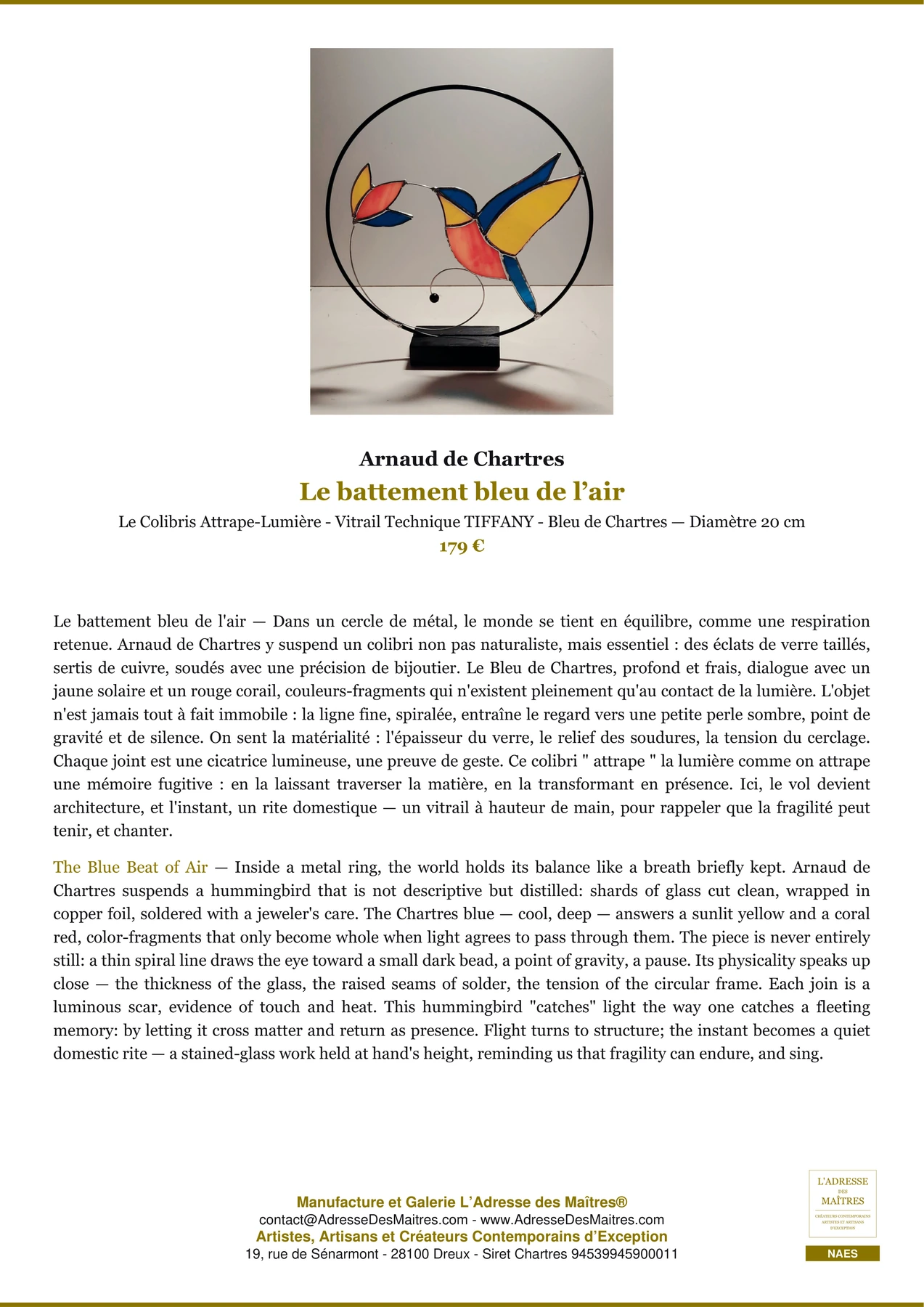
Discover 9 Tiffany stained glass pieces in our online gallery.
Leave a comment